
This year, the Tennessee General Assembly will consider expanding the Education Freedom Scholarship (EFS) program. Governor Lee’s proposed FY 2027 budget includes $304 million to double the number of available scholarships from 20,000 to 40,000. The following excerpts from our Education Freedom Scholarship Act and FY 2027 budget summary reports highlight key features of the program and proposed expansion.
Education Freedom Scholarships 101
In the 2025-26 school year, the Education Freedom Scholarship program provided about $7,300 per year to 20,000 Tennessee students for the costs and expenses of attending private school. Key features of the scholarships (which some refer to as vouchers) include:
- Scholarship Amount — EFS is separate from Tennessee Investment in Student Achievement (TISA) funding, the state’s public school funding formula. However, each scholarship is equal to TISA’s combined state and local base per pupil amount (i.e., $7,295 in FY 2026).
- Student Eligibility — Any Tennessee student is eligible, but half of scholarships are reserved for students eligible for the existing Education Savings Account (ESA) program, those under 300% of eligibility for reduced-price lunch (i.e., about $173,000 for a family of 4 in the 2024-25 school year), and students with disabilities. The remaining half are available for any student. (1)
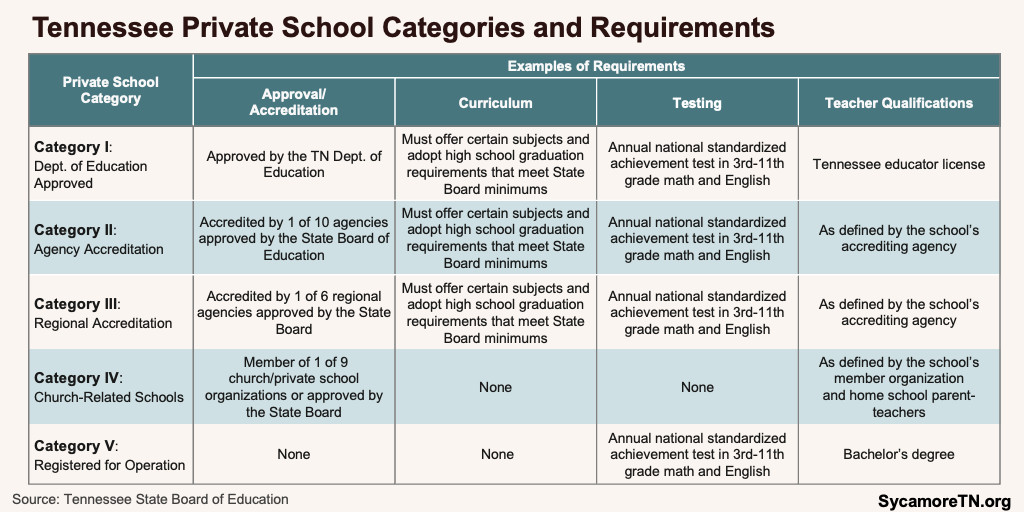
- School Eligibility — Scholarships are limited to students enrolled in Category I, II, and III private schools. (Table 1) In the first year of the program, 241 private schools participated in EFS which represented 73% of all Category I, II, and III private schools in the state. (1) (2) (3)
- Eligible Expenses — Scholarship funds must be used first to pay for tuition and fees, and remaining funds can pay for other eligible expenses. These include textbooks, curricula, instruction materials, uniforms, tutoring services, transportation expenses, computer hardware, technological devices, other technology fees, summer school fees and materials, fees for postsecondary courses, exams, entrance exams, industry certifications, and educational therapy services. (1)
- Testing Requirements — Each year, 3rd-11th grade EFS recipients must take the Tennessee Comprehensive Assessment Program (TCAP) or a nationally standardized achievement test. Schools must submit scores to the Tennessee Comptroller’s Office of Research and Education Accountability (OREA), and OREA must submit an annual report of the results to the House and Senate Education Committees. (1)
Table 1
Proposed FY 2027 Expansion
Governor Lee’s FY 2027 budget includes a total of $304 million in recurring funds for EFS—a proposed increase of $155 million over FY 2026. This would increase EFS program funding from about 2% of the Tennessee Department of Education’s total budget from state revenues in FY 2026 to 4% in FY 2027. The proposal would:
- Double the number of private school scholarships from 20,000 to 40,000. The number of scholarships is set to automatically increase by 5,000 each year if the prior year’s applications exceed 75% of available slots—subject to funding availability. (1) To increase the number of scholarships beyond the additional 5,000 allowed in law, the General Assembly must pass separate legislation in addition to the budget.
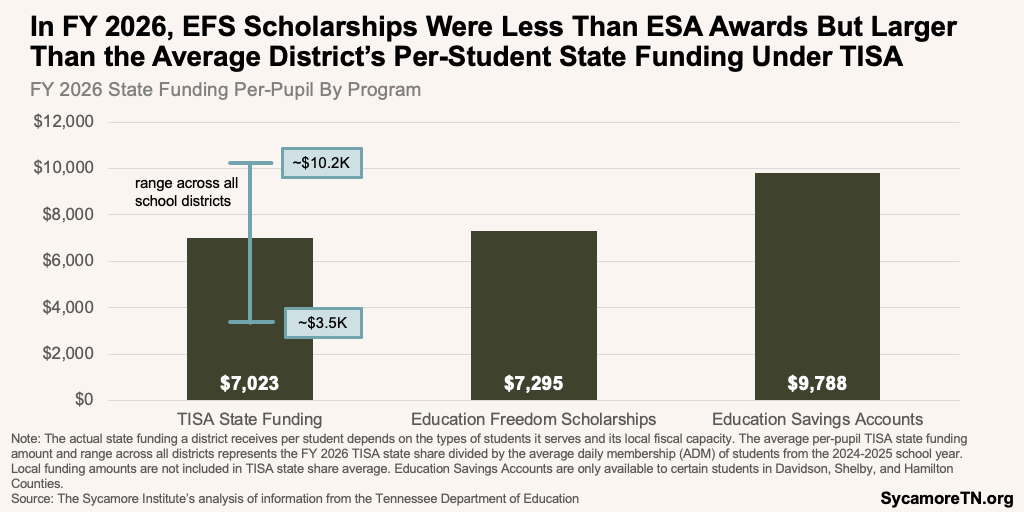
- Increase scholarship amounts from $7,295 in FY 2026 to $7,530 in FY 2027—consistent with the increase in the TISA per-pupil base. (1) (6) For context, scholarships under the EFS program in FY 2026 were less than those under the ESA program but more than what the average school district received in state funding per student under TISA (which excludes local funding). (Figure 1)
Figure 1
References
Click to Open/Close
References
- State of Tennessee. Public Chapter 7 of the First Extraordinary Session. Tennessee Secretary of State. [Online] January 2025. https://publications.tnsosfiles.com/acts/114/extra/pc0007EOS.pdf.
- Tennessee Department of Education. Education Freedom Scholarship. Tennessee Department of Education. [Online] [Cited: March 6, 2026.] https://www.tn.gov/education/efs/parents-and-students.html.
- —. Non-Public Schools Directory. [Online] March 4, 2026. https://www.tn.gov/education/families/school-options/non-public-schools.html.
- Tennessee State Board of Education. Policy 3.500: Category II and III Private School Accrediting Agencies. [Online] May 31, 2024. https://www.tn.gov/content/dam/tn/stateboardofeducation/documents/2024-sbe-meetings/may-31%2c-2024-/5-31-24%20VI%20K%20Category%20II%20and%20III%20Private%20School%20Accrediting%20Agencies%20Policy%203.500%20Clean.pdf.
- —. Rule: Chapter 0520-07-02 Non-Public School Approval Process. [Online] June 2024. https://publications.tnsosfiles.com/rules/0520/0520-07/0520-07-02.20240616.pdf.
- Tennessee General Assembly. HB 2631 / SB 2690 (as introduced). Tennessee General Assembly. [Online] February 9, 2026. https://www.capitol.tn.gov/Bills/114/Bill/HB2631.pdf.
- Tennessee Department of Education. TISA FY 2026 Final Allocations. Tennessee Department of Education. [Online] August 15, 2025. https://www.tn.gov/content/dam/tn/stateboardofeducation/documents/2025-sbe-meetings/august-15%2c-2025-sbe-meeting/8-15-25%20II%20C%20FY%202025-26%20TISA%20Allocations%20Attachment.pdf.
- —. Tennessee Education Freedom Scholarship Program. [Online] [Cited: February 12, 2026.] https://www.tn.gov/education/efs.html.
- —. Education Savings Account Program. [Online] [Cited: February 12, 2026.] https://www.tn.gov/content/tn/education/esa.html.