
Key Takeaways
- Financing for housing construction hinges on its potential profitability (i.e., return) from the income that comes from renting or selling completed units.
- A “capital stack” is the combination of funding sources builders use to finance housing construction, which often includes both debt from lenders and equity from investors.
- Affordable housing developers typically face funding gaps in the traditional capital stack due to the lower prices/rents needed to make a unit affordable for lower-income households.
- Developers rely on multiple tools to fill the financing gap, including public programs, subsidies, and other private sector resources and approaches.
- These tools supplement upfront funding for development, help boost the rental revenues of affordable housing, and/or reduce developers’ costs.
- It can be challenging for developers to piece various tools together to fill the funding gap because each tool comes with trade-offs, and not all resources are available everywhere.
Housing is a necessity, and has grown increasingly expensive in Tennessee over the last decade. Much of this was driven by increased demand and diminished supply. Financing for housing developments can be challenging, and the process is particularly complex for affordable housing. This report examines how these developments are financed, and the unique challenges affordable housing developments navigate.
Financing Housing Development
All housing developments come with both upfront costs and ongoing maintenance. Initial expenses typically include roughly 10-20% for land acquisition, 60-70% for hard costs like labor and building materials, and 20-30% for soft costs like permits, project designs, and impact or permit inspection fees. Additionally, buildings need ongoing maintenance after they’re built—either by the developer or a buyer.
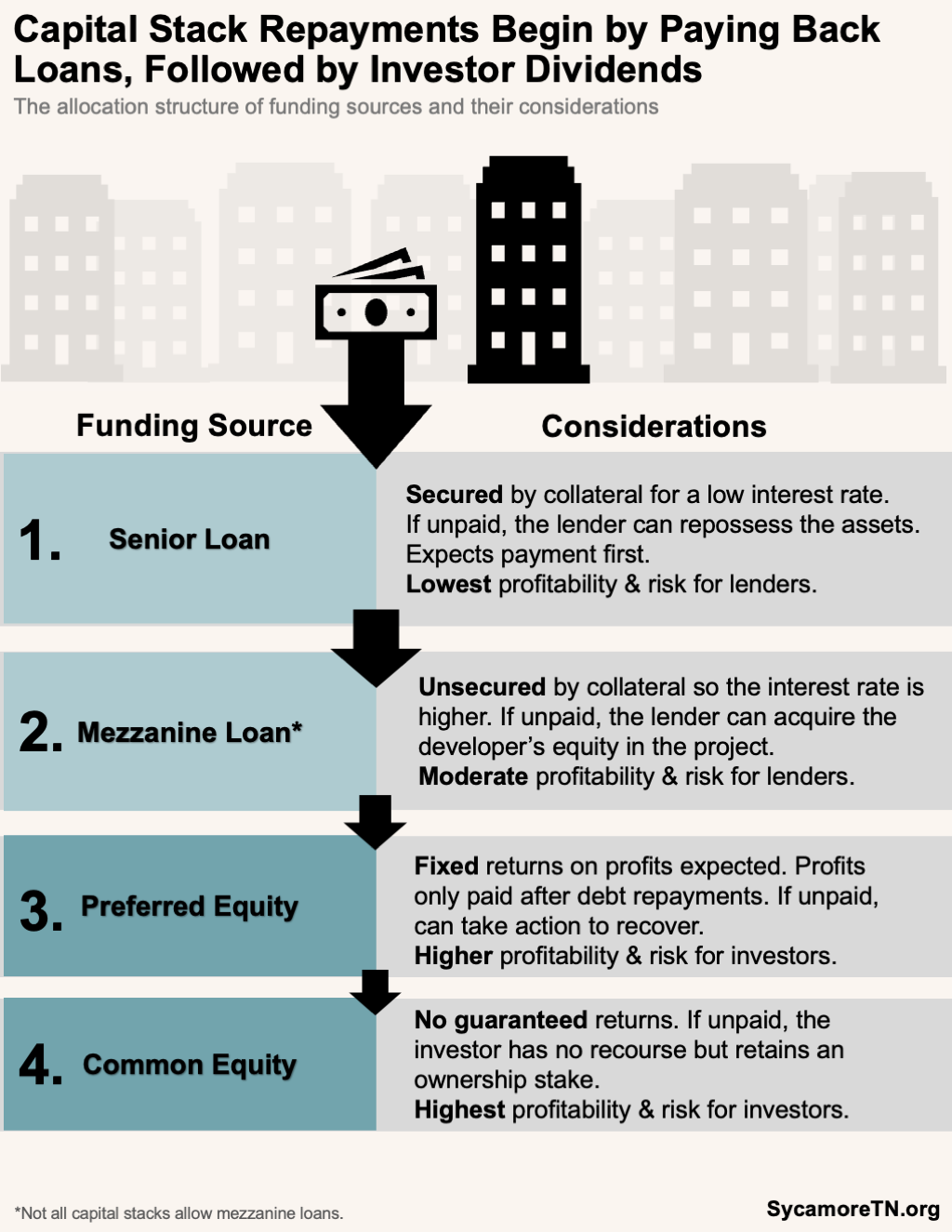
A “capital stack” is the combination of funding sources used to finance a project, which often includes both debt from lenders and equity from investors (Figure 1). A capital stack is hierarchical, defining who gets paid back first based on risk and return. (2) (3)
Debt Financing
Debt financing is money a builder borrows and must repay to the lender over time with interest. Financial institutions will offer developers a loan only if it appears secure—that is, they believe the funds will be repaid. There are two levels of debt financing:
- Senior debt is usually the largest and least expensive source of funding for a housing development.(2) It is repaid first, and if the developer defaults, the lender can take ownership of the property and its assets. It carries the lowest risk for lenders and offers developers the lowest interest rates.
- Mezzanine debt helps cover gaps left by other financing sources.(2) (3) Developers seek lenders willing to accept higher risk for higher returns, which means higher interest rates. It is the second repayment priority, and if the developer defaults, mezzanine lenders can claim the developer’s equity in the project.
Equity Financing
Equity financing provides funds in exchange for ownership or profit shares in a project. It includes preferred and common equity. Preferred equity guarantees investors a portion of profits after debt repayment, offering lower risk, limited decision-making power, and smaller returns. Common equity represents full ownership, with decision-making authority and higher potential returns—but it is paid last and carries greater risk. (3) (4)
Figure 1
Risk and Return
The feasibility of a development depends on its projected profitability from rental or sale income. To secure financing, developers must show lenders and investors that completed units will generate enough revenue to cover costs. Because these projections rely on market conditions, they carry inherent risk. Lenders earn interest for assuming this risk, while investors receive an ownership stake, potential decision-making authority, and the ability to set exit conditions. High interest rates further reduce profitability and can deter investors—especially those in preferred equity—since loan costs and return expectations rise together.
Debt and equity financing both carry risks for developers. Delays, labor shortages, and unexpected cost increases can jeopardize funding. Construction loans often follow a “draw schedule,” releasing funds as milestones are met, so disruptions can strain budgets and cash flow. Cost overruns also create uncertainty for investors, who may seek exit strategies that shift more financial risk onto developers.
Figure 2
Financing Affordable Housing
“Affordable housing” refers to developments where units are priced below market rates for lower-income households. Housing is considered affordable when costs do not exceed 30% of a household’s income. (5) (6) In practice, affordable—sometimes called “income-based”— housing units are rental homes priced so families earning less than the area median income (AMI) can keep housing costs below that threshold. (7)
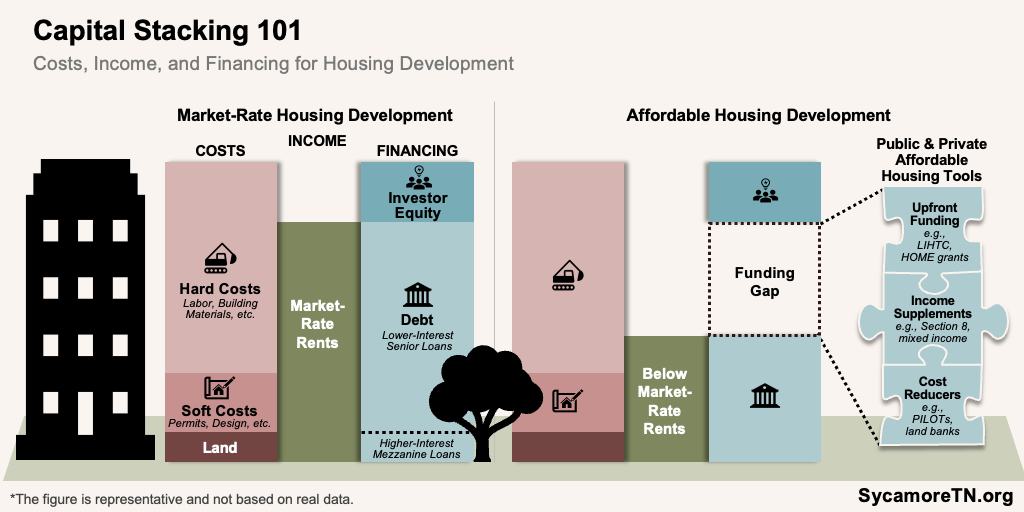
Affordable housing developers face funding gaps because lower rents and prices make projects less profitable than market-rate builds. Construction costs exceed anticipated profit, so lenders provide only what projected revenue can cover, leaving a shortfall in the capital stack.
To fill this gap, affordable housing developers often rely on multiple tools—including public programs, subsidies, and other private sector resources and approaches (Figure 2). These tools generally take several forms—including resources that supplement upfront funding, help boost affordable housing rental revenues, or reduce developers’ costs. (8) The following sections highlight key programs and tools in these categories.
Tool: Upfront Funding Supplements
Affordable housing developers use grants, subsidies, and other assistance to supplement traditional financing sources and help cover upfront building costs. These funds are often available through federal or state programs. In some cases, private foundations and donors provide upfront contributions to a project.
Low-Income Housing Tax Credits
The Low-Income Housing Tax Credit (LIHTC) program is the largest federal program that supports construction of affordable rental housing. (7) It reduces federal tax liability for 10 years in exchange for maintaining affordability for 30 years. Developers often sell these credits as equity to raise upfront cash for construction. LIHTCs come in two forms: non-competitive 4% credits, which cover about 30% of eligible costs, and competitive 9% credits, which cover about 70%. A recent federal law will increase the number of 9% credits by 12% starting in 2026. (9) In Tennessee, the Tennessee Housing Development Agency (THDA) awards 9% credits based on priorities such as location, housing needs, and energy efficiency. (10) (7) (11)
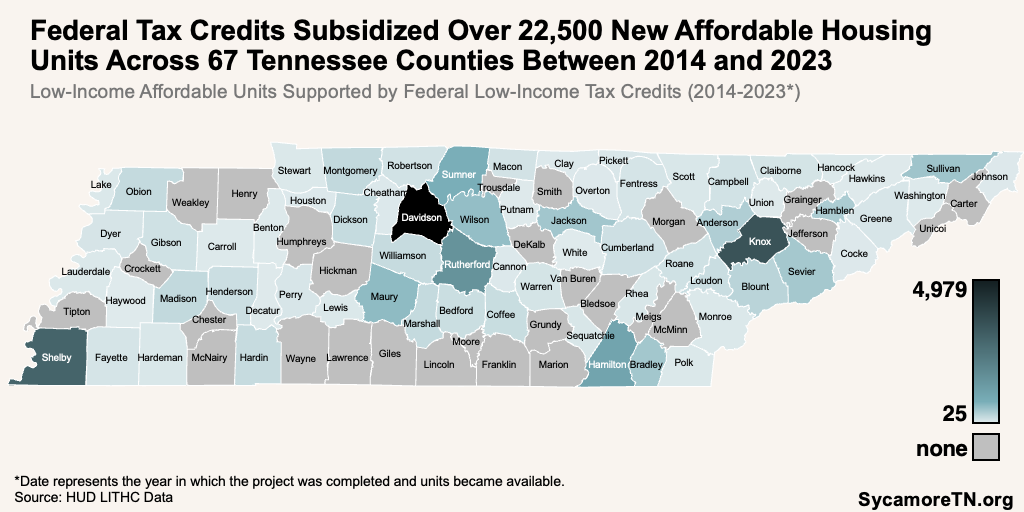
In FY 2024, Tennessee awarded $99.5 million in LIHTCs to build 824 new rental units and rehabilitate 60 more. (12) From 2014 to 2023, the program supported 238 projects, creating over 22,500 affordable units across 67 counties (Figure 3). Of these, 33% of units used 4% credits, 29% used 9% credits, and 27% combined both. Data for the remaining 14% of units was not reported. (13)
Figure 3
Other Federal Upfront Funding Supplements
The federal government offers grants to state and local governments to help offset the costs of developing affordable housing. For example—
- HOME Grants are federal formula funds provided to state and local housing authorities to build or preserve affordable housing for low-income households.(14) (15) (12) In FY 2025, Tennessee allocated $11.2 million in HOME funds for these purposes, though the president’s FY 2026 budget proposes eliminating the program.[1] (12) (16)
- Housing Trust Fund (HTF) dollars go directly to THDA to build, preserve, and rehabilitate rental housing for households earning 30% or less of the area median income.(17) (12) Funds are awarded competitively using the same structure as LIHTC allocations. (12) In FY 2025, Tennessee allocated $8.5 million HTF dollars for affordable housing development and preservation. (12)
- Community Development Block Grants (CDBGs) are federal formula funds awarded to states and certain local governments for economic and community development, including infrastructure that supports or refurbishes affordable housing. These funds cannot be used to build new units.(12)(18) In FY 2025, Tennessee allocated $13 million in CDBG dollars for infrastructure benefiting low- and moderate-income housing.[1] (12)
State and Local Upfront Funding Supplements
The state and some local governments have established their own housing funds to subsidize the construction and preservation of affordable housing. THDA’s Tennessee Housing Trust Fund, financed through mortgage revenues, supported 178 new rental units in FY 2025 and will provide $3 million this year for the Affordable Housing Development Gap Subsidy Program. (12) (19) (20) The state also allocated $12.5 million in COVID-related federal relief to create or improve 250 units. (21) Nashville operates the Barnes Housing Trust Fund, while Chattanooga recently launched the Housing Production Fund to invest in affordable and mixed-income developments. (22) (23) (24)
Philanthropic organizations and private entities also contribute to affordable housing through donations or below-market investments. Across Tennessee, groups such as Amazon, the East Tennessee Foundation, the Community Foundation of Greater Chattanooga, and U.S. Bank have provided funds to support construction and preservation efforts. (25) (26) (27) (28)
Tool: Income Supplements
Developers can use programs and strategies to increase the income potential of affordable housing. The federal project-based Section 8 program, for example, supplements affordable rents to match fair market rates, providing a steady revenue stream. Some developers also cross-subsidize by including market-rate units in mixed-income projects, which helps offset lower rents and improve financial viability.
Examples of Income Supplements
Federal project-based Section 8 vouchers subsidize affordable housing landlords, closing the gap between market-rate and affordable rents. (29) (12) Under this program, low-income tenants pay 30% of their income as rent, while landlords receive payments covering the difference between those rents and an agreed market-rate amount. This approach helps owners manage costs while keeping housing affordable. As of June 2025, Tennessee had about 4,000 project-based voucher units. (30)
Mixed-income developments blend affordable and market-rate units to balance financial viability and community impact. Market-rate units generate additional income that offsets lower rents from affordable units, making it easier to cover operating costs, secure financing, and sustain the project over time while serving low- and moderate-income households. For example, the Metropolitan Development and Housing Agency in Nashville has successfully funded multiple mixed-income developments throughout the 2020s. (30)
Tool: Cost Reducers
Affordable housing builders may also be able to use tools designed to reduce their costs. For example, local governments may reduce property tax liabilities or offer free, low-, or reduced-cost public land.
Examples of Cost Reducers
State law allows local governments to offer property tax breaks for affordable housing development—known as payment-in-lieu-of-taxes (PILOT) programs. (31) (32) These breaks reduce the ongoing costs of maintaining a property. Currently, cities like Nashville, Memphis, and Chattanooga offer targeted PILOT programs to affordable housing developers. (33) (34) (35)
Local governments in Tennessee may also offer incentives to reduce some of the soft costs associated with building affordable housing. State legislation passed in 2024 allows cities to promote affordable housing development through voluntary attainable housing incentive programs. These programs enable property owners to voluntarily provide affordable housing in exchange for zoning exceptions that can ease the development process. (36) (37) (38) (39)
In addition, private and public sector tools can reduce the cost of borrowing money. Examples include—
- Community Investment Tax Credit (CITC) — These credits incentivize financial institutions to provide loans for affordable projects at lower interest rates. (40) In 2025, Tennessee awarded $551 million in CITCs for the creation and preservation of affordable housing—including the construction of over 2,200 new rental units. (12)
- Local Industrial Development Board Bonds — Since 2024, state law allows local governments to issue industrial development board bonds to provide lower-cost debt for affordable housing projects. Because these bonds are tax-exempt, buyers accept lower interest rates, making the funds cheaper than traditional loans. The proceeds are then loaned to developers to build or rehabilitate affordable housing. (41)(42)
- Public-Private Loan Funds — The Nashville Catalyst Fund is a nonprofit loan fund that offers low-cost lending to affordable housing developers using resources donated by private institutions, local government, and other donors.(43) (44)
- Federally-Insured Loans — The federal government insures loans for affordable housing preservation and development, reducing the risk for financial institutions and allowing them to offer lower-cost loans.(45)
- Community Development Financial Institutions — The federal government subsidizes Community Development Financial Institutions (CDFIs) to lend and invest in underserved communities—allowing them to offer less expensive financing options for affordable housing development. (46) (47)
Governments have also found ways to reduce or eliminate the costs of land for affordable housing developers. For example, governments can offer priority bidding on public lands or partner with affordable housing nonprofits and developers, CDFIs, and community land trusts/banks to develop and maintain underutilized or blighted properties. (48) (49) (50) (51) In Tennessee, however, state law only allows certain cities and counties to establish a land bank without legislative approval. (50) (52) (53) Nashville also recently established a Faith Based Development Institute to facilitate the development of affordable housing on land owned by churches and other faith-based organizations. (54)
Trade-Offs and Considerations
It can be challenging for developers to piece various tools together to fill the funding gap because each tool comes with trade-offs, and not all resources are available everywhere. Developers must navigate complex requirements tied to programs, subsidies, and grants, which can dictate income limits, project location, or even building materials. Rules may differ in their practicality across regions, even for federal programs. Some tools, like the 9% LIHTC, are highly competitive, and smaller local governments may lack the resources to implement options such as PILOT programs. Additionally, funding sources often follow different timelines, making coordination challenging and slowing projects compared to market-rate developments competing for limited land and resources.
As policymakers and stakeholders look to expand the state’s affordable housing supply, key questions to consider include—
- Could Tennessee provide additional, flexible support for low-income housing development? For example, other states, such as Georgia, offer state-specific tax credits that supplement LIHTCs.(55) In 2024, Tennessee created a Rural and Workforce Housing Tax Credit but has not taken the necessary steps to authorize funding for the program. (56) (57)
- Could the state deploy a broader range of tools to help local governments meet their communities’ needs? For example, most counties and cities are barred by state law from establishing a land bank.(53)
- What resources do local governments need to use the tools that are available to them? For example, some cities and counties may be unaware of or lack funding and administrative capacity to manage a PILOT program. (58)(59) (60) (31) (32) (61)
- Are there tweaks that could be made to existing programs to further their impact? For example, Tennessee is among a small number of states that includes LIHTC income in property tax assessments—treating them like income rather than an upfront funding source. (62)
- Are there ways that state and local governments can encourage more philanthropic or faith-based funding initiatives? For example, states such as Maryland and New York have passed legislation to make it easier to develop housing on faith-based organizations’ land. (63)
- How can the requirements of various funding sources be better coordinated to streamline affordable development projects? For example, state-led coordination of various gap-filling funding tools could streamline financing for developers.
- What obstacles do developers across the state—both market-rate and affordable—face in financing more housing development? There is little empirical information available on the actual budgets of Tennessee’s developers. Further research on this piece of the housing puzzle would be beneficial in identifying opportunities for improvement.
Parting Words
Financing for housing is complex, and affordable housing developments face additional unique challenges. Developers must fund construction without the income needed to cover costs, relying on multiple tools with varying requirements and timelines to close gaps left by traditional financing. As housing costs rise in Tennessee, state, local, and private stakeholders may want to consider how best to use and expand these tools to address challenges and increase affordable housing supply.
[1] Includes only expenditures from state grants—not those awarded directly to local governments.
References
Click to Open/Close
References
- Deursen, Hanneke van. Affordable Housing Finance 101. [Online] Shelterforce, May 28, 2025. https://shelterforce.org/2025/05/28/affordable-housing-finance-101/.
- Graham, Patrick. The Capital Stack Explained. [Online] January 31, 2023. https://propertymetrics.com/blog/capital-stack/.
- J.P. Morgan Chase. Understanding the real estate capital stack. [Online] June 18, 2024. https://www.jpmorgan.com/insights/real-estate/commercial-term-lending/what-is-a-capital-stack-in-real-estate.
- Liquidity. Equity Funding for Property Development. [Online] 2025. https://www.liquidity.com/resource-funding/equity-funding-for-property-development.
- Herbert, Christopher, Hermann, Alexander and McCue, Daniel. Measuring Housing Affordability: Assessing the 30-Percent of Income Standard. [Online] September 2018. https://www.jchs.harvard.edu/sites/default/files/Harvard_JCHS_Herbert_Hermann_McCue_measuring_housing_affordability.pdf.
- Danilo Pelletiere, PhD. Getting to the Heart of Housing’s Fundamental Question: How Much Can a Family Afford? – A Primer on Housing Affordability Standards in U.S. Housing Policy . [Online] February 2008. https://nlihc.org/sites/default/files/affordabilityresearchnote2-19-08.pdf.
- The Tax Policy Center. What is the Low-Income Housing Tax Credit and how does it work? [Online] The Urban Institute and Brookings Institution, January 2024. https://taxpolicycenter.org/briefing-book/what-low-income-housing-tax-credit-and-how-does-it-work.
- Garcia, David. Making it Pencil: The Math Behind Housing Development. [Online] August 2019. http://ternercenter.berkeley.edu/wp-content/uploads/2020/08/Making_It_Pencil_The_Math_Behind_Housing_Development.pdf.
- Barclay Damon LLP. Key Affordable-Housing Provisions in the One Big Beautiful Bill Act. [Online] July 10, 2025. https://www.barclaydamon.com/alerts/key-affordable-housing-provisions-in-the-one-big-beautiful-bill-act.
- Tennessee Housing Development Agency. Low-Income Housing Tax Credit Program 2025 Qualified Allocation Program. [Online] February 10, 2025. https://thda.org/pdf/2025-QAP-signed-by-Governor-2.10.2025-Updated-for-Website.pdf.
- Kneightly, Mark. An Introduction to the Low-Income Housing Tax Credit. [Online] Congressional Research Service, April 26, 2023. https://sgp.fas.org/crs/misc/RS22389.pdf.
- Tennessee Housing Development Agency, Tennessee Department of Economic and Community Development, and Tennessee Department of Health. State of Tennessee Fiscal Year 2024-2025 Consolidate Annual Performance and Evaluation Report. [Online] 2025. https://thda.org/research-and-reports/consolidated-planning/.
- U.S. Department of Housing and Urban Development (HUD). Low-Income Housing Tax Credit (LIHTC): Property Level Data. [Online] [Cited: September 3, 2025.] https://www.huduser.gov/portal/datasets/lihtc/property.html.
- Watson, Henry. An Overview of the HOME Investment Partnerships Program. [Online] Congressional Research Service, August 11, 2024. https://www.congress.gov/crs-product/R40118.
- Tennessee Housing Development Agency. HOME program. [Online] 2025. https://thda.org/government-nonprofit-partners/home-program.
- Department of Housing and Urban Development. HOME Investment Partnerships Program: Summary of Resources. [Online] 2025. https://www.hud.gov/sites/dfiles/CFO/documents/2026_CJ_Program_HOME.pdf.
- Jones, Katie. The Housing Trust Fund: An Overview. [Online] Congressional Research Service, December 20, 2021. https://www.congress.gov/crs-product/R40781.
- Office of Community Planning and Development. Expenditure Report – Use of CDBG Funds by TENNESSEE. [Online] Department of Housing and Urban Development, February 2, 2024. https://files.hudexchange.info/reports/published/CDBG_Expend_Grantee_AAAA-TN_TN_2022.pdf.
- Tennessee Housing Development Agency (THDA). Tennessee Housing Trust Fund. [Online] [Cited: August 29, 2025.] https://thda.org/govt-non-profit/tennessee-housing-trust-fund/.
- —. Development Gap Subsidy. [Online] [Cited: August 29, 2025.] https://thda.org/govt-non-profit/affordable-housing-development-gap-subsidy/.
- State of Tennessee. Tennessee Resiliency Plan: Reocvery Plan Performance Report. [Online] July 31, 2025. https://www.tn.gov/content/dam/tn/finance/documents/lola/Tennessee%20Resiliency%20Plan%207.22.25.pdf.
- Metro Nashville and Davidson County. Barnes Housing Trust Fund. [Online] [Cited: August 29, 2025.] https://www.nashville.gov/departments/mayor/housing/barnes-fund.
- Invest Chattanooga. Frequently Asked Questions: Partnering with Invest Chattanooga. [Online] [Cited: August 29, 2025.] https://www.investchattanooga.org/faq.
- Chattanooga Area Chamber of Commerce. ‘Invest Chattanooga’ to Catalyze Affordable Housing Development with $20 Million Housing Production Fund. [Online] [Cited: August 29, 2025.] https://chattanoogachamber.com/invest-chattanooga-to-catalyze-affordable-housing-development-with-20-million-housing-production-fund/.
- Amazon. Everything You Need to Know About Amazon’s Housing Fund—a $3.6 Billion Committment to Help People Access Affordable Housing. [Online] December 20, 2024. https://www.aboutamazon.com/news/community/amazon-housing-equity-fund.
- East Tennessee Foundation. Affordable Housing Trust Fund. [Online] https://easttennesseefoundation.org/grants/affordable-housing-trust-fund/.
- Community Foundation of Greater Chattanooga. Community Impact. [Online] 2025. https://www.cfgc.org/community-impact.
- U.S. Bank. U.S. Bank Foundation Opportunity Fund. [Online] 2025. https://www.usbank.com/about-us-bank/community/opportunity-fund.html.
- McCarty, Maggie. An Overview of the Section 8 Housing Programs: Housing Choice Vouchers and Project-Based Rental Assistance. [Online] Congressional Research Service, February 7, 2014. https://www.congress.gov/crs_external_products/RL/PDF/RL32284/RL32284.19.pdf.
- Department of Housing and Urban Development. Housing Choice Voucher – Summary Page. [Online] June 2025. https://app.powerbigov.us/view?r=eyJrIjoiM2Y2OTQ2MTAtODVkNC00YmM2LThhOWEtZWY4MGU5YWFmZDFmIiwidCI6IjYxNTUyNGM1LTIyZTktNGJjZC1hODkzLTExODBhNTNmYzdiMiJ9.
- County Technical Assistance Service. Payment in Lieu of Tax Agreements. [Online] University of Tennessee, Institute of Public Service, March 28, 2025. https://www.ctas.tennessee.edu/node/2472/printable/pdf.
- Mamantov, Mark. Abating Property Taxes in Tennessee: An Essential Tool in the Economic Development Toolbox. [Online] University of Tennessee, Knoxville, School of Law, 2003. https://ir.law.utk.edu/cgi/viewcontent.cgi?article=1023&context=transactions.
- Nashville and Davidson County Government. Metro Nashville — Davidson County Mixed-Income PILOT Program. [Online] 2025. https://www.nashville.gov/sites/default/files/2024-01/Mixed-Income-PILOT-Program-Details.pdf?ct=1706025526.
- Chattanooga, City of. Affordible Housing Payment-in-Lieu-of-Taxes (PILOT). [Online] 2025. https://chattanooga.gov/business/funds-finder/affordable-housing-payment-lieu-taxes-pilot.
- Memphis, The City of. Middle Income Housing “Pilot” Program. [Online] October 14, 2024. https://www.memphistn.gov/wp-content/uploads/2024/09/MI-pilot-Guidelines-FINAL.pdf.
- State of Tennessee Code. Public Chapter No. 1051. [Online] May 28, 2024. https://publications.tnsosfiles.com/acts/113/pub/pc1051.pdf.
- State of Tennessee. Tennessee Code § 66-35-102. [Online] 2025. https://law.justia.com/codes/tennessee/title-66/chapter-35/section-66-35-102/.
- —. Tennessee Code §13-3-601. [Online] 2025. https://law.justia.com/codes/tennessee/title-13/chapter-3/part-6/section-13-3-601/.
- —. Tennessee Code §13-4-401. [Online] 2025. https://law.justia.com/codes/tennessee/title-13/chapter-4/part-4/section-13-4-401/.
- Tennessee Housing Development Agency. Community Investment Tax Credit. [Online] 2025. https://thda.org/government-nonprofit-partners/community-investment-tax-credit.
- State of Tennessee. Public Chapter No. 1012 (2024). [Online] April 25, 2024. https://publications.tnsosfiles.com/acts/113/pub/pc1012.pdf.
- Tennessee Comptroller of the Treasury. Industrial Development Boards – General Information. [Online] 2025. https://comptroller.tn.gov/office-functions/lgf/debt/industrial-development-corporations-debt-reporting.html.
- The Nashville Catalyst Fund. About the Catalyst Fund. [Online] 2025. https://www.nashvillecatalyst.org/about-the-fund.
- Community Foundation of Middle Tennessee. Nashville Catalyst Fund Makes First Investment to Expand Affordable Housing in Nashville. [Online] March 5, 2025. https://www.cfmt.org/stories/nashville-catalyst-fund-makes-first-investment-to-expand-affordable-housing-in-nashville/.
- Development, Department of Housing and Urban. Description of Multifamily Programs. [Online] 2025. https://www.hud.gov/hud-partners/multifamily-programs.
- Department of the Treasury – Community Development Financial Institutions Fund. About Us. [Online] 2025. https://www.cdfifund.gov/about.
- U.S. Department of Treasury. Community Development Financial Institutions Fund. [Online] 2025. https://www.cdfifund.gov/programs-training/programs/cdfi-program.
- Mcrae, Oshane. Can Community Land Trusts Solve the Housing Crisis? [Online] Fourth Economy, April 24, 2025. https://www.fourtheconomy.com/post/can-community-land-trusts-solve-the-housing-crisis.
- Leonard, Natasha and Lowery, Lauren. What City Leaders Need to Know About Community Land Trusts. [Online] National League of Cities, August 17, 2021. https://www.nlc.org/article/2021/08/17/what-city-leaders-need-know-about-community-land-trusts/.
- Mansa, Morgan. Tennessee Housing Development Agency Issue Brief: Land Banking to Eliminate Blight and Support Affordable Housing. [Online] July 2016. https://thda.org/pdf/Land-Bank-Issue-Brief.pdf.
- Community Redevelopment Agency. Essential Housing Program. [Online] https://cramemphis.org/memphis-essential-housing/.
- The Department of Housing and Urban Development. Land Banking 101: What is a Land Bank? Neighborhood Stabilization Prorgrams Toolkit. [Online] https://files.hudexchange.info/resources/documents/LandBankingBasics.pdf.
- State of Tennessee. TN Code § 13-30-103. [Online] https://law.justia.com/codes/tennessee/title-13/chapter-30/section-13-30-103/.
- Metropolitan Government of Nashville and Davidson County – Mayor’s Office. Media Release. [Online] August 22, 2024. https://www.nashville.gov/departments/mayor/news/nashville-receives-first-its-kind-federal-grant-remove-obstacles-housing.
- Novogradac. State LIHTC Program Descriptions. Affordable Housing Resource Center. [Online] [Cited: September 2, 2025.] https://www.novoco.com/resource-centers/affordable-housing-tax-credits/state-lihtc-program-descriptions#tn.
- State of Tennessee. Public Chapter No. 971 (2024). [Online] April 2024. https://publications.tnsosfiles.com/acts/113/pub/pc0971.pdf.
- Tennessee General Assembly. SJR 0027. 114th General Assembly. [Online] January 2025. [Cited: September 2, 2025.] https://wapp.capitol.tn.gov/apps/BillInfo/Default.aspx?BillNumber=SJR0027.
- MacDonald, Graham. The Effect of Local Government Policies on Housing Supply. [Online] UC Berkeley, Terner Center for Housing Innovation, May 2016. https://ternercenter.berkeley.edu/wp-content/uploads/pdfs/The_Effect_of_Local_Government_Policies_on_Housing_Supply.pdf.
- Housing Assistance Council. 2025 Rural Housing Priorities. [Online] January 7, 2025. https://ruralhome.org/wp-content/uploads/2025/01/HACs-Policy-Priorities-for-2025.pdf.
- Manji, Shazia and Rachel , Ozer-Bearson. Pro-Housing Destination Programs: How States are Incentivizing Pro-Housing Reform. [Online] November 2024. https://ternercenter.berkeley.edu/research-and-policy/pro-housing-designation-programs-how-states-are-incentivizing-pro-housing-reform/.
- Tennessee Advisory Commission on Intergovernmental Relations. Encouraging More Cooperation and Accountability in Payment in Lieu of Tax Agreements. [Online] January 2018. https://www.tn.gov/content/dam/tn/tacir/2018-publications/2018_PILOTAgreements.pdf.
- —. Assessing the Value of Low-Income Housing for Property Tax Purposes: Whether and How to Consider the Value of Low-Income Housing Tax Credits. [Online] January 2015. https://www.tn.gov/content/dam/tn/tacir/documents/2015LIHTC.pdf.
- Been, Vicki, Ketema, Helen and Murphy, Matthew. Building Homes on Faith-Based Owned Land: State-led Approaches to Increasing Housing Supply. [Online] NYU Furman Center, April 2025. https://furmancenter.org/files/Building_Homes_on_Faith-Based_Owned_Land_508.pdf.
- Shah, Sohil. Saving Our Cities: Land Banking in Tennessee. [Online] https://www.memphis.edu/law/documents/shah46.pdf.