

Key Takeaways
- To become law, a bill must receive majority approval in the Tennessee House of Representatives and the Senate and be signed by the governor.
- The House and Senate have different rules that shape the legislative process.
- Bills carry over between each year of a two-year legislative session, which means a bill that did not pass in 2025 can still be considered in 2026.
- Bills must be filed early but can be amended within limits created by a bill’s caption, which identifies the relevant part of Tennessee law and related subject matter.
- Bills often pass through several committees in the House and Senate before reaching a floor vote—depending on scope and impact.
- Bills can “die” in several ways, but there are legislative actions that can bring them back to life.
- The House and Senate must pass the same version of a bill for it to become law—often resolving disagreements through amendments and conference committees.
The Tennessee General Assembly will reconvene on January 13, 2026 for legislative session. Each year, legislators file more than 1,400 bills and pass over 500 into law. To become law, a bill must receive majority approval in the House of Representatives (50 out of 99 representatives) and the Senate (17 out of 33 senators) and be signed by the governor. While the process appears straightforward, there are several complex steps. This brief explains 6 things to know about Tennessee’s legislative session.
1. The House and Senate Have Different Rules That Shape the Legislative Process.
The Tennessee Constitution outlines broad responsibilities of the General Assembly, but the House and Senate develop their own procedural rules. The House and Senate each approve their rules in the first year of each two-year session of the General Assembly. These rules each detail bill and amendment filing deadlines, committee structure, and voting procedures. (1) (2) (3)
Differences in House and Senate committee structure and rules shape the legislative process. For example, the House has subcommittees—meaning bills must usually pass through more committees than in the Senate. Additionally, the House limits the number of bills each representative can file per year, while Senators can file as many as they want. (2) (3)
Committee chairs, who are appointed by the House and Senate speakers, set and enforce most committee procedures. For example, they implement committee rules, control committee calendars (i.e., creating the agenda for each meeting), and preside over member discussion. The chair can also set specific deadlines for filing amendments to be heard in their committee and have discretion to call or cancel meetings. (2) (3)
2. Bills Carry Over Between Each Year of a Two-Year Legislative Session.
One legislative session of the Tennessee General Assembly meets over a two-year period. There is no specified end date for legislative session, but the Tennessee Constitution limits the General Assembly to 90 session days over a two-year period. A “session day”—commonly known as floor session— is when either the House or Senate meet as a full chamber and does not include days when only committees meet. (1)
Figure 1
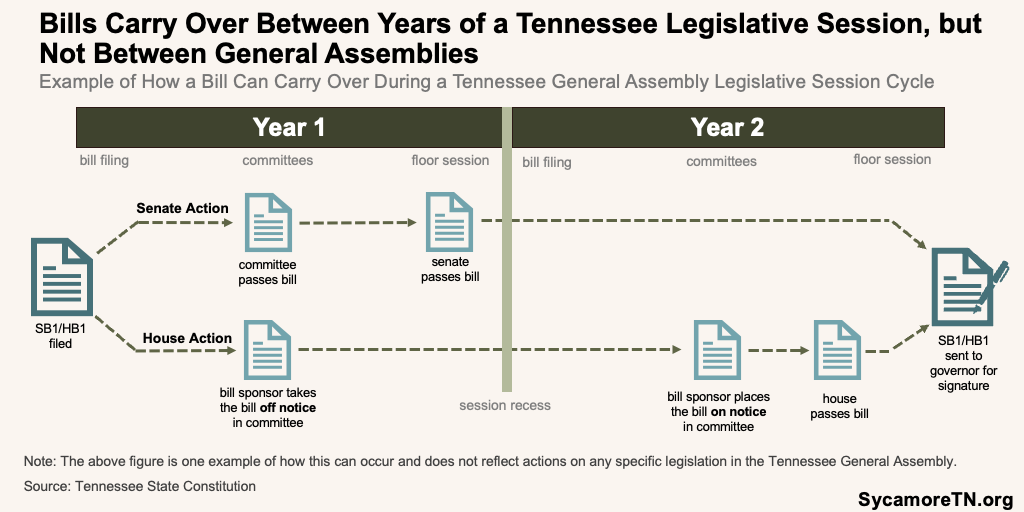
Because Tennessee’s 114th General Assembly is in its second year, bills that did not pass last year can still be considered this year. A bill that did not pass both chambers in 2025 does not need to restart the legislative process in 2026. For example, if a bill passed the Senate but not the House in 2025, it only needs to pass the House in 2026 for it to go to the governor for signature (Figure 1). When the 115th General Assembly convenes in 2027, the legislative session process restarts and no bills from the 114th General Assembly will carry over.
3. Bills Must Be Filed Early But Can Be Amended Within Limits Created by a Bill’s Caption.
Legislators typically have until early February each year to file bills to create, revise, or repeal state law. If a legislator misses the deadline to file a bill, it cannot be filed unless approved unanimously by their chamber’s speaker, majority leader, and minority leader or by two-thirds of the chamber. (2) (3)
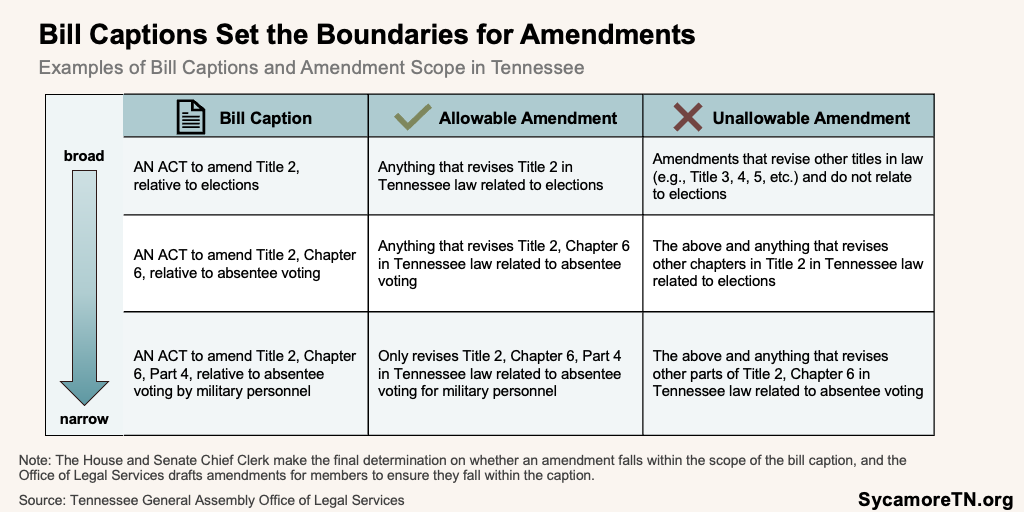
Bills may be amended during session but only within the scope of the caption, which identifies the relevant part of Tennessee law and related subject matter. A bill’s caption cannot be changed after it is filed. Broad captions allow wide-ranging amendments, while narrow captions limit changes to specific provisions. For example, if a bill’s caption is “AN ACT to amend Tennessee Code Annotated, Title 2, relative to elections,” a legislator can file an amendment that changes anything in Title 2 related to elections regardless of what the original bill did. However, if a bill’s caption is “AN ACT to amend Tennessee Code Annotated, Title 2, Chapter 6, Part 4, relative to absentee voting by military personnel,” a legislator can only file an amendment revising that specific part and related to that subject. (4) (Figure 2)
Figure 2
Legislators sometimes file “caption bills,” which initially make no substantive changes but serve as placeholders to be amended later. When introduced, “caption bills” usually have broad captions but little meaningful impact. For example, a caption bill might change the due date of a report (e.g., from July 1 to July 15) or delete an outdated portion of state law. However, legislators can amend these bills during the legislative process to change anything within the scope of the caption. (4)
4. Bills Must Often Pass Through Several Committees Depending on Scope and Impact.
Bills are assigned to committees based on their subject area and impact. Under the Tennessee Constitution, bills must be passed three times on both the House and Senate floors. The first two “considerations” usually happen without debate. After the second, each speaker assigns a bill to the appropriate committee (e.g., health, transportation, education, etc.), and a bill’s sponsor (i.e., the legislator) must notify the committee’s chair to have it placed on a calendar. (2) (3)
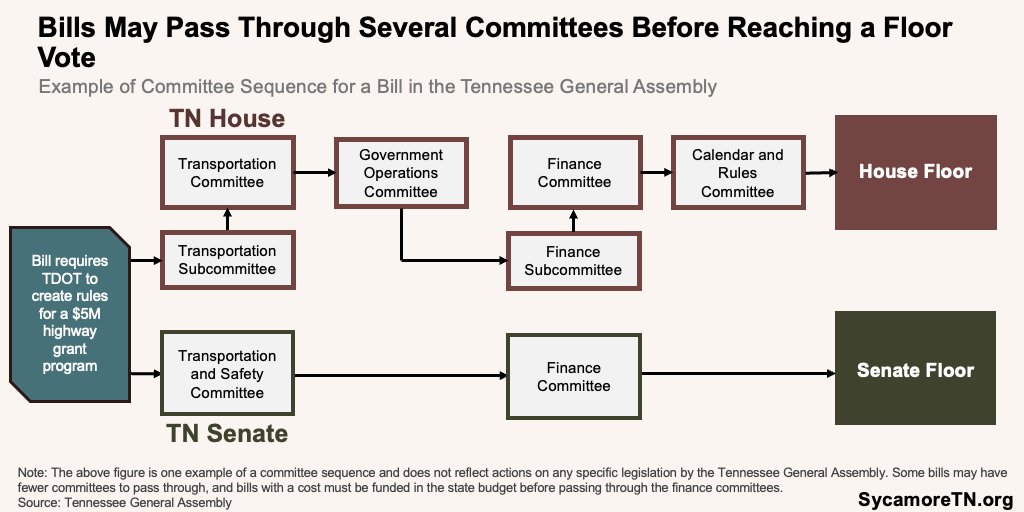
Depending on its scope and impact, a bill may need to be considered by multiple committees before a floor vote. For example, a bill impacting education and health may need to pass through both health- and education- related committees. Some bills must also go through additional committees with special jurisdiction. For example, bills requiring state agencies to issue rules must typically go through the House Government Operations Committee, and those affecting revenue or expenditures must pass also through the Finance, Ways, and Means Committees. (Figure 3)
Figure 3
5. Bills Can “Die” in Several Ways, But There Are Legislative Actions That Can Bring Them Back to Life.
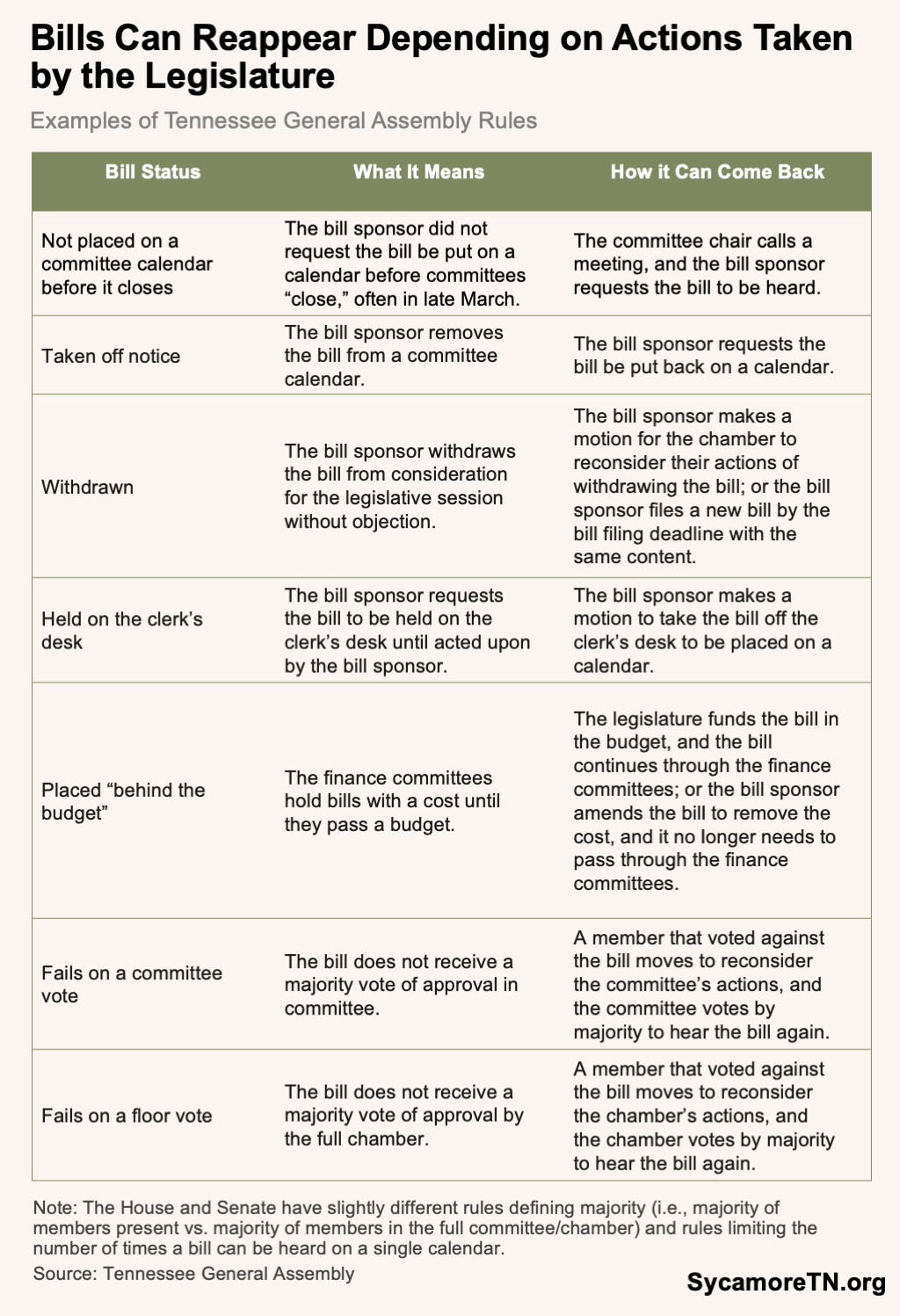
Most bills introduced during session do not become law. Many bills do not pass through the committee process. They may, for example, be taken off notice by the bill sponsor, fail in committee, or be placed “behind the budget.” However, there are avenues by which the bill could reappear and continue through the legislative process depending on actions taken by the bill sponsor, committee, or chamber. Generally, a legislator can move to reconsider any prior action on a bill with approval from a majority of the committee or chamber. Table 1 explains some of the ways a bill may “die” and come back.
Table 1
Common Legislative Terms and Phrases
Behind the Budget: A phrase used to describe bills that require funding that has not been appropriated by the legislature. Most bills with a cost are placed behind the budget until after the legislature passes the budget.
Call the Question or Move Previous Question: A motion to end debate and vote on a bill or amendment. At least two-thirds of members present must agree to the motion to end debate.
Fiscal Note or Memo: A document prepared by the Fiscal Review Committee staff that indicates whether a bill or amendment will lead to an increase or decrease in state and local revenue and/or expenditures.
Flow Motion: A motion that suspends several rules of each chamber to allow bills to move through committees and floor session at a faster pace. Flow motion typically occurs during the final days of session.
General Subcommittee: In the Senate, bills may be referred to the general subcommittee by the speaker, committee chair, or bill sponsor. Aside from the appropriations subcommittee, the Senate does not have subcommittees. This means bills referred to general subcommittee are essentially taken off notice.
Motion: A formal term used by a legislator when he or she wants the committee or chamber to take a specific action, such as passing, amending, voting, or tabling a bill.
Roll a Bill: A phrase used to delay the consideration of a bill to a later time. For example, bills can be rolled to “the heel” (i.e., to the end of a committee’s calendar), to a later spot on the calendar, or to a later meeting.
Summer Study: An action to delay discussion of a bill until after legislative session. Committee chairs may call for a summer study meeting to discuss the bill, but a bill cannot be voted on or passed during summer study.
Taking a Bill Off Notice: Removing a bill from the committee calendar at the request of the bill sponsor or committee chair.
6. The House and Senate Must Pass the Same Version of a Bill for it to Become Law.
The Tennessee Constitution requires that the House and Senate pass the same version of a bill for it to go to the governor for signature. Identical versions of each bill (i.e., “companion bills”) must be introduced in both chambers to have a chance at becoming law. Throughout the process, however, the House and Senate may each change the bill in their own way. If there are any differences between the chambers’ versions, it cannot become law. (1)
The House and Senate reconcile different versions of a bill through amendments and message calendars. The House and Senate can resolve differences in a bill by adopting the same amendment as the other chamber. Occasionally, the House and Senate will pass different versions. In that case, “message calendars” during floor sessions indicate that a different version of the bill has passed in the other chamber. In these instances, the bill will go back and forth between the House and Senate until one chamber conforms with the other chamber’s version of the bill.
Conference committees allow the House and Senate to resolve any disagreements on a bill. If neither the House nor Senate conforms with the other chamber’s version of the bill, the bill sponsors may request a conference committee, which consists of representatives and senators appointed by each speaker. If the conference committee agrees on a new version of the bill, it is presented for a floor vote in both chambers. Conference committees are rare and typically occur during the final days of session. (2) (3)
Parting Words
The Tennessee General Assembly discusses many pieces of legislation each year on topics such as health, transportation, and education. Understanding how a legislative session works—from bill filing to procedural motions—helps demystify the lawmaking process. These rules shape which ideas move forward and ultimately become law.
Additional Resources
For more information on Tennessee’s legislative session, check out the following resources:
- The Sycamore Institute’s Tennessee State Budget Primer: Explains Tennessee’s finances and budget process.
- Tennessee General Assembly: Search for bills, amendments, calendars, and livestream legislative hearings.
- About the Tennessee Legislature: Provides an overview of the structure and responsibilites of the Tennessee General Assembly.
- How a Bill Becomes Law: Explains how a bill becomes law in Tennessee.
- Tennesse House of Representatives Dashboard: View House schedules, calendars, and bill amendments.
- Tennessee Secretary of State Acts and Resolutions: Includes all laws and resolutions enacted by the Tennessee General Assembly.
- Tennessee Code Annotated: All current Tennessee state law.
References
Click to Open/Close
References
- Tennessee. Tennessee State Constitution. [Online] January 11, 2023. https://publications.tnsosfiles.com/pub/2023%20TN%20Constitution.pdf.
- Tennessee Senate. Permanent Rules of Order of the Senate for the 114th General Assembly. Tennessee General Assembly. [Online] 2025. [Cited: January 6, 2026.] https://capitol.tn.gov/Archives/Senate/114GA/publications/Permanent%20Rules%20Of%20Order%20114th.pdf.
- Tennessee House of Representatives. Permanent Rules of Order for the House of Representatives of the 114th General Assembly. Tennessee General Assembly. [Online] 2025. [Cited: January 6, 2026.] https://www.capitol.tn.gov/Archives/House/114GA/publications/114th%20Permanent%20Rules%20of%20Order.pdf.
- Tennessee Office of Legal Services. 114th General Assembly Legislative Drafting Guide. Tennessee General Assembly. [Online] 2024. [Cited: January 6, 2026.] https://www.capitol.tn.gov/Archives/joint/staff/legal/Drafting%20Guide%202025.pdf.