

Key Takeaways
- State and local zoning and building policies affect nearly every aspect of housing development and can affect the supply and cost of homes available to meet Tennessee’s growing demand.
- State law gives counties and cities broad authority to decide if and how to zone, but it also requires any community that adopts zoning to follow a standardized planning process.
- As state and local policymakers weigh changes to these regulatory tools that affect housing supply and affordability, they may want to consider:
- Exploring approaches beyond single-family zoning that allow more homes on the land available for residential use.
- Revisiting building codes to lower development costs for housing types that are larger than two units.
- Incentivizing or equipping local governments to adopt clear, transparent policies and processes to reduce development barriers.
- Refining approval procedures and increasing transparency to help reduce conflict and clarify public expectations around new development.
Tennessee’s housing supply has failed to keep up with demand in recent decades—leading to rapid price increases across the state. State and local policymakers have a range of available policy tools that could help increase supply and/or control cost growth—including the regulation and enforcement of zoning and building policies. (1) (2) (3) (4) This paper explains why these specific tools matter, how they work in Tennessee, and the opportunities and challenges they can present for housing supply and affordability. See the Key Terms text box at the end for additional information about some of the terms used in this paper and related policy conversations.
Why It Matters for Housing
State and local policies shape nearly every aspect of housing development, from what can be built and where to how long approvals take. Some of these tools include:
- Zoning limits what, where, and how much can be built and what it can look like.
- Building Codes define how homes are built. They cover health and safety standards and some design elements (e.g., building height requirements).
- Permitting is the administrative process builders go through to demonstrate that their plans meet zoning and building code requirements for permission to develop.
- Inspections during and after construction ensure development complies with relevant requirements.
These policy tools come with trade-offs that affect Tennessee’s housing supply. These regulations help communities guide growth to achieve desired goals, like protecting health and safety, managing infrastructure, protecting the environment, preserving neighborhood character, and gathering local input. At the same time, these tools also affect the costs, timelines, and feasibility of homebuilding—all of which impact housing supply and affordability. (5) (3) (6) (7) While the remainder of this report explores these dynamics in greater detail, a few common examples illustrate how choices around zoning and building codes shape outcomes:
-
- Minimum lot size requirements and limits on the number of units per lot constrain potential supply by reducing the total number of homes that can be built and increasing per-unit land costs.
- Vague or overly strict local requirements can make projects unfeasible or result in lengthy approval processes.
- Mandates like parking minimums reduce habitable space, which can affect the type and number of units that can be built affordably.
- Zoning hearings and additional public review processes can add time and costs to approvals and, in some cases, could contribute to project delays or cancellations.
History
In the early 20th century, health and safety concerns led to the development of local zoning practices as a way to balance private property rights and the public welfare. As cities grew with industrialization, local governments had to address growing legal concerns about land use—largely depending on private property disputes and civil lawsuits to address health and safety concerns. To approach this, many cities began developing zoning practices as a policy tool to manage local land use. (8) (9) (10)
Federal and state actions in the 1920s and ‘30s affirmed the authority of Tennessee’s local governments to plan their communities. In the 1920s, landmark federal court cases and legislation explicitly authorized local governments to zone land. In 1935, Tennessee state law delegated zoning authority to counties and municipalities—spurring the development of local processes for regulating land use. (9) (11) (12) (13) As zoning became more prevalent, the insurance, engineering, and construction industries developed building standards that shaped today’s building codes. (14)
Zoning in Tennessee
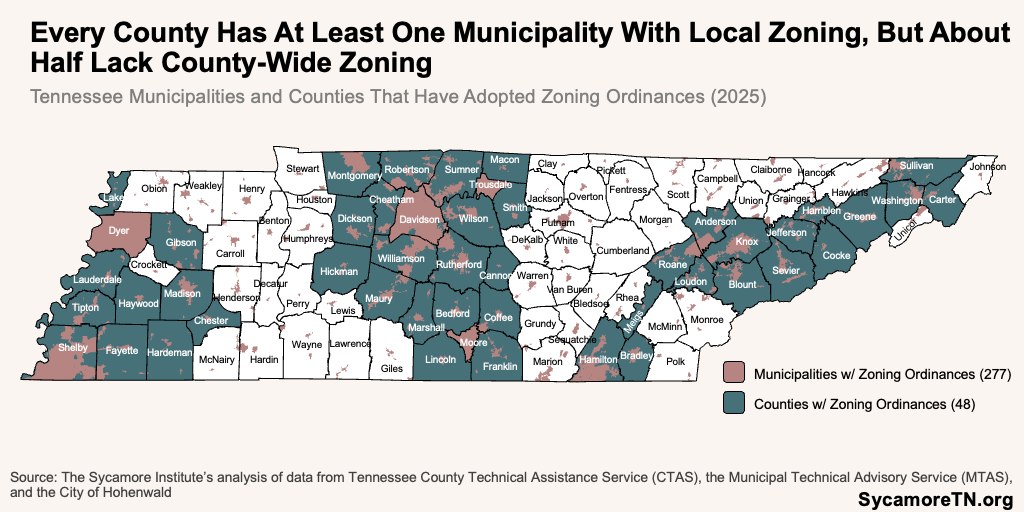
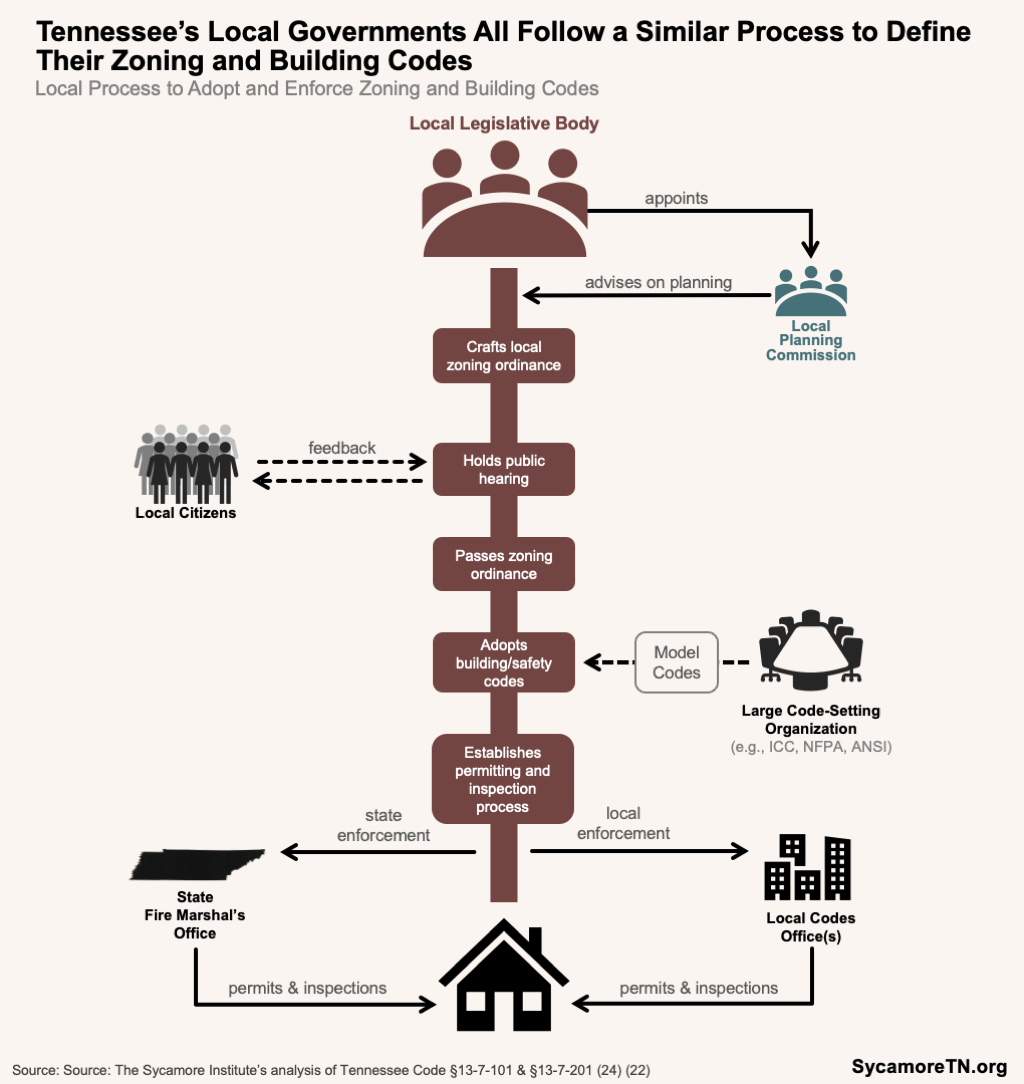
State law gives counties and cities wide latitude to decide if and how to zone, but it also requires any community[1] that adopts zoning to follow a standardized planning process. (15) In practice, cities are more likely than counties to use zoning to balance competing land uses where demand is higher—often in more tailored ways that reflect local priorities. Counties tend to have a more limited role while fulfilling state requirements to coordinate with municipalities around city growth. (16) (17) According to data compiled by the state’s county and municipal technical assistance offices, 48 counties and 276 municipalities—or 51% and 80%, respectively—had adopted zoning ordinances as of 2025 (Figure 1). (18) (19) When local governments do rely on zoning, the framework includes formal planning bodies, zoning ordinances, building codes, and enforcement tools such as permits and inspections (Figure 2).
Figure 1
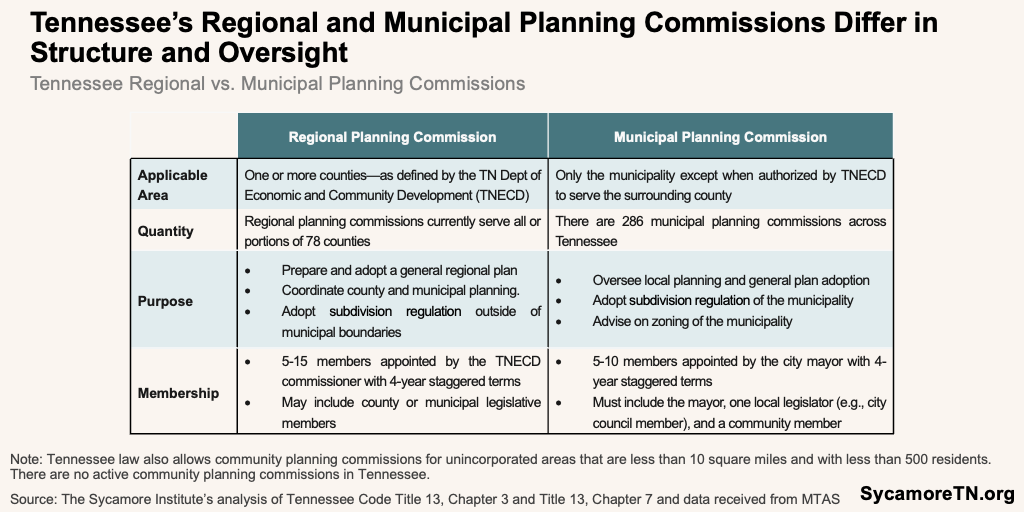
Locally appointed planning commissions review and make recommendations on land use policy. Tennessee has regional and municipal planning commissions which differ in jurisdiction, structure, and membership. (Table 1) (13) (22) These commissions craft plans that often account for future growth and specify different types of land uses. By state law, these plans must include maps, charts, and descriptions of zoning designations and allowable uses. (23) (24)
Table 1
Local legislative bodies adopt and amend zoning ordinances based on planning commission recommendations. Depending on the level of government, either a city council or a county commission uses its local planning commission’s plan to create or change a local zoning ordinance. (25) The planning commission makes recommendations on planning policies, including proposing new ones and revisions to existing ones.
Local governments must allow public input on zoning decisions and hold a public hearing to adopt or amend zoning ordinances after planning commission approval. State law does not require a local referendum, though a governing body may choose to call one. (26) (27) Otherwise, state law only requires the local legislative body to receive public comment on zoning changes before it votes to approve any changes (e.g., allowing a duplex development in a zone otherwise restricted to single-family homes).
Figure 2
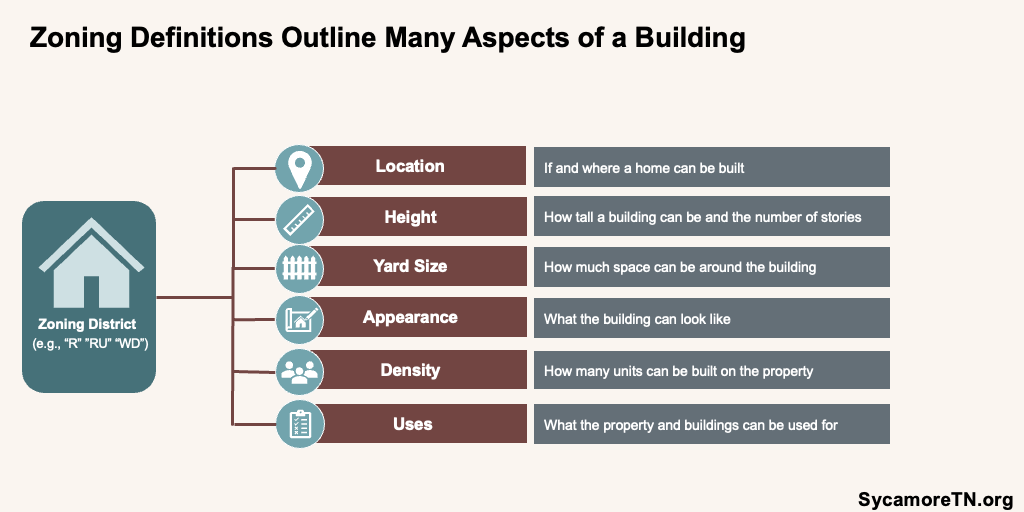
Local governments have flexibility in how they define and designate their zoning districts. For example, there is no standardized syntax for zoning codes, but they generally reflect their identified uses. These designations—however they are named—define and regulate the density, uses, and acceptable structural elements allowed within the zoned area (Figure 3). “R” is widely used for residential uses, but local codes are often more specific. To illustrate how these can be flexibly defined, consider the different ways “R” is used in different cities across the state:
- The Memphis and Shelby County Unified Development Code has seven different “R” designations for single-family homes and five “RU” codes for multi-family.(28)
- The Metro Nashville and Davidson County Code of Ordinances contains over 30 different residential classifications—including “RS” for single-family only, “R” for both single- and two-family, and “RM” for multi-family.(29)
- The Kingsport Code of Ordinances contains 9 different residential zoning districts: “R-1” definitions for single-family homes, “R-2” through “R-5” for multi-family, and special residential districts for golf course communities and urban agriculture estates. (30)
Figure 3
Local zoning ordinances often allow exceptions through special approval processes. Some uses are allowed “by right,” meaning they can proceed without any special approvals if they meet all zoning requirements. (31) “Conditional” or “special uses” are allowed only under certain conditions—e.g., requiring additional review, public hearings, or permits. This tiered approach gives local governments flexibility to accommodate uses that fit the goals of a community but may need closer review to address potential effects.
In Tennessee, local governments are pre-empted from zoning certain types of land and uses. For example, when preexisting farms are annexed by a municipality, they can remain exempt from most zoning and other types of local land use restrictions (e.g., maximum noise requirements) that would disrupt their operations. In addition, Tennessee’s 2025 Farmland Preservation Act provides funding for farmers who choose to place permanent restrictions on their land to prevent future commercial or residential development. (32) To qualify, land must meet a definition developed by the Tennessee Department of Agriculture (TDA), and landowners must apply to TDA and show proof that the land will be used for farming or forestry. (33) (34) State law also limits local zoning power over (35) (36):
- Group homes for individuals with disabilities,
- Non-trailer manufactured homes,
- Telecommunications facilities and towers, and
- Preexisting short-term rental units.
Building Codes in Tennessee
Building codes work alongside zoning to shape how communities are built. While zoning determines where and what type of development can occur, building codes establish how those structures are to be safely constructed. For example, they set minimum standards for design, materials, and construction practices to reduce risks of fire, structural failure, and water damage.
Most Tennessee building codes are based on national or international standards that vary by size, use, and complexity. (37) Organizations such as the International Code Council (ICC) and the National Fire Protection Association (NFPA) develop specialized model codes—for example, specific standards for plumbing, electrical systems, HVAC, fire safety, structural integrity, and site work and for different development types (e.g., factories, large apartment buildings, single-family homes). (37) (38) (39) The Tennessee State Fire Marshal’s Office (SFMO) adopts several of these codes as Tennessee’s statewide minimum building safety standards—establishing baseline requirements for materials and installation. (40) (41) (42)
Figure 4
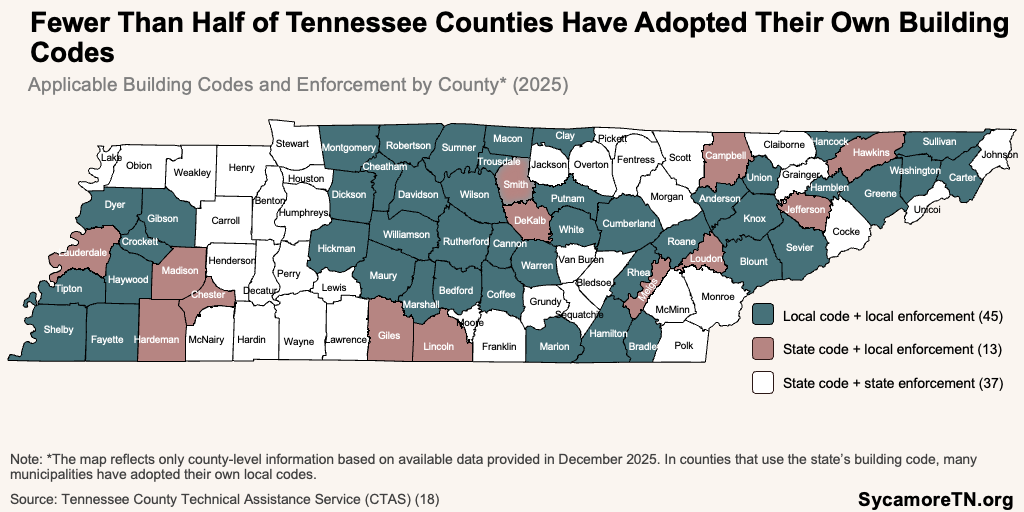
Local governments can adopt and/or enforce a building code that meets or exceeds the state’s minimum standards, or they can rely on the state code and/or SFMO enforcement. (43) At the county-level, 45 Tennessee counties enforce their own building codes, 37 rely on the state’s code and State Fire Marshal’s Office enforcement, and 13 adopt the state’s code and locally enforce it (Figure 4).[2]Most local building codes in Tennessee are adopted versions of the International Residential Code (IRC) for one- and two-family homes and the International Building Code (IBC) for larger buildings.
Some types of housing must meet additional federal requirements. Federal building codes are typically based on model codes but also include other requirements for things like accessibility, energy, and safety. (44) Federally-supported affordable housing developments must meet the building code standards of the U.S. Department of Housing and Urban Development (HUD). (45) Moreover, all manufactured homes must meet HUD building and installation codes—but states can set additional installation standards. (46)
Permits and Inspections in Tennessee
Local governments use permitting and inspection processes to approve construction and verify that it complies with local standards. Permits are only issued and construction can only proceed once local officials confirm that a project meets zoning and building code requirements. Projects must also undergo inspections throughout the building process to certify compliance with applicable building codes. Inspections must be conducted at defined points in the construction process and often require a fee. Additionally, approvals are typically valid only for a limited period during which construction must begin.
If a local government opts out of enforcing building codes itself, builders must comply with the state’s minimum standards and obtain a state building permit through the Tennessee SFMO. The SFMO requires inspections at three key stages—foundation, framing and rough-in for utilities, and a final inspection before the building can be occupied. (47) (40) (41)
Local governments that enforce a building code themselves design their own enforcement processes that can exceed the state’s minimum standards. For example, depending on the scope and size of the project, a builder may need to obtain permits for grading and site preparation, foundations, sewage systems, electrical systems, and fire safety systems.
Certified building inspectors—employed by or contracted with state and local governments—enforce these processes. Inspectors are typically professionals with backgrounds in construction, fire safety, or engineering who are trained to ensure compliance with adopted building and fire codes. Inspectors are certified by the SFMO and—depending on who is responsible for enforcement—have historically been employed directly by a local government or the SFMO. In 2024, Tennessee passed a law that allows contracting with third-party certified building inspectors approved by the SFMO. (48)
Policy Options to Address Housing Supply and Affordability
State and local use of zoning and building codes can have a significant impact on housing supply and affordability. This section summarizes relevant options that Tennessee policymakers concerned about housing costs may want to consider. See the Key Terms text box for additional information about some of the terms used in this section and related policy conversations.
Each of these policy approaches has trade-offs to weigh carefully. For example, any changes that make it easier to increase supply could also set the stage for more demand on local infrastructure or alter the makeup of existing neighborhoods. Changes like these can stir strong emotions, as people often have deep feelings about and resist policy shifts that affect the nature of the places they call home. Policymakers must balance the goals and trade-offs of improving access to housing for Tennesseans based on the distinct needs, values, and priorities of their communities and constituents.
Allowing More Homes on the Same Amount of Land
Exploring approaches beyond single-family zoning could help to increase housing supply at lower price points by using available land more efficiently. Since its inception, residential zoning has largely prioritized single-family housing. This approach constrains the potential supply of housing, which puts upward pressure on the cost of each home that does get built. Examples of approaches that allow for more households to live on a given plot of land include:
- Reducing requirements related to lot size, parking minimums, setbacks, and height.(49) (11)
- Allowing more variety of housing types (e.g., accessory dwelling units, fourplexes etc.) in residential areas—similar to recent changes adopted in Knoxville. (50)(51)
- Preapproving building plans for a greater range of multi-unit housing types (e.g. cottage courts, duplexes, etc.)—like those recently adopted in Memphis and Bristol. (52)(53) (54) (39) (55)
- Adopting form-based zoning or performance-based zoning instead of traditional use-based zoning, which can offer flexibility while still reflecting community preferences.(3) (2) For example, Nashville and Chattanooga have applied form-based practices to control the development of their downtown regions while maintaining historical character. (56) (57)
Adjusting Building Codes for Small, Multi-Unit Housing
Revisiting building codes could help to increase housing supply by lowering costs for some “Missing Middle” housing types. For example, one- and two-family residential buildings are subject to IRC standards, while anything larger is subject to more stringent IBC standards. As a result, medium-density developments (e.g., fourplexes) must meet the same costlier requirements as large multi-family apartment buildings. (58) (59) A 2024 state law enabled local governments to exempt multi-unit buildings that are six stories or less from the IBC’s two-staircase requirement. (60) (43) Identifying similar opportunities to exempt smaller, multi-unit structures from requirements whose costs may outweigh the intended benefits could make them more financially feasible to build. A few examples include fire safety standards (e.g., smoke detector or sprinkler system requirements), building height limits, and utility meter sizes. (58)
Simplifying Local Building Requirements and Approvals
Refining some local requirements could help lower costs and ease development by simplifying the building and approval processes. Because communities have flexibility to tailor their local approaches, zoning and building requirements can be vague and vary widely across the state—sometimes even a few miles apart. Meanwhile, siloed planning, code enforcement, and permitting offices may have overlapping or even contradictory rules and schedules, creating a confusing and costlier environment for developers to navigate. (61) (4) (62)
Local governments could address these challenges by clarifying expectations, streamlining processes, limiting special boards and commissions, and offering pre-approved building plans. (13) Together, these types of refinements can increase predictability for developers by making rules clear, shortening timelines, reducing development costs, and protecting property values. (63) (64)
More State Support for Predictable Local Planning & Regulation
Incentivizing or equipping local governments to adopt clear zoning, building codes, and enforcement processes could also reduce barriers to housing development. The state could find ways to support locals in refining and simplifying their building and approval requirements and processes. For example:
- Technical Support for Local Planning — Zoning is an optional function of local governments and may be difficult for those with limited capacity and funding. (24) (65) While larger communities often employ their own planners, smaller counties and towns must rely on outside resources such as contracting with regional development districts (i.e., multi-county economic and planning support organizations). In 2025, Tennessee created a new local planning technical assistance office within the University of Tennessee’s Institute for Public Service with a $1.5 million recurring investment. (66) The state could explore other ways to provided additional support for locals by increasing planning support staff or incentivizing local governments to hire more planners.
- Statewide Guidance for Local Requirements — More specific statewide expectations and guidance for local governments—like mandating or outlining clear and detailed language for regulation and enforcement or limiting special boards and commissions—could streamline processes and promote speed and transparency. (67) (68)(69) (70) (71) (72) (4) (53)
Involving the Community Earlier
Refining approval procedures and increasing transparency could help reduce conflict and clarify public expectations around new development. For example, focusing public engagement on earlier planning stages allows all stakeholders to address concerns and contribute to a shared vision for future development. (73) By creating clear, objective policies—such as by-right standards in place of discretionary approvals—and clearly articulating public benefits, these tools can set expectations, strengthen trust and transparency, and reduce fear of change. They also curb the use of case‑by‑case exceptions, a hallmark of traditional zoning that often fuels opposition at the neighborhood level. (74) (70) (4) (75)
Parting Words
Zoning, building codes, permitting, and inspection requirements are tools intended to help communities guide development and advance shared goals. When designed and implemented thoughtfully, these policies can also support greater supply and affordability of housing for Tennessee residents. However, these decisions always involve trade-offs—requiring careful consideration of how to balance affordability, safety, local control, and community priorities.
Key Terms
Accessory Dwelling Unit (ADU): A secondary, smaller housing unit on the same lot as a primary home (e.g., in a garage, basement, or as a detached structure).
Adaptive Reuse: Converting underutilized buildings, especially commercial ones, to residential use.
By-Right Development: Projects that meet all existing zoning and building code requirements get automatic approval without the need for lengthy discretionary review.
Discretionary Review: A process where a review body (like the legislature) has the power to approve or deny a project even when it follows all requirements.
Downzoning: Rezoning an area to reduce the potential density and/or types of allowable uses.
Euclidean or Use-Based Zoning: A traditional approach to zoning that separates land into districts based on land use, such as residential, commercial, or industrial.
Form-Based Zoning: Zoning that regulates the physical form of buildings and their relationship to the street rather than their use. For example, it can encourage mixed-use neighborhoods with both housing and business.
Greenfield Development: Building new housing or development in previously undeveloped areas, such as farmlands, forests, or open spaces.
Infill Development: Building new housing or development in already developed areas.
Minimum Lot Size: Rules that define the smallest allowable parcel of land on which a home or other structure may be built (e.g. 1 acre or 6,000 square feet).
Missing Middle Housing: Housing types that help fill a common gap between single-family homes and large apartment buildings, such as duplexes, triplexes, townhomes, and courtyard apartments.
NIMBY: An acronym for “not in my backyard,” often used to describe people who oppose adding more housing development in their communities.
Parking Minimums: Requirements that a building include a minimum number of off-street parking spots per housing unit.
Performance-Based Zoning: Zoning that sets measurable outcomes (e.g., noise, traffic, environmental impacts) instead of prescribing specific uses or forms.
Setback:The minimum distance from a building to nearby property lines, streets, or other structures.
Single-Family Zoning: A zoning approach that limits land to one detached housing unit per lot, prohibiting duplexes, apartments, or other multi-unit housing types.
Subdivision Powers: The authority of a local government to regulate the division of land into smaller lots, including setting requirements for streets, utilities, lot sizes, and other infrastructure before development can occur.
Transit-Oriented Development (TOD): Planning around public transit hubs to increase density, walkability, and mixed-use (housing + commercial) development.
Time-Certain Review: A requirement that permits be approved or denied within a set timeframe.
Upzoning: Rezoning an area to increase the potential density and/or types of allowable uses.
YIMBY: An acronym for “yes in my backyard,” often used to describe people who support adding more housing development in their communities.
[1] Unless otherwise specified, the use of the term “local governments” or “communities” refers to both counties and municipalities.
[2] Statewide data on municipal building codes was not readily available at the time of publication.
References
Click to Open/Close
References
- Weinstock, Lida. U.S. Housing Supply: Recent Trends and Policy Considerations . [Online] Congressional Research Service, July 7, 2023. https://www.congress.gov/crs-product/R47617.
- Watsky, Rachel. The Problems With Euclidean Zoning. [Online] Boston University School of Law, July 19, 2018. https://sites.bu.edu/dome/2018/07/19/the-problems-with-euclidean-zoning/.
- Furth, Salim, Hamilton, Emily and Gardner, Charles. Housing Reform in the States: A Menu of Options for 2026. Mercatus Center – George Mason Univeristy. [Online] September 9, 2025. https://www.mercatus.org/research/policy-briefs/housing-reform-states-menu-options-2026#_ednref7.
- Gardner, Charles and Dean, George. How to Streamline Housing Permitting in Tennessee. [Online] October 31, 2024. https://www.mercatus.org/research/policy-briefs/how-streamline-housing-permitting-tennessee#:~:text=Download%20the%20Policy%20Brief%20PDF,understood%2C%20and%20subject%20to%20delays..
- Tennessee Advisory Commission on Intergovernmental Relations. Reducing the Burden: Increasing Housing Supply to Lower Housing Costs. [Online] May 2024. https://www.tn.gov/content/dam/tn/tacir/2024publications/2024_HousingAffordability.pdf.
- Mojica, Christina. Dividing Lines: Understanding the tradeoffs in modern zoning and its impact on communities. [Online] The Reason Foundation, November 21, 2024. http://reason.org/commentary/dividing-lines-understanding-the-tradeoffs-in-modern-zoning-and-its-impact-on-communities/.
- Schuetz, Jenny. Is zoning a useful tool or a regulatory barrier? [Online] The Brookings Institute, October 31, 2019. https://www.brookings.edu/articles/is-zoning-a-useful-tool-or-a-regulatory-barrier/.
- Tennessee Advisory Commission on Intergovernmental Relations. Land Use Legislation. [Online] February 6, 2013. https://www.tn.gov/content/dam/tn/tacir/commission-meetings/2013-february/Tab%208_LandUse.pdf.
- Scott, Mel. American City Planning Since 1890: A History Commemorating the 50th Anniversary of the American Institute of Planners. [Online] 1969. https://www.ucpress.edu/books/american-city-planning/epub-pdf.
- Stuart Meck, AICP. Model Planning and Zoning Enabling Legislation: A Short History. [Online] March 1996. https://planning-org-uploaded-media.s3.amazonaws.com/legacy_resources/growingsmart/pdf/PAS462.pdf.
- Preis, Benjamin and Desmond, Emily. Land Use, Permitting, & Building Code Reform: A Path Forward. [Online] National Housing Crisis Task Force – Accelerator for America & Nowak Metro Finance Lab, March 4, 2025. https://nationalhousingcrisis.org/app/uploads/2025/06/Land-Use-and-Building-Code-Reform.pdf.
- U.S. Supreme Court. Village of Euclid v. Ambler Realty Co. . [Online] November 22, 1926. https://supreme.justia.com/cases/federal/us/272/365/#annotation.
- Municipal Technical Advisory Service. Zoning. [Online] 08 29, 2024. https://www.mtas.tennessee.edu/reference/zoning.
- Listokin, David and Hattis, David. Building Codes and Housing. Vol. 8, No. 1, Regulatory Barriers to Affordable Housing. [Online] Cityscape Journal , 2005. https://www.jstor.org/stable/20868571?read-now=1&seq=4#page_scan_tab_contents.
- Tennessee Code. § 13-7-201. [Online] 2024. https://law.justia.com/codes/tennessee/title-13/chapter-7/part-2/section-13-7-201/.
- Tennessee Advisory Commission on Intergovernmental Relations. Public Chapter 1101 of 1998 Guidebook Update—Information Presentation. [Online] December 13, 2017. https://www.tn.gov/content/dam/tn/tacir/documents/2017_UpdatedGrowthPolicyGuidebook.pdf.
- Tennessee Code. §6-58-101. [Online] 2024. https://law.justia.com/codes/tennessee/title-6/municipal-government-generally/chapter-58/section-6-58-101/.
- County Technical Assistance Service. Data Recieved from CTAS Staff on December, 2025. [Online] 2025. [Cited: December 17, 2025.]
- Municipal Technical Advisory Service. Data Recieved from MTAS Staff on December, 2025. [Online] [Cited: December 18, 2025.]
- City of Hohenwald. City of Hohenwald Zoning Ordinance. [Online] July 20, 1998. https://www.hohenwald.com/pdfs/zoning.pdf.
- Municipal Technical Advisory Service. Zoning. [Online] August 29, 2024. https://www.mtas.tennessee.edu/reference/zoning.
- Tennessee Code. § 13-4-101. [Online] 2024. https://law.justia.com/codes/tennessee/title-13/chapter-4/part-1/section-13-4-101/.
- —. § 13-4-201. [Online] 2024. https://law.justia.com/codes/tennessee/title-13/chapter-4/part-2/section-13-4-201/.
- —. § 13-7-101. [Online] 2024. https://law.justia.com/codes/tennessee/title-13/chapter-7/part-1/section-13-7-101/.
- —. § 13-7-202. [Online] 2024. https://law.justia.com/codes/tennessee/title-13/chapter-7/part-2/section-13-7-202/.
- —. § 13-7-203. [Online] 2024. https://law.justia.com/codes/tennessee/title-13/chapter-7/part-2/section-13-7-203/.
- Tennessee Advisory Commission on Intergovernmental Relations. The Zoning Process and Consent to Rezone Private Property. [Online] October 2015. https://www.tn.gov/content/dam/tn/tacir/commission-meetings/2015-october/2015OctoberTab4Zoning.pdf.
- Land Use Control Board, Shelby County Board of Commissioners and The Memphis City Council. The Memphis and Shelby County Unified Development Code. [Online] August 20, 2024. https://shelbycountytn.gov/DocumentCenter/View/40803/Unified-Development-Code-ZTA-24-2?bidId=.
- Metro Government of Nashville and Davidson County. Code of Ordinances – Title 17 “Zoning”. [Online] September 10, 2025. https://library.municode.com/tn/metro_government_of_nashville_and_davidson_county/codes/code_of_ordinances?nodeId=CD_TIT17ZO_CH17.08ZODILAUS.
- City of Kingsport. Code of Ordinances. [Online] December 18, 2025. https://library.municode.com/tn/kingsport/codes/code_of_ordinances?nodeId=PTIICOOR_CH114ZO_ARTIIIDI_DIV2ES_S114-175SAESAR.
- Municipal Technical Advisory Service. Adoption of Local Ordinances. [Online] Spetember 28, 2023. https://www.mtas.tennessee.edu/reference/adoption-local-ordinances.
- Tennessee. Public Chapter 470 of the 114th Tennessee General Assembly. [Online] May 15, 2025. https://publications.tnsosfiles.com/acts/114/pub/pc0470.pdf.
- Tennessee Code. §43-1-110 . [Online] 2025. https://advance.lexis.com/documentpage/?nodeid=ABRAABAABAAI&nodepath=%2FROOT%2FABR%2FABRAAB%2FABRAABAAB%2FABRAABAABAAI&level=4&haschildren=&populated=false&title=43-1-110.+Farmland+preservation+fund.&config=025054JABlOTJjNmIyNi0wYjI0LTRjZGEtYWE5ZC0zNGFhOW.
- Tennessee Department of Agriculture. Notice of Rulemaking Hearing. [Online] December 19, 2025. https://publications.tnsosfiles.com/rules_filings/12-32-25.pdf.
- Tennessee Code. § 13-7-601. [Online] May 17, 2018. https://law.justia.com/codes/tennessee/title-13/chapter-7/part-6/section-13-7-601/.
- Municipal Technical Advisory Service. Limits on Zoning Authority. [Online] September 28, 2023. https://www.mtas.tennessee.edu/reference/limits-zoning-authority.
- International Code Council. About the Code Council. [Online] 2025. https://www.iccsafe.org/wp-content/uploads/23-22477_CORP_Overview_BRO_.pdf.
- National Fire Protection Association. History of the National Fire Protection Association . [Online] November 6, 2024. https://www.nfpa.org/news-blogs-and-articles/blogs/2024/11/06/history-of-nfpa.
- Insurance Institute for Business and Home Safety. The Benefits of Statewide Building Codes. [Online] January 2019. https://ibhs.org/wp-content/uploads/2019/01/The-Benefits-of-Statewide-Building-Codes_IBHS.pdf.
- Tennessee Department of Commerce and Insurance. Codes Enforcement. [Online] April 12, 2021. https://www.tn.gov/commerce/fire/codes-enforcement.html.
- —. Tennessee State Fire Marshal’s Office Currently Adopted Codes. [Online] April 17, 2025. https://www.tn.gov/commerce/fire/codes-enforcement/history.html.
- Municipal Technical Advisory Service. Statewide Building Standards. [Online] September 22, 2025. https://www.mtas.tennessee.edu/reference/statewide-building-standards.
- Tennessee Code. § 68-120-101. [Online] 2024. https://law.justia.com/codes/tennessee/title-68/safety/chapter-120/part-1/section-68-120-101/.
- Library of Congress. Building Codes, Standards, and Regulations: Frequently Asked Questions. [Online] April 23, 2025. https://www.congress.gov/crs-product/R47665#_Ref196309463.
- U.S. Department of Housing and Urban Development. Minimum Property Standards. [Online] 2025. https://www.hud.gov/hud-partners/minimum-property-standards.
- The Federal Register. Manufactured Home Construction and Safety Standards. [Online] September 16, 2024. https://www.federalregister.gov/documents/2024/09/16/2024-20545/manufactured-home-construction-and-safety-standards.
- Tennessee Department of Commerce and Insurance. Residential Permit FAQs. [Online] 2025. https://www.tn.gov/commerce/fire/residential-permits/fire-residential-faqs.html.
- Tennessee. Public Chapter 771 of the 113th Tennessee General Assembly. [Online] April 23, 2024. https://publications.tnsosfiles.com/acts/113/pub/pc0771.pdf.
- Matuga, Michelle. The Effects of Minimum-Lot-Size Reform on Houston Land Values. [Online] The Department of Housing and Urban Development, Cityscape, 2024. https://www.huduser.gov/portal/periodicals/cityscape/vol26num3/article9.html.
- City of Knoxville. Housing Strategy Update. [Online] February 2024. https://cdnsm5-hosted.civiclive.com/UserFiles/Servers/Server_109478/File/CommunityDevelopment/Housing-Strategy-Document-021524.pdf.
- Knoxville-Knox County Planning. Middle Housing. https://knoxplanning.org/zoning/middle-housing. [Online]
- California Building Officials. Pre-Approved ADU Plans. [Online] 2025. https://www.calbo.org/post/pre-approved-adu-plans.
- Erfurt, Edward and Beckworth, Lindsey. Say Yes to New Housing—Before Anyone Even Asks To Build It. Strong Towns. [Online] October 27, 2023. https://www.strongtowns.org/journal/2023/10/27/pre-approved-building-plans.
- Strong Towns. Memphis Leads the Way with Preapproved Plans for Housing. [Online] April 1, 2025. https://www.strongtowns.org/journal/2025/4/1/memphis-leads-the-way-with-preapproved-plans-for-housing-ac.
- City of Bristol. Residential Building Plans. [Online] 2025. https://www.bristoltn.gov/DocumentCenter/View/9218/HomebuildersForum-Residential-Building-Plans.
- City of Chattanooga. Form-Based Zoning. [Online] 2025. [Cited: December 8, 2025.] https://chattanooga.gov/stay-informed/zoning-maps/form-based-zoning.
- Nashville and Davidson County. Downtown Code (DTC). [Online] 2025. https://www.nashville.gov/departments/planning/long-range-planning/community-plans/downtown/downtown-code-dtc.
- Zeanah, John. Beyond Zoning: Hidden Code Barriers to Middle-Scale Housing. [Online] Center for Building in North America, September 2025. https://www.centerforbuilding.org/publication/beyond-zoninghidden-code-barriers-to-middle-scale-housing.
- Hamilton, Emily. Reforming US Building Codes. [Online] 2025. https://www.cato.org/regulation/winter-2024-2025/reforming-us-building-codes.
- Horowitz, Alex. Small Single-Stairway Apartment Buildings Have Strong Safety Record. Pew. [Online] February 27, 2025. https://www.pewtrusts.org/en/research-and-analysis/reports/2025/02/small-single-stairway-apartment-buildings-have-strong-safety-record.
- Regulatory Transparency Project. The Land Use Labyrinth: Problems of Land Use Regulation and the Permitting Process. [Online] January 8, 2020. https://rtp.fedsoc.org/paper/the-land-use-labyrinth-problems-of-land-use-regulation-and-the-permitting-process/#:~:text=These%20barriers%20create%20a%20chilling,required%20and%20from%20which%20departments?.
- Himebaugh, Daniel. Tie Goes to the Landowner: Ambiguous Zoning Ordinances and the Strict Construction Rule. [Online] American Bar Association, The Urban Lawyer, 2011. https://www.jstor.org/stable/41638051?read-now=1&seq=1#page_scan_tab_contents.
- Freemark, Yonah, et al. Moving Toward Transit-Oriented Development in Nashville: Opportunities for Transit-Adjacent Housing in a Changing Nashville . Urban Institute. [Online] April 2025. https://www.urban.org/sites/default/files/2025-04/Moving_Toward_Transit-Oriented_Development_in_Nashville.pdf.
- Municipal Technical Advisory Service. Next Steps for Vested Property Rights. [Online] University of Tennessee, Institute for Public Service, March 28, 2025. https://www.mtas.tennessee.edu/reference/next-steps-vested-property-rights.
- Tennessee Department of Economic and Community Development Local Planning Assistance Office. Tennessee Planning Commissioner Handbook. [Online] January 2003. https://www.mtas.tennessee.edu/system/files/mrln/books/main/Scan_TennesseePlanningCommissionerHandbook_CD_Nov282022.pdf.
- University of Tennessee Institute for Public Service. State Funds Local Planning Agency at UT Institute for Public Service. [Online] May 15, 2025. https://www.ips.tennessee.edu/article/state-funds-local-planning-agency-ut-institute-public-service.
- Tennessee General Assembly. HB0396/SB0244. [Online] January 22, 2025. https://wapp.capitol.tn.gov/apps/BillInfo/Default.aspx?BillNumber=HB0396&GA=114.
- —. HB0652/SB0785. [Online] February 3, 2025. https://wapp.capitol.tn.gov/apps/BillInfo/Default.aspx?BillNumber=HB0652.
- —. HB1306/SB1271. [Online] February 6, 2025. https://wapp.capitol.tn.gov/apps/BillInfo/Default.aspx?BillNumber=HB1306.
- Lemar, Anika. The public hearing process for new housing is broken. Here’s how to fix it. [Online] The Brookings Institute, May 4, 2022. https://www.brookings.edu/articles/the-public-hearing-process-for-new-housing-is-broken-heres-how-to-fix-it/.
- —. Overparticipation: Designing Effective Land Use Public Processes. [Online] Fordham Law Review, 2021. https://ir.lawnet.fordham.edu/flr/vol90/iss3/2/.
- MacDonald, Graham. The Effect of Local Government Policies on Housing Supply. [Online] UC Berkeley, Terner Center for Housing Innovation, May 2016. https://ternercenter.berkeley.edu/wp-content/uploads/pdfs/The_Effect_of_Local_Government_Policies_on_Housing_Supply.pdf.
- Monkkonen, Paavo. Understanding and Challenging Opposition to Housing Construction in California’s Urban Areas. [Online] December 1, 2016. https://papers.ssrn.com/sol3/papers.cfm?abstract_id=3459823.
- Manuel, Tiffany and Kendall-Taylor, Nat. “You Don’t Have to Live Here”: Why Housing Messages are Backfiring and 10 Things We Can Do About It. [Online] October 2016. https://www.frameworksinstitute.org/app/uploads/2020/06/You_Dont_Have_to_Live_Here.pdf.
- Susano, Judge Charles D. The Westchester Company, LLC v. Metropolitan Government of Nashville and Davidson County, Tennessee. [Online] https://www.tncourts.gov/courts/court-appeals/opinions/2005/12/20/westchester-company-llc-v-metropolitan-government-nashville.