
Key Takeaways
- Compared to the FY 2026 enacted budget, Gov. Lee’s budget proposes a total of $2.9 billion in new spending and deposits in FYs 2026 and 2027—funded mainly by a large FY 2025 surplus, previously unallocated recurring revenues, and new FY 2027 revenue growth.
- Spending in the governor’s FY 2027 recommendation from all revenue sources is 10% (or $6.1 billion) lower than FY 2026 estimates. Spending from state revenues is 0.4% (or $125 million) lower.
- The largest recurring increases are related to TennCare, school funding formula growth, a doubling of Education Freedom Scholarships, and state personnel-related costs.
- Gov. Lee’s recommendation continues the recent practice of using the General Fund to subsidize transportation-related activities that were historically funded by dedicated user fee-like revenues.
- The Budget expects growth in total state tax collections that is more typical of the state’s experience before the ups and downs that came with the pandemic and recent tax cuts.
- The recommendation reflects a growing reliance on the state sales tax as the result of strong sales tax growth and cuts to other taxes.
- The state’s main rainy day reserve would total $2.2 billion in FY 2027 and cover about 31 days of General Fund operations—about 6 days more than before the Great Recession.
On February 2, 2026, Tennessee Governor Bill Lee released his $57.9 billion recommendation for the FY 2027 state budget along with recommended changes for FY 2026. Budgets reflect policymakers’ goals, the public goods and services intended to help meet those goals, and a detailed plan to finance them. This is Gov. Lee’s final budget recommendation before he is set to leave office in January 2027. It is now the legislature’s job to consider and act on this recommendation.
Figure 1
General Fund Overview
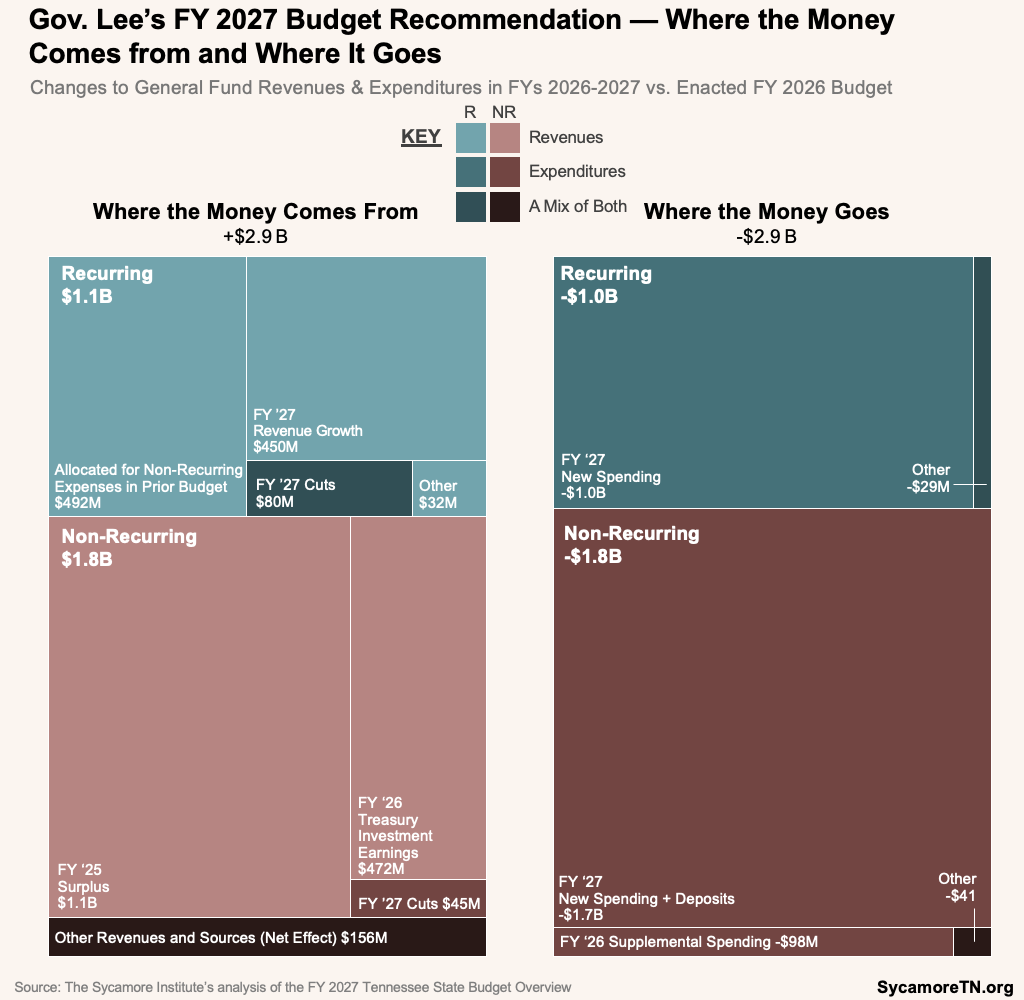
Compared to the FY 2026 enacted budget, Gov. Lee’s budget proposes a total of $2.9 billion in new spending and deposits in FYs 2026 and 2027—funded mainly by a large FY 2025 surplus, previously unallocated recurring revenues, and new FY 2027 revenue growth. This report discusses many of the spending items throughout. The budget is balanced with (Figure 1):
- $1.1 billion from the FY 2025 end-of-year surplus.
- $492 million in recurring money used for non-recurring purposes in FY 2026 (discussed below).
- $472 million from earnings on the treasurer’s investment of state funds.
- $450 million in new FY 2027 tax growth (discussed later).
- $124 million from proposed spending reductions—including $80 million recurring and $45 million non-recurring.
- $189 million in other revenues and balances—including $32 million recurring and $156 million non-recurring.
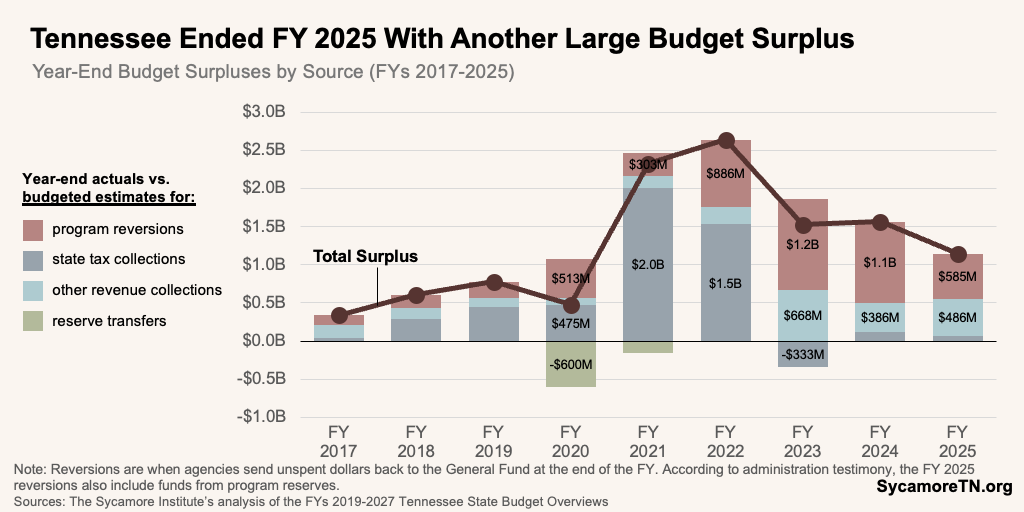
The state ended FY 2025 with another large $1.1 billion surplus—largely from unspent program “reversions” (Figure 2). State agencies reverted about $860 million in unspent money and program reserves to the General Fund—or $585 million more than expected. The surplus also includes $72 million in FY 2025 General Fund overcollections (i.e., actual tax collections above those expected) and $486 million in other higher-than-expected revenues (e.g., earnings from the treasurer’s investment of state funds).
Figure 2
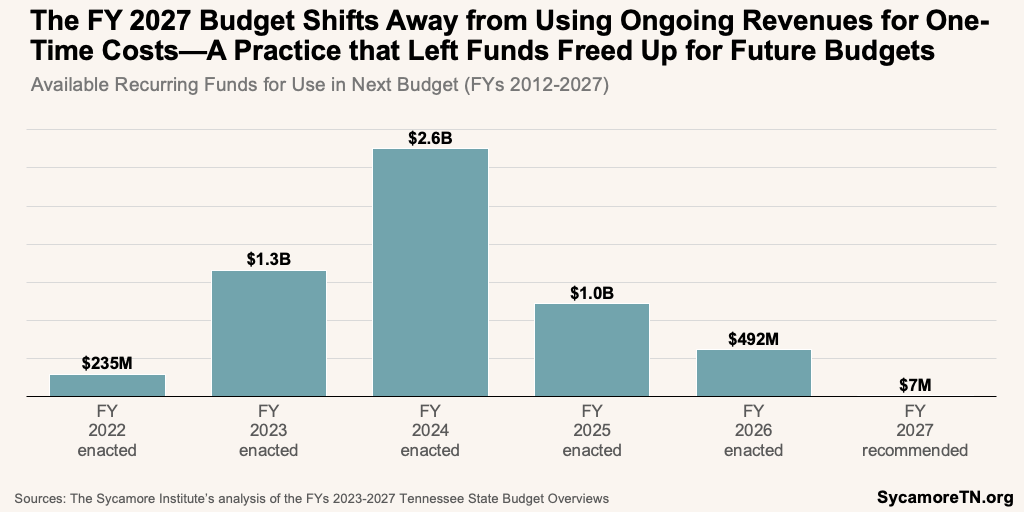
In addition to the surplus, the FY 2027 Budget also draws on $492 million in recurring revenue that the prior budget allocated for non-recurring purposes—a recent practice this budget ends. The last several budgets used new recurring revenues for one-time purposes for fear that revenue collections could slow or decline (Figure 3). By not tying these dollars up for long-term commitments, they remain unallocated for future years. The recommendation winds this practice down—leaving only $7 million in recurring funds unallocated.
Figure 3
Changes to the FY 2026 Budget
The Budget reflects $98 million in supplemental spending in FY 2026, the current fiscal year (Figure 4). The governor makes supplemental requests each year because actual revenue and spending needs often differ from original estimates. This year’s number includes:
- $53 million to cover increased service costs associated with children in the Department of Children’s Services’ custody.
- $11 million in bonus payments for school districts in which 50% or more schools received an A in the state’s school rating system.
- $11 million to supplement a new K-12 school construction grant program (discussed more in the K-12 Education section later in this report).
- $8 million to partially replace forgone federal funding for Summer EBT—a federal program that provides $120 to the families of eligible children to help cover grocery costs during the summer. Tennessee is one of 11 states who do not currently plan to participate this year. (2) Tennessee last participated in the program in 2024, when over $68 million was distributed to at least 569,175 children. (3)
Figure 4
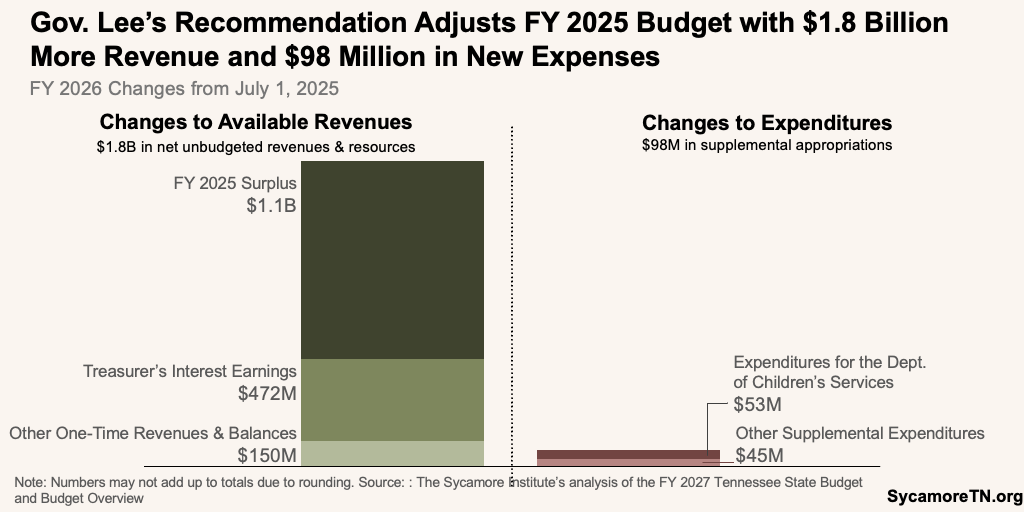
The Budget also anticipates an additional $1.8 billion in available funds for FY 2026 beyond what was initially planned (Figure 4). This includes the net effect of the FY 2025 surplus discussed above and $622 million in previously unbudgeted revenues. The largest sources of unbudgeted revenues are the treasurer’s earnings.
The Budget does not include a mid-year revision of the current year’s tax projection. Five months into the fiscal year, actual collections are tracking slightly better than projections. General Fund collections were about $92 million (or 1%) above estimates for the fiscal year through December. (5)
Figure 5
The FY 2027 Recommended Budget
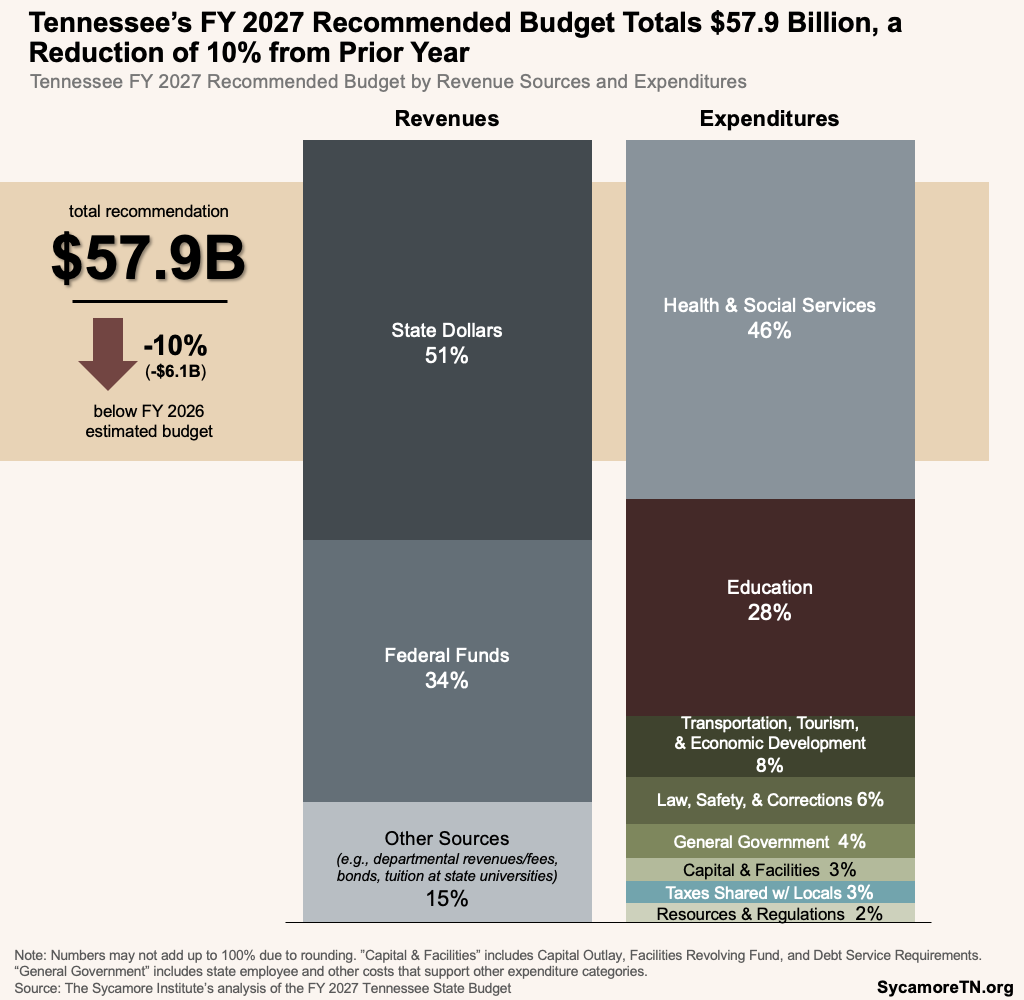
The FY 2027 recommended budget totals $57.9 billion from all revenue sources, a decrease of 9.6% (or $6.2 billion) below estimates for the current year. The funding mix is 51% state dollars, 34% federal, and 15% from tuition, bonds, and other sources. Health and Social Services (46%) and Education (28%) account for nearly three-quarters of total expenditures (Figure 5).
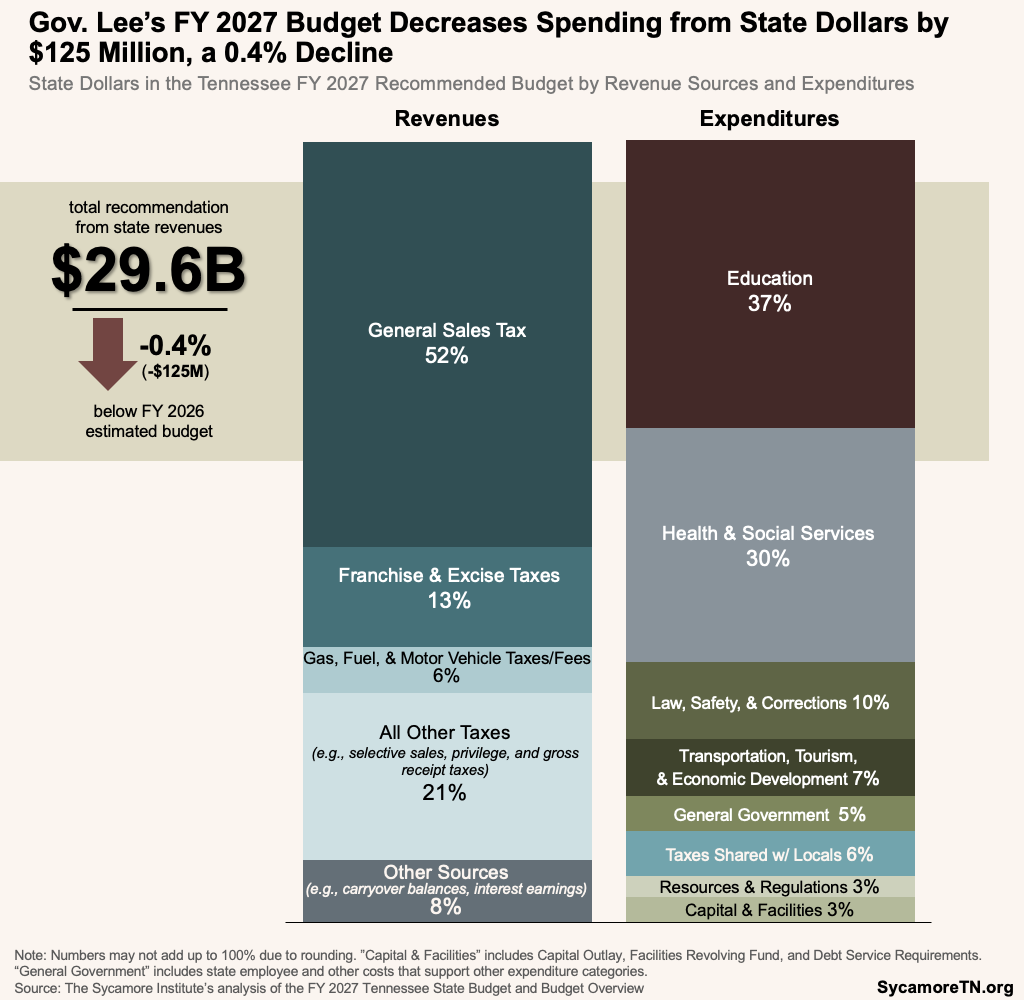
State dollars in the recommended budget total $29.6 billion, a decrease of 0.4% (or $125 million) from the current year. Most of the state dollars in the FY 2027 budget come from taxes—the largest of which are sales and business taxes (Figure 6). Education (37%) and Health and Social Services (30%) account for almost two-thirds of expenditures from state appropriations.
Figure 6
The General Fund in Context
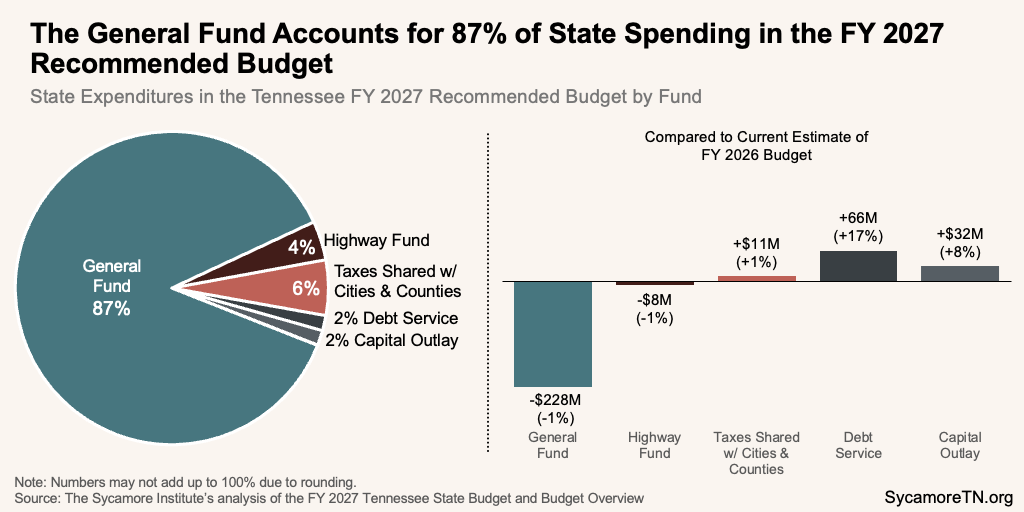
The administration’s recommended budget often focuses on state dollars in the General Fund, which would account for 87% of all state spending in FY 2027 (Figure 7). That number does not include state appropriations for Capital Outlay and the Facilities Revolving Fund, which some calculations include with the General Fund because General Fund revenue partly pays into those funds.
Figure 7
Recommended Increases and One-Time Spending and Allocations
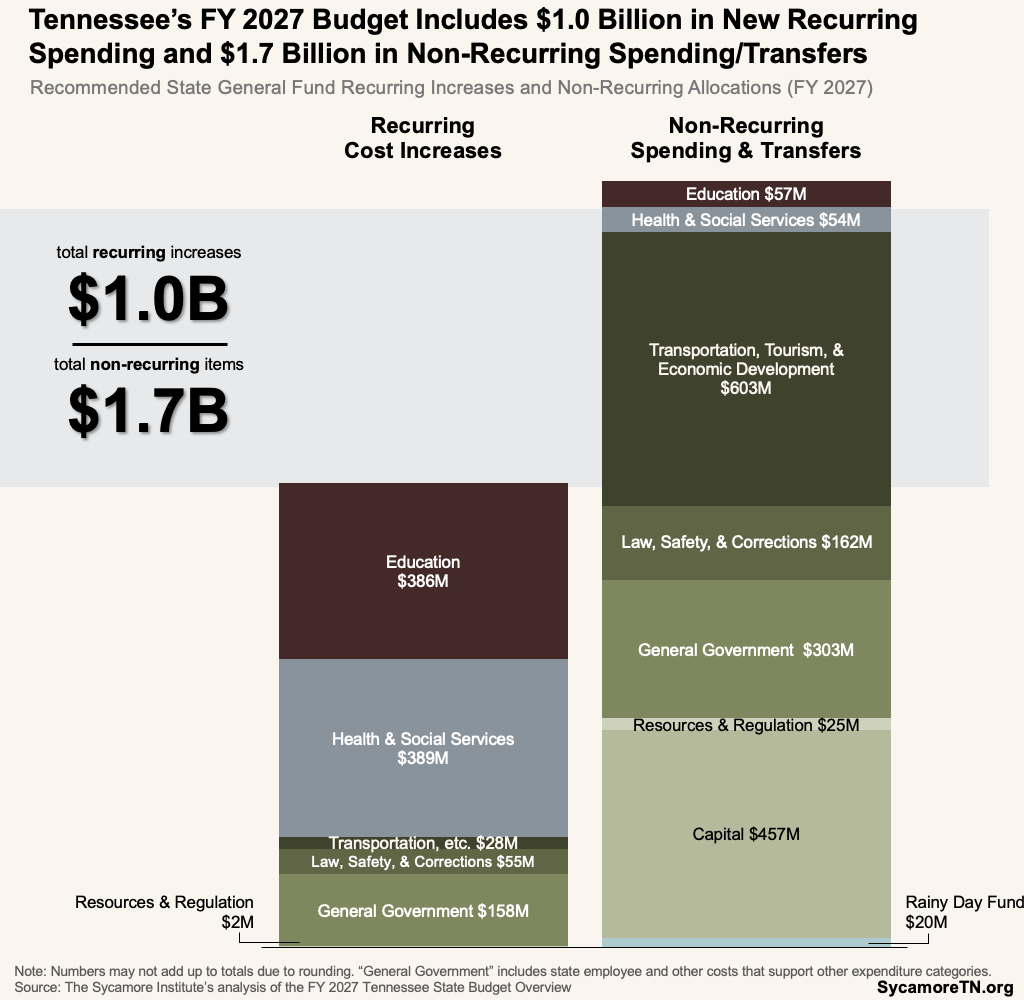
The Budget recommends $1.0 billion in new recurring General Fund spending and $1.7 billion in non-recurring spending and transfers in FY 2027 (Figure 8). Recurring spending is expected to occur every year and is added to the budget’s base, while non-recurring expenditures are one-time. The largest increases are highlighted below.
The Budget’s Largest Recurring Increases
- $215 million to fund inflationary cost increases, a routine change in the federal match rate, and other activities related to TennCare, the state’s Medicaid program.
- $179 million for public K-12 education, which includes funding for teacher pay increases, growth in the state’s school funding formula, and other public school initiatives.
- $155 million to double the number of available Education Freedom Scholarships to 40,000 for the 2026-2027 school year.
- $143 million for personnel-related costs for state employee salary and health insurance increases (excluding teacher pay increases).
The Budget’s Largest Non-Recurring Allocations
- $457 million for capital projects and maintenance.
- $456 million in General Fund transfers for transportation-related activities.
- $190 million for technology- and system-related upgrades throughout state government.
- $91 million for activities and projects related to public safety.
Figure 8
Highlights and Initiatives
This section includes additional summaries and context for initiatives affecting the FY 2027 recommended budget. Unless otherwise noted, the recurring and one-time spending plans discussed in the previous sections include the costs discussed below.
K-12 Education
The Budget includes $7.9 billion for K-12 education—including $7.1 billion for the Tennessee Investment in Student Achievement (TISA), the state’s public school funding formula. A $170 million recurring increase for TISA accounts for enrollment growth, teacher pay raises, and a 3.2% increase to the formula’s base per pupil amount—from $7,295 in FY 2026 to $7,530 in FY 2027 (Figure 9).[1] Although the TISA statute does not include automatic inflationary increases, the recommended increase is in line with prior years’, and growth in the formula’s state dollars overtook inflation in FY 2024 with the addition of $750 million to implement TISA (Figure 9). The actual state funding a district receives per student depends on the types of students it serves and its local fiscal capacity.
Within the proposed TISA increase is $87.5 million in state funding for teacher salary increases. Local school districts will be required to contribute $37.5 million for a total state and local increase of $125 million. (6) Lawmakers have routinely enacted dedicated recurring increases for teacher pay since FY 2016. Despite these efforts, Tennessee teachers’ average pay growth has not kept up with inflation. After adjusting for inflation, teachers’ average pay during the 2023-2024 school year was still about 8% lower than in 2014-2015 (Figure 10). For context, teacher pay in Tennessee’s surrounding states also failed to keep up with inflation, while median earnings for Tennessee workers with bachelor’s degrees saw 3% real growth. (7) (8) (42)
Figure 9
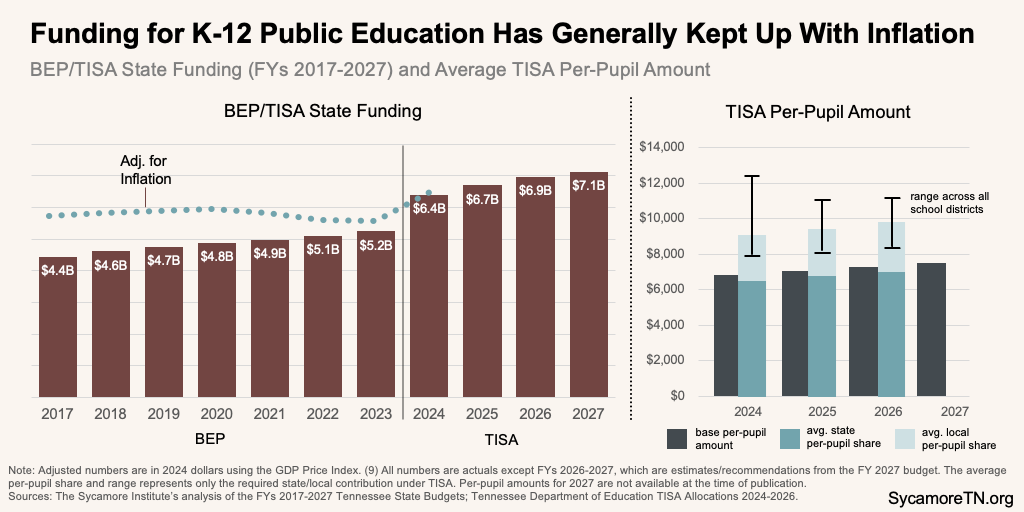
Figure 10
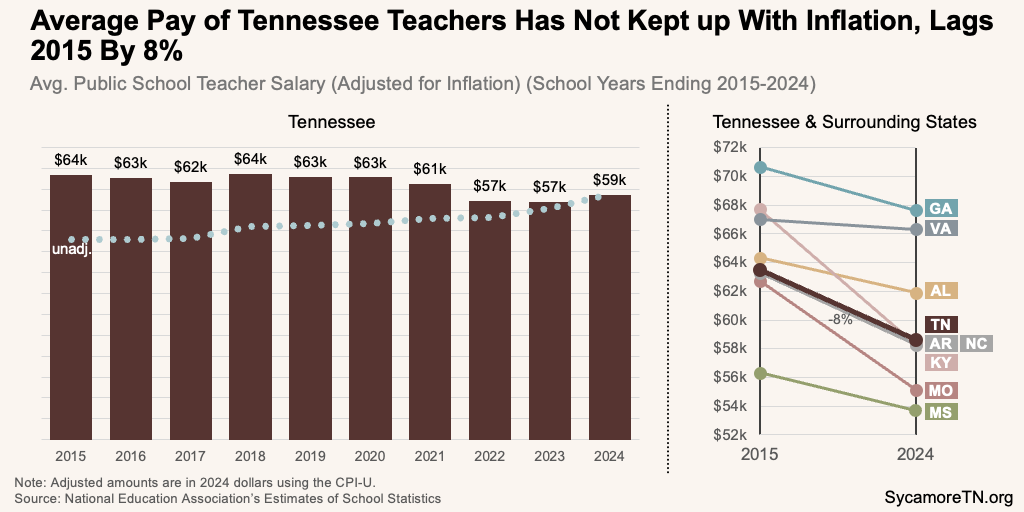
Figure 11
Within the total for K-12 is $304 million in recurring funds for Education Freedom Scholarships (EFS) to double the number of private school scholarships from 20,000 to 40,000. The number of scholarships is set to automatically increase by 5,000 each year if the prior year’s applications exceed 75% of available slots—subject to funding availability. (15) To increase the number of scholarships beyond the additional 5,000 allowed in law, the General Assembly must pass separate legislation in addition to the budget. The recommended total includes:
- $146 million for the existing 20,000 scholarships.
- A $42 million increase to fund the law’s 5,000 additional scholarships and an increase in the scholarship amount.
- A $113 million increase for another 15,000 scholarships.
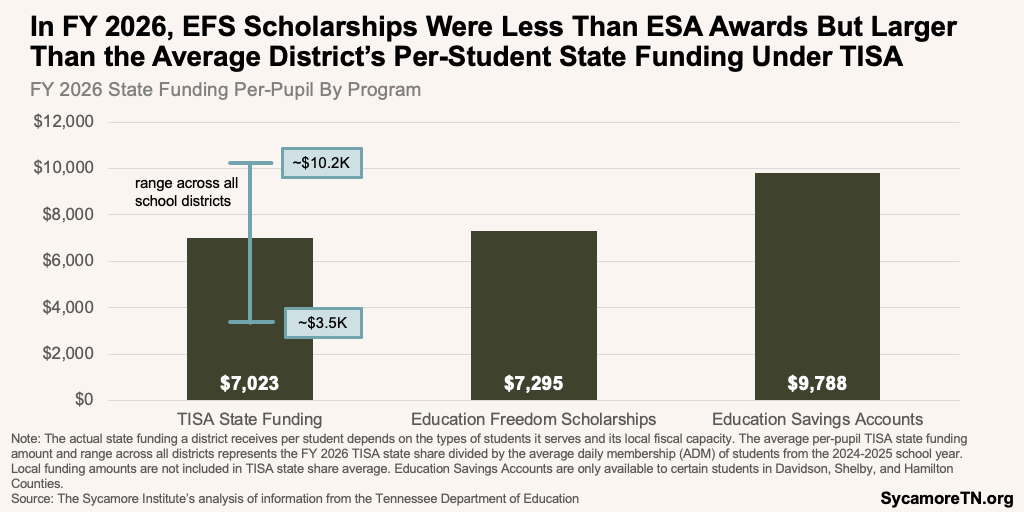
The money for EFS is separate from TISA but tied to TISA’s combined state and local base per pupil amount. As a result, EFS amounts will increase from $7,295 in FY 2026 to $7,530 in FY 2027. For context, scholarships under the EFS program in FY 2026 were less than those under a similar Education Savings Account program but more than what the average school district received in state funding per student under TISA (which excludes local funding) (Figure 11).
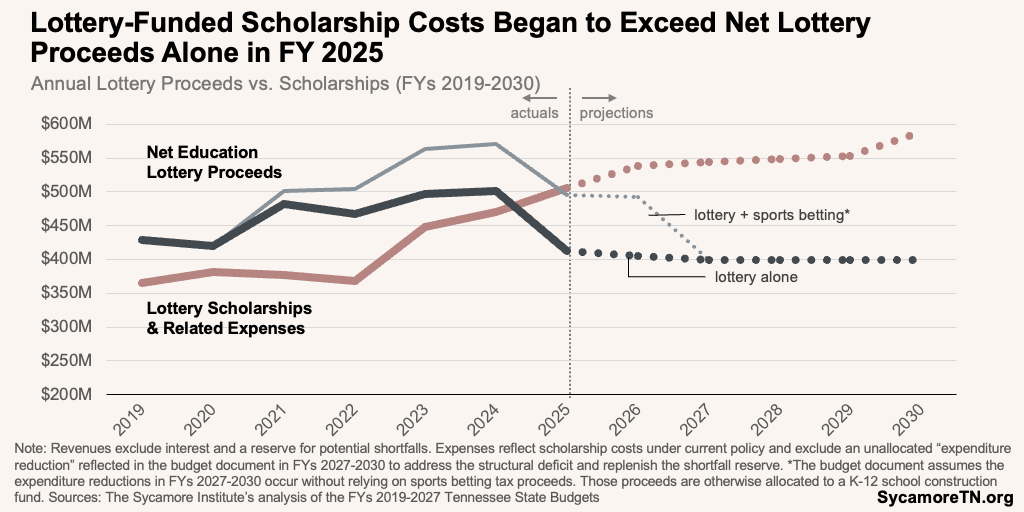
The recommendation also uses one-time General Fund money in FYs 2026 and 2027 to boost funding for a school construction grant program initially meant to rely on sports betting revenue. Last year, lawmakers created the program as part of the EFS Act and planned to pay for it with sports betting revenue. However, some of those dollars will be needed to help cover a shortfall between lottery scholarship costs and expected lottery proceeds in FYs 2026 and 2027 (discussed below). The recommendation proposes $98 million for the program in FY 2026 and $112 million in FY 2027—totals which include non-recurring General Fund subsidies of $11 million and $20 million, respectively.
Figure 12
Post-Secondary Scholarships and Lottery Funds
The budget projects a deficit between state scholarship costs and the lottery proceeds that fund them—using lottery revenue estimates at the conservative end of projected ranges (Figure 12). Scholarship costs have grown in recent years due to increases in the HOPE scholarship and dual enrollment grants (Figure 13), while lottery proceeds have dropped. A sports betting-related tax began supplementing lottery proceeds in FY 2021, but the 2025 EFS Act redirected any sports betting funds not needed to cover scholarship costs to a K-12 school construction fund. The FY 2027 budget reflects using a portion of the sports betting tax to close the funding gap in FY 2026 but assumes other actions are taken to manage scholarship costs in future years. (16)
Figure 13
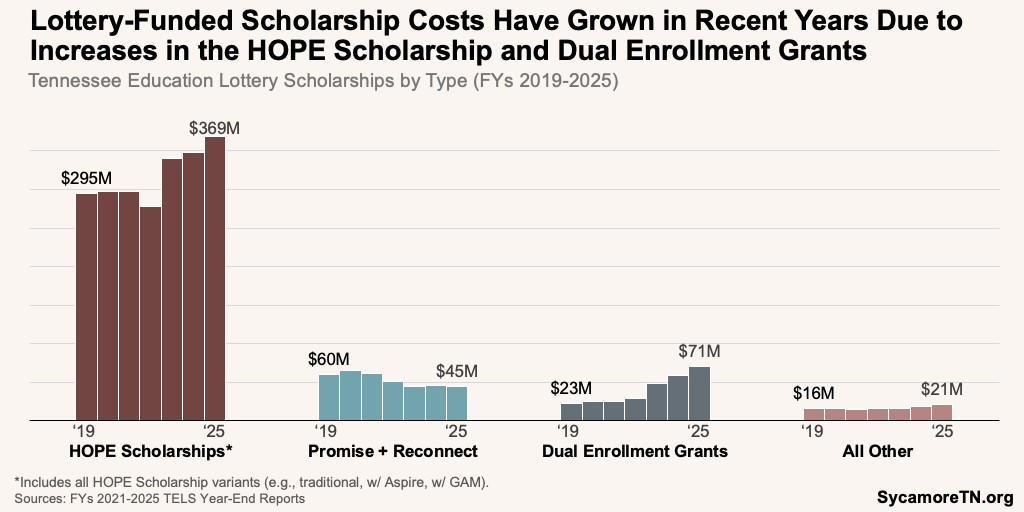
Figure 14
Tennessee Highway Patrol
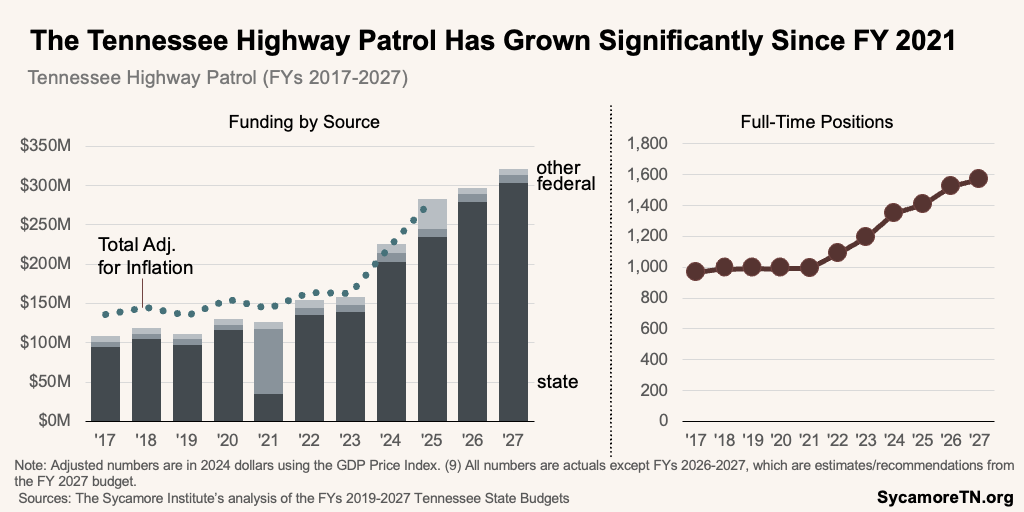
The recommendation includes a total of $303 million in state funding for the Tennessee Highway Patrol (THP)—reflecting significant growth since FY 2021 (Figure 14). Between FYs 2021 and 2026, over $60 million in recurring state funding was added to THP’s budget to expand the number of state troopers and support staff. The FY 2027 recommendation proposes adding another recurring $10 million for this purpose. Compared to FY 2021, the FY 2027 recommendation would increase total THP funding by 154% and expand staffing by 58%.
TennCare Shared Savings & Rural Health
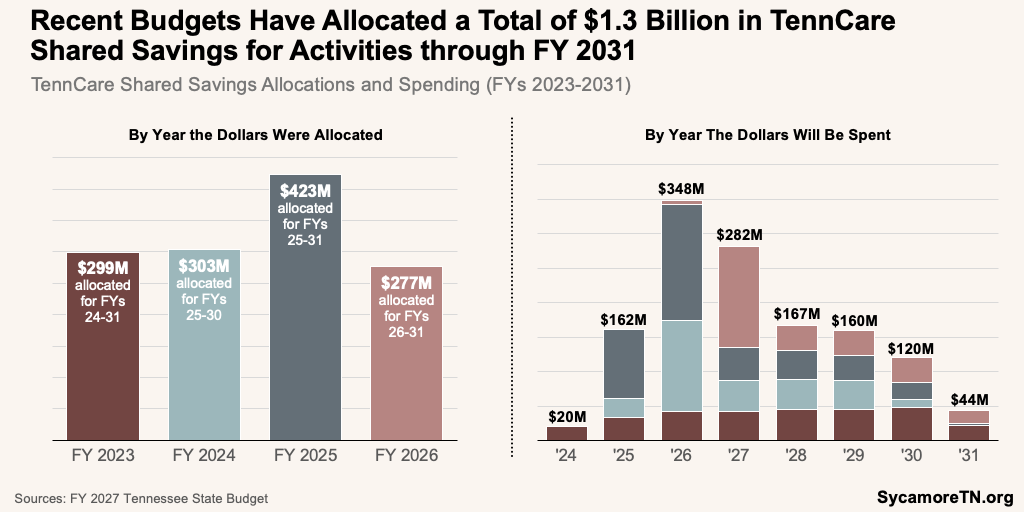
For the fourth year, the Budget proposes new multi-year investments using TennCare shared savings dollars. Tennessee received a total of $1.3 billion in shared savings between FYs 2023-2026 for meeting annual TennCare spending limits set by the federal government (Figure 15). This total includes $277 million received in FY 2026 and allocated to activities in FYs 2026-2031—including $125 million in FY 2027 to supplement efforts under the new federal Rural Health Transformation Program and $144 million over the course of FYs 2027-2031 for a program to help incentivize employment among TennCare recipients. Information on allocations from prior years can be found here and here.
While not reflected in the budget, the state is also expected to receive a total of $207 million in FY 2026 and over $1 billion over 5 years from a federal Rural Health Transformation Program. (18) The program was established as part of the federal One Big Beautiful Bill Act. Tennessee proposed using the federal funds for investments in over a dozen areas—with the largest focused on expanding rural maternity care capacity, providing value-based payments for rural providers, and expanding the primary care safety net. (19)
Figure 15
General Fund Subsidies for Transportation
The FY 2027 recommendation continues the recent practice of using General Fund dollars for transportation-related activities that were historically funded by dedicated user fee-like revenues. This includes subsidies for Highway Fund road construction and maintenance and Transportation Equity Fund support for airports.
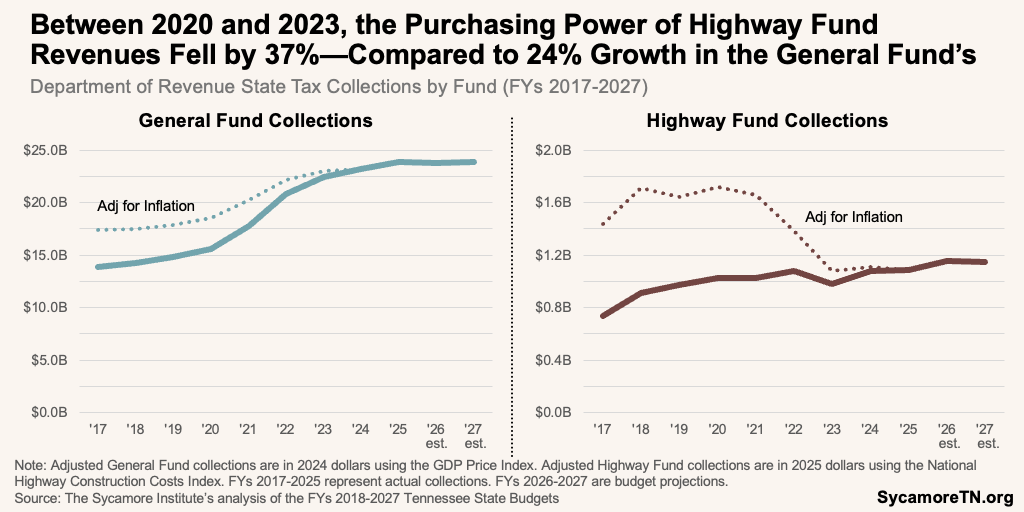
Tennessee’s Highway Fund revenues have failed to keep up with the costs of building roads despite recent efforts. The 2017 IMPROVE Act increased taxes and fees that support the state’s Highway Fund in FYs 2018-2020, and the 2023 Transportation Modernization Act introduced higher electric vehicle fees and new fees for hybrid. Traditionally, these revenue sources functioned much like user fees, linking what drivers paid to how much they used the system. Today, however, those connections have weakened, and the revenues they generate no longer align closely with actual road use or construction needs and costs. As a result, Highway Fund revenues fell in value by 37% between FYs 2020 and 2023 after adjusting for inflation in highway construction costs—compared to General Fund revenues, which experienced a 24% inflation-adjusted gain during this same period (Figure 16). (20)
Gov. Lee’s FY 2027 budget continues to chip away at the Highway Fund’s structural funding issues with General Fund subsidies of $400 million non-recurring and $25 million recurring. This follows one-time transfers of $1 billion in FY 2026 and $3.3 billion in FY 2024. Beginning in FY 2026, the Highway Fund also began receiving an estimated $96 million per year in General Fund sales tax collected on tires. (21) Despite these efforts, the state continues to face a $30 billion backlog of road projects. (22)
Figure 16
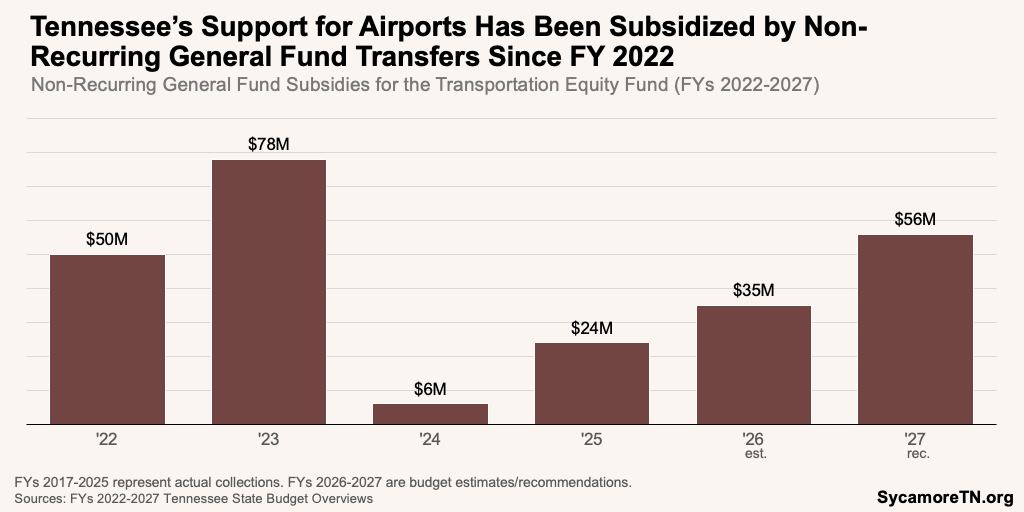
In addition to the Highway Fund, the budget also includes $56.2 million in one-time General Fund subsidies for airports—an activity that was previously funded by aviation fuel taxes. Historically, the state’s aviation fuel tax supported state funding for airports. Lawmakers capped and cut that tax in 2021, which led to a drop in the program’s dedicated funding. (23) (24) Beginning in FY 2022, these activities receive an ongoing $3 million General Fund transfer—along with non-recurring subsidies in each of FYs 2022-2027 (Figure 17).
Figure 17
Nuclear Energy Investments
The FY 2027 Budget includes $38 million in one-time General Fund money for nuclear energy initiatives. Within this total is:
- $25 million to the Tennessee Department of Economic and Community Development (TNECD) for nuclear industry initiative grants. This funding is part of the TNECD’s Nuclear Energy Supply Chain Investment Fund established in FY 2024 to provide grants to businesses focused on nuclear energy production and development. Between FYs 2024 and 2027, the Budget has included a total of $85 million in one-time money for the fund.
- $10 million to the Tennessee Higher Education Commission (THEC) for the Governor’s Investment in Vocational Education (GIVE) grants focused on nuclear energy sector development. This funding is consistent with one-time money in the FY 2026 budget for the same purpose.
- $3 million to Tennessee Technological University (TTU) to establish a nuclear energy and cybersecurity academy.
FY 2027 Spending Reductions
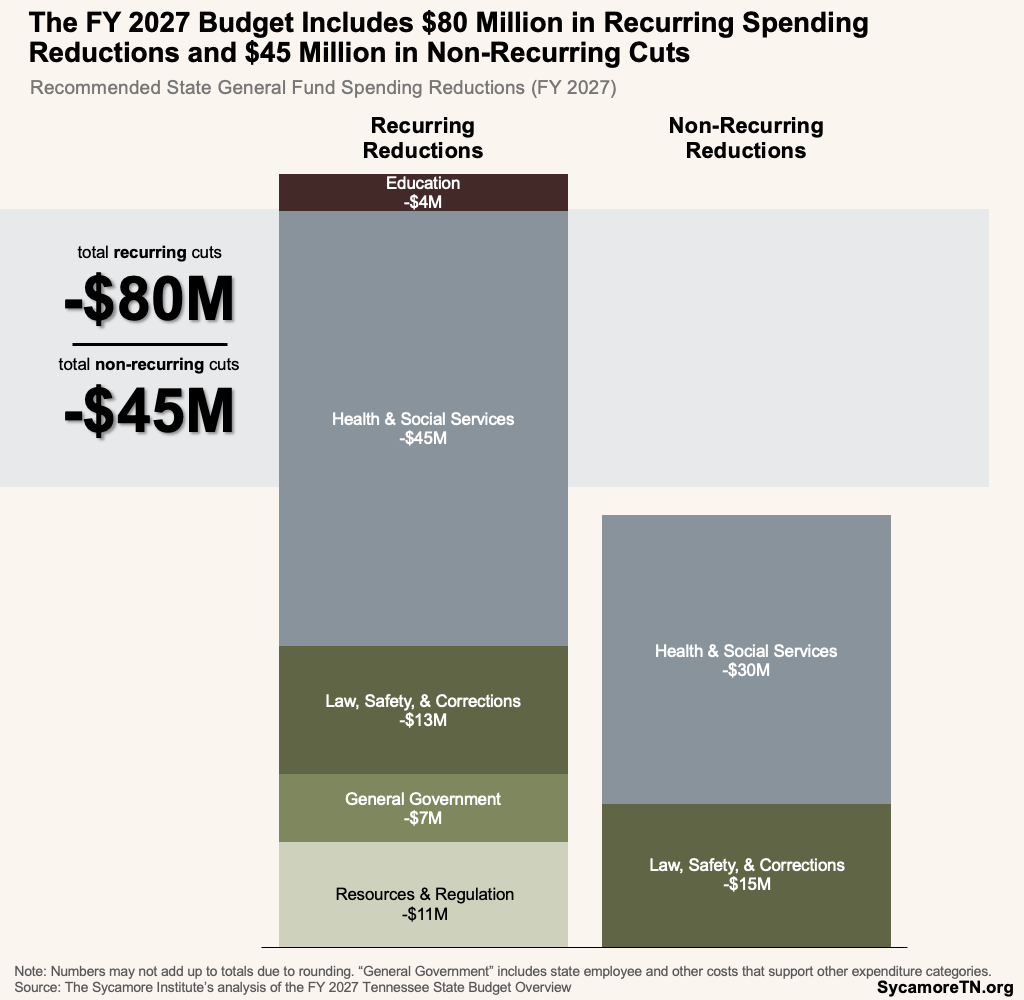
The Budget proposes reductions totaling $80 million recurring and $45 million non-recurring (Figure 18). In total, these reductions represent about -0.4% of total FY 2027 recommended recurring spending and -1.5% of non-recurring. The non-recurring reductions replace state dollars with other temporary sources of funding. The largest recurring reductions include:
- $31 million in reduced spending from state General Fund revenues—largely within TennCare and the Department of Environment and Conservation—will be covered by other ongoing sources of revenue (e.g., drug rebates, state park fees).
- $14 million from TennCare—primarily from reduced costs associated with the Department of Disability and Aging’s services for individuals with developmental and intellectual disabilities.
- $13 million across state government from vacant state employee positions and items labeled as “operational efficiencies.”
- A $4 million reduction to the state’s recurring obligations for funding other post-employment benefits (OPEB)—which includes health insurance for retired state employees. This reduced obligation comes on the heels of $550 million in one-time deposits in recent years to help pay down those long-term liabilities.
Figure 18
FY 2027 State Tax Revenue Growth
The Budget expects total state tax collections to grow by 2.24% (or $500 million) in FY 2026.[2] The state experienced rapid pandemic-era growth in tax collections and then adopted several franchise and excise tax changes (Figure 19). The FY 2027 growth rate is closer to those the state experienced before these changes.
The State Funding Board recommended a range of 2.03% to 2.23% growth in recurring state tax revenues for FY 2027 based on expert estimates that ranged from 2.23% to 2.46%. The recommended range for recurring General Fund revenues was 2.25% to 2.35% based on expert estimates that ranged from 2.35% to 2.56%. As has been in the case in recent years, the recommendation is based on rates at the top of the Funding Board’s recommended ranges.
The direction and degree of expected change vary by revenue type (Figure 19):
- +3.0% gain (+$445 million) in general sales tax collections.
- +11.0% gain (+$113 million) in selective sales and gross receipts taxes collections—including +$74 million from a new tax on hemp-derived cannabinoid products (e.g., CBD, Delta-8) that went into effect on January 1, 2026.(25)
- +1.4% gain (+$23 million) in gas, fuel, and motor vehicle taxes and fees collections.
- -3.1% loss (-$123 million) in franchise and excise tax collections.
Figure 19
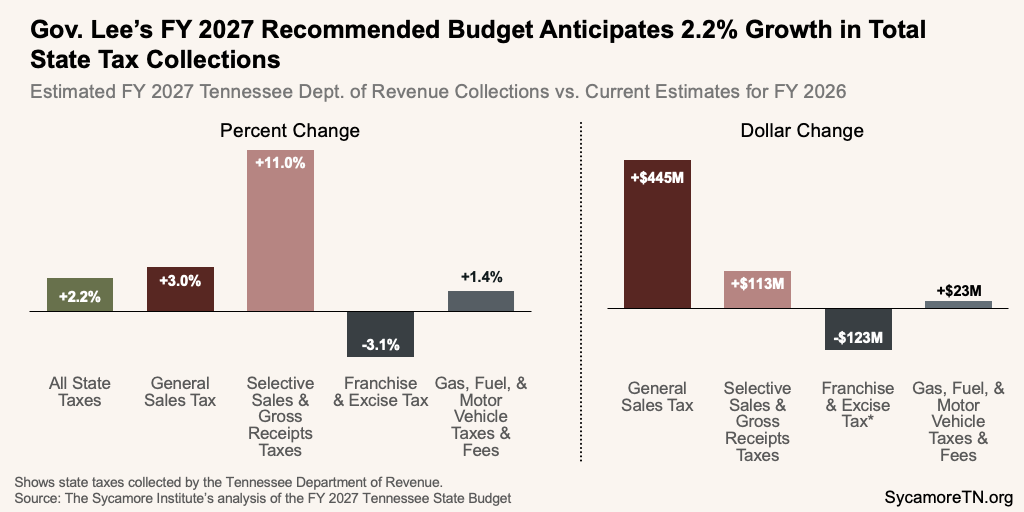
Figure 20
State Tax Growth in Context
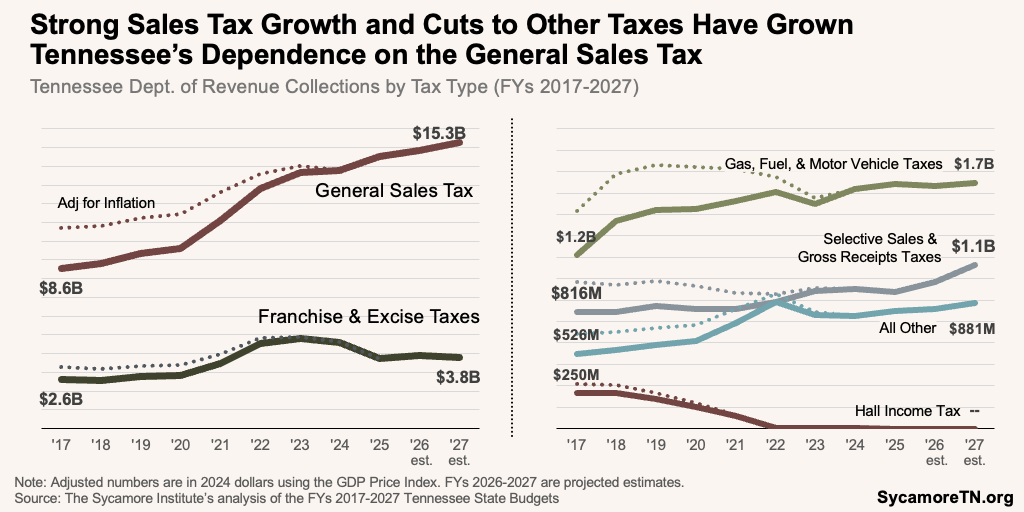
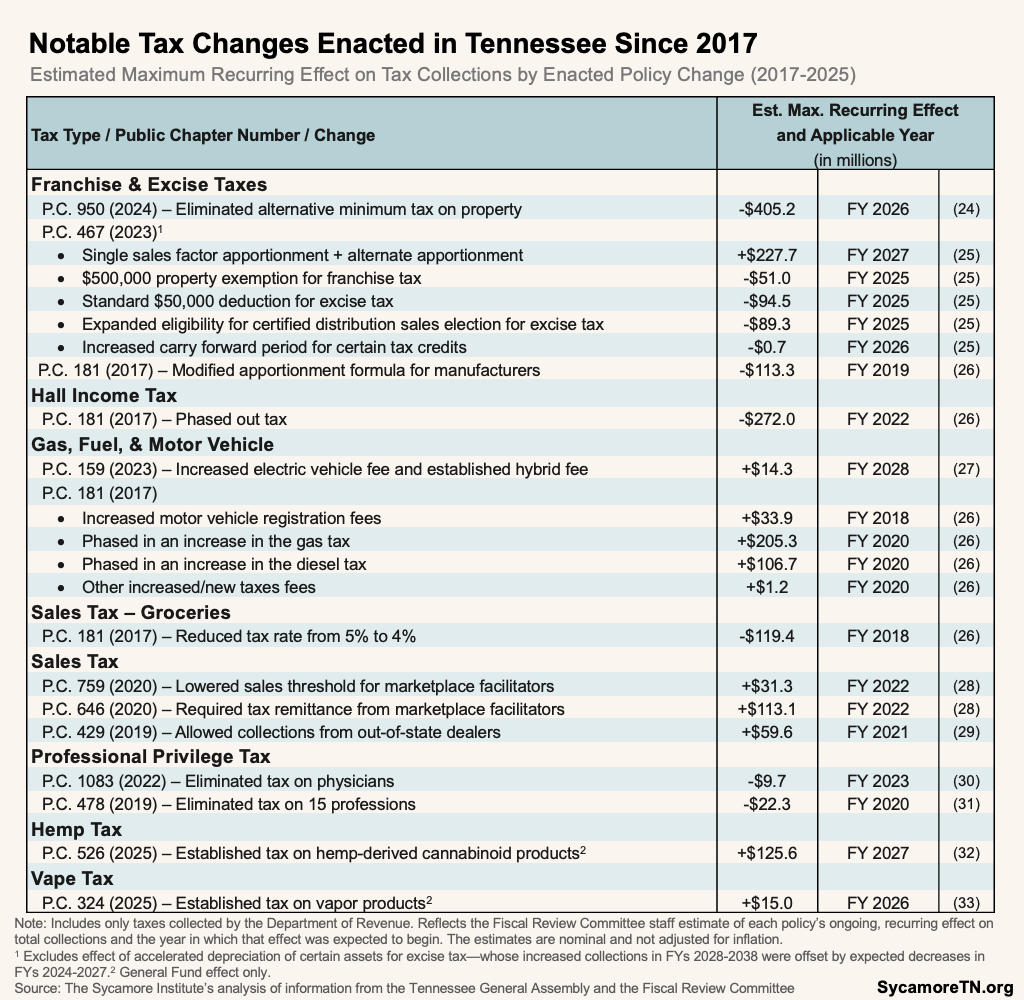
Strong sales tax growth and cuts to other taxes have grown the General Fund’s dependence on sales tax in recent years (Figures 20 and 21). Collections from the state’s general sales tax—which includes a 4% tax on groceries—are expected to grow the most of any of the state’s broad tax categories between FY 2017 and the projections for FY 2027. Over this period, sales tax collections are expected to grow an average of 6.0% per year (without adjusting for inflation)—compared to 3.8% for franchise and excise taxes, 3.4% for selective sales and gross receipts taxes (e.g., tobacco, alcohol, and hemp taxes), 3.6% for gas, fuel, and motor vehicle taxes and fees, and 5.3% for all other taxes. These numbers reflect the following notable tax changes that went into effect over the last decade (Table 1):
Tax Reductions
- Franchise & Excise Taxes — Several changes to the franchise and excise taxes were adopted in 2017, 2023, and 2024, which—when combined—were expected to ultimately reduce collections by over $500 million a year. (26) (27)
- Income Tax — The 2017 IMPROVE Act eliminated the state’s Hall Income Tax on investment income, which was phased out between FYs 2017 and 2021. At the time of passage, it was expected to reduce collections by about $272 million a year. (28) However, the tax brought in $322 million in state revenue in FY 2016.
- Grocery Tax — The IMPROVE Act also reduced the state’s grocery sales tax from 5% to 4% beginning in FY 2017, which was expected to reduce collections by over $119 million per year. (28)
- Professional Privilege Tax — Exemptions to the state’s professional privilege tax enacted in 2019 and 2022 were expected to reduce revenues by a total of about $32 million a year. (29) (30)
Tax Increases
- Gas, Fuel, and Motor Vehicle Taxes and Fees — New and increased gas, fuel, and motor vehicle taxes in fees in both the 2017 IMPROVE Act and the 2024 Transportation Modernization Act were expected to generate over $360 million in additional revenue annually. (28) (31)
- Sales Tax — The state made several expansions to sales tax collections for online retailers and marketplace facilitators (e.g., Etsy) in 2019-2020. Together, those changes were expected to increase sales tax collections by about $200 million per year. (32) (33)
- Vape and Hemp Taxes — New taxes enacted in 2025 for vape and hemp-derived cannabinoid products (e.g., Delta-8, CBD) are expected to bring in about $140 million in new revenue annually. (34) (35)
Figure 21
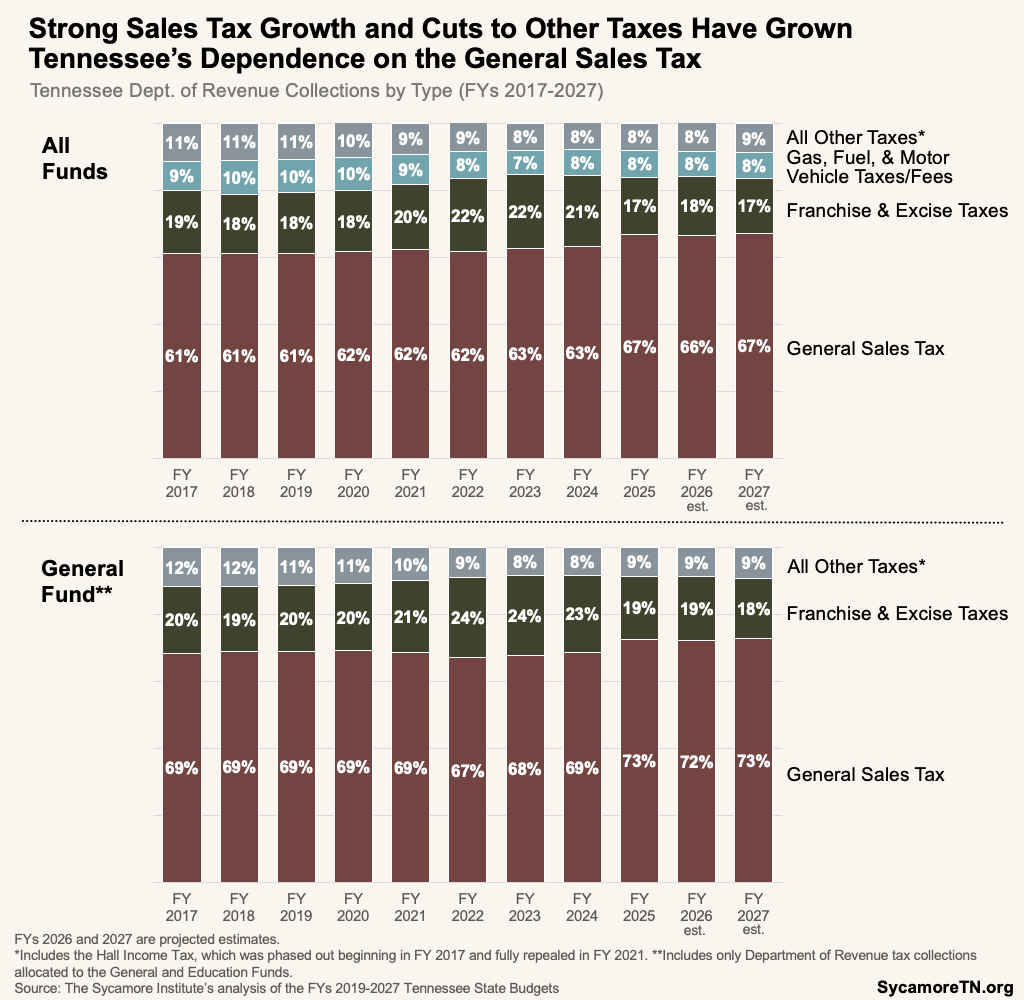
Table 1
Federal Funding
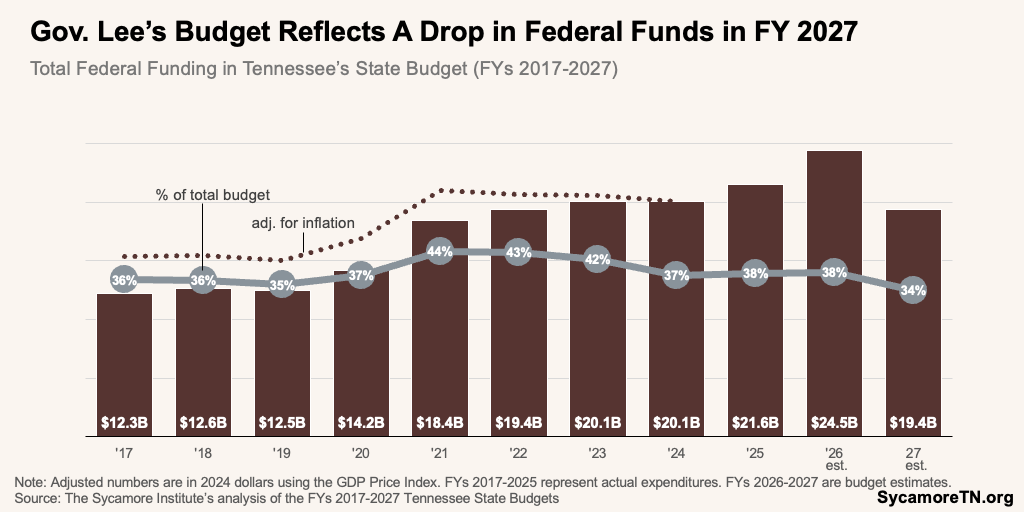
The FY 2026 estimate continues to reflect balances associated with COVID-related federal funding (Figure 22). Many of these funds had to be obligated by states by December 31, 2024, and spent by December 31, 2026. (36) As a result, these dollars are likely to ultimately be spread over FYs 2026-2027 once actual expenditures are reported. Even so, federal funds under the FY 2027 projection are expected to account for the smallest share of the overall budget in over ten years (Figure 22).
Although the budget includes some federal funding changes, it also largely reflects baseline assumptions and may not fully capture very recent or uncertain federal policy shifts. For example, it does not yet reflect a $207 million federal Rural Health Transformation grant the state will likely receive in both FYs 2026 and 2027 that was announced in December. However, the recommendation reflects the effects of some federal funding changes, including—
- A $60 million recurring increase in state dollars to cover new federal administrative cost-sharing requirements for the Supplemental Nutrition Assistance Program. This total reflects only a partial-year impact because the state and federal fiscal years do not fully align. The full ongoing annual cost is expected to be closer to $77 million.
- A $40 million reduction to federal child care funding associated with a recent change to the Child Care and Development Block Grant funding formula.(37)
- A $35 million federal COVID funding reduction within the Department of Education. Under the Biden administration, the U.S. Department of Education had extended the deadline by which states had to spend remaining COVID-era Education Stabilization Funds, but in March 2025, the Trump administration rescinded those extensions early.(38)
- A $31 million federal funding reduction within the Department of Environment and Conservation reflects elimination of a Solar for All energy program. The federal government rescinded these grants in August 2025.(39) (40)
- $4 million in TennCare shared savings dollars in FY 2026 to replace reduced federal funding for county health departments.
Figure 22
Rainy Day Reserves
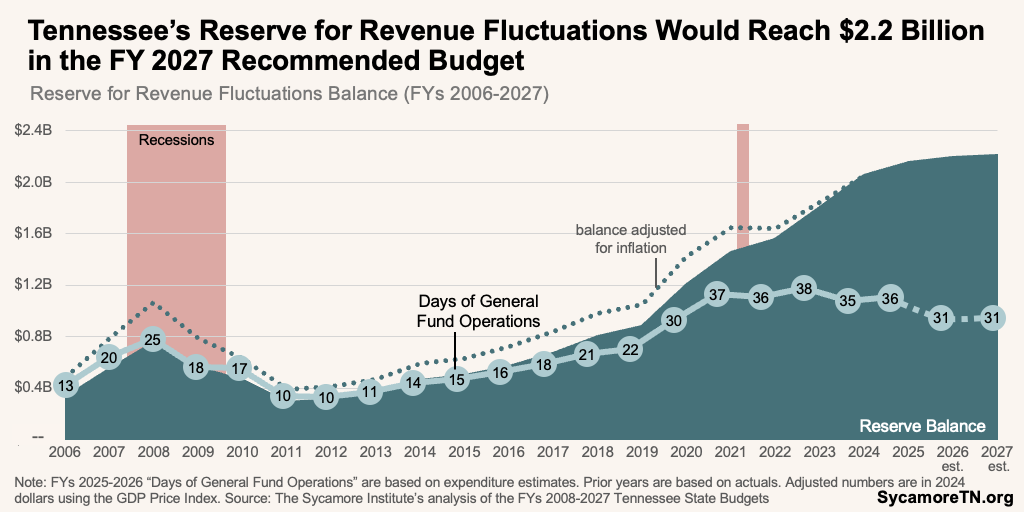
The Budget recommends a $20 million deposit to the state’s rainy day fund in FY 2027, bringing the Reserve for Revenue Fluctuations balance up to $2.2 billion.[3] This balance would be the highest ever (Figure 23). These rainy day reserves are a tool of last resort should Tennessee need to respond to an economic downturn. (41) Reserve balances provide a cushion during a recession, when state revenues often slow or decline.
- This balance would cover about 31 days of state-funded General Fund operations at the recommended FY 2027 levels. This is about 6 days more cushion than just before states began to feel the effects of the Great Recession.
- The Reserve for Revenue Fluctuations would exceed its statutory target by about $273 million. State law sets a target for that fund at 8% of General Fund revenues, and the FY 2027 recommended balance represents about 9.1%.[4] (41)
Figure 23
Key Budget Resources
- Sycamore’s Tennessee State Budget Primer
- FY 2027 Tennessee State Budget
- Budget Overview for the FY 2027 Tennessee State Budget
- Gov. Lee’s 2026 State of the State Address
- FY 2027 Budget Presentation to the House and Senate Finance Committees
- Archive of Tennessee State Budgets
[1]Administration officials indicated that the effective FY 2027 TISA formula increase to school districts may be closer to $250 million—noting an undistributed $80 million overage in the FY 2026 base due to lower-than-projected enrollment. Officials made similar statements during the FY 2026 budget process, though actual enrollment ultimately did not require the additional $80 million.
[2] Only state taxes collected by the Tennessee Department of Revenue. Includes both recurring and non-recurring.
[3] Our analyses of the state’s rainy day fund typically also includes the TennCare Reserve, which has also been used in the past to respond to economic downturns. However, recent budget documents show that a significant portion of those balances are already obligated for specific purposes (e.g., shared savings, IT improvements), so we have excluded them from this summary.
[4] Calculated by adding Department of Revenue and other state revenue allocations to the General Fund, Education Fund, and Debt Service Fund minus the Gas Tax allocation to the Debt Service Fund (from page A-65 of the Budget).
References
Click to Open/Close
References
References
- Tennessee Department of Finance and Administration. Budget Overview: Fiscal Year 2026-2027. [Online] February 2, 2026. https://www.tn.gov/content/dam/tn/finance/budget/documents/overviewspresentations/FY27Recommended_Final.pdf.
- U.S. Department of Agriculture. SUN Bucks: 2026 Participating Tribal Nations/States/Territories . [Online] [Cited: February 9, 2026.] https://www.fns.usda.gov/summer/sunbucks.
- Tennessee Department of Human Services. Annual Report: 2024. [Online] 2024. https://www.tn.gov/content/dam/tn/human-services/documents/TDHS%202024%20Annual%20Report.pdf.
- State of Tennessee. Tennessee State Budgets for FYs 2001-2002 through 2024-2027. [Online] 2001-2026. Available from https://www.tn.gov/finance/fa/fa-budget-information/fa-budget-archive.html.
- Tennessee Department of Finance and Administration. December Revenues. [Online] January 16, 2026. https://www.tn.gov/content/tn/finance/news.revenues.html.
- Tennessee General Assembly. HB 2631 / SB 2690 (as introduced) . [Online] February 9, 2026. https://www.capitol.tn.gov/Bills/114/Bill/HB2631.pdf.
- U.S. Census Bureau. American Community Survey 1-Year Estimates (Table S2001). [Online] 2011-2024. Available from https://www.data.census.gov.
- U.S. Bureau of Labor Statistics. Consumer Price Index for All Urban Consumers: All Items in U.S. City Average [CPIAUCSL]. Retrieved from FRED, Federal Reserve Bank of St. Louis. [Online] February 2026. https://fred.stlouisfed.org/series/CPIAUCSL.
- U.S. Bureau of Economic Analysis. Gross Domestic Product: Chain-type Price Index [GDPCTPI]. Retrieved from FRED, Federal Reserve Bank of St. Louis. [Online] February 2025. https://fred.stlouisfed.org/series/GDPCTPI.
- Tennessee Department of Education. FY 2024 TISA Final Allocations. [Online] August 4, 2023. https://www.tn.gov/content/dam/tn/stateboardofeducation/documents/2023-sbe-meetings/august-4%2c-2023-sbe-meeting/8-4-23%20II%20B%20TISA%20Allocations%20for%20FY%202023-24%20Attachment.pdf.
- —. FY 2025 TISA Final Allocations. [Online] August 16, 2024. https://www.tn.gov/content/tn/sbe/meetings/meetings-calendar/2024/8/16/august-16–2024-sbe-meeting.html.
- —. FY 2026 TISA Final Allocations. [Online] August 15, 2026. https://www.tn.gov/content/dam/tn/stateboardofeducation/documents/2025-sbe-meetings/august-15%2c-2025-sbe-meeting/8-15-25%20II%20C%20FY%202025-26%20TISA%20Allocations%20Attachment.pdf.
- —. Tennessee Education Freedom Scholarship Program. [Online] [Cited: February 12, 2026.] https://www.tn.gov/education/efs.html.
- —. Education Savings Account Program. [Online] [Cited: Februar 12, 2026.] https://www.tn.gov/content/tn/education/esa.html.
- Tennessee Code Annotated. Tenn. Code Ann. § 49-6-3504. [Online] 2025. [Cited: February 11, 2026.] https://advance.lexis.com/documentpage/?pdmfid=1000516&crid=154cd1d3-76ea-456a-9b35-e9000f8a5925&nodeid=ABXAAGABLAAE&nodepath=%2FROOT%2FABX%2FABXAAG%2FABXAAGABL%2FABXAAGABLAAE&level=4&haschildren=&populated=false&title=49-6-3504.+Scholarship+availability+.
- Tennessee General Assembly. Senate Amendment 1 to SB 6001 (adopted). [Online] January 2025. https://www.capitol.tn.gov/Bills/114/Amend/SA6002.pdf.
- Tennessee Higher Education Commission. TELS Year-End Reports for 2020-21 through 2024-25. [Online] January 2026. https://www.tn.gov/thec/dat a-research-reports/reports-studies-pub/financial-aid-reports/tn-hope-scholarship-program.html.
- U.S. Centers for Medicare and Medicaid Services. CMS Announces $50 Billion in Awards to Strengthen Rural Health in All 50 States . [Online] December 29, 2025. https://www.cms.gov/newsroom/press-releases/cms-announces-50-billion-awards-strengthen-rural-health-all-50-states.
- Tennessee Department of Health. Rural Health Access for Tennessee’s Future. [Online] https://www.tn.gov/health/rural.html.
- U.S. Department of Transportation. The National Highway Construction Cost Index (NHCCI). [Online] January 2025. https://data.transportation.gov/Research-and-Statistics/NHCCI/r94d-n4f9/about_data.
- Tennessee General Assembly. HB 969–SB 144 (Public Chapter No. 508). [Online] 2025. https://wapp.capitol.tn.gov/apps/BillInfo/Default?BillNumber=HB0969.
- Tennessee Department of Finance and Administration. FY 2027 Budget Presentation. [Online] February 2026. https://www.tn.gov/content/dam/tn/finance/budget/documents/overviewspresentations/FY27%20Budget%20Presentation%20-%20FINAL.pdf.
- Styf, Jon. Tennessee’s Airports Seek $125M in New Annual Funding. The Center Square. [Online] January 27, 2022. https://www.washingtonexaminer.com/politics/tennessees-airports-seek-125m-in-new-annual-funding.
- Tennessee General Assembly. SB 772–HB 773 (Public Chapter No. 477). 112th General Assembly. [Online] 2021. https://wapp.capitol.tn.gov/apps/BillInfo/Default?BillNumber=SB0772&ga=112.
- State of Tennessee. Public Chapter No. 526 (2025). [Online] May 27, 2025. https://wapp.capitol.tn.gov/apps/BillInfo/Default?BillNumber=HB1376&ga=114.
- Tennessee General Assembly Fiscal Review Staff. Fiscal Memorandum: HB 1893–SB 2103. [Online] April 2, 2024. https://www.capitol.tn.gov/Bills/113/Fiscal/FM2785.pdf.
- —. Fiscal Memorandum: SB 275–HB 323. [Online] May 4, 2023. https://www.capitol.tn.gov/Bills/113/Fiscal/FM1374.pdf.
- —. Fiscal Memorandum: HB 534–SB1221. [Online] April 20, 2017. https://www.capitol.tn.gov/Bills/110/Fiscal/FM1477.pdf.
- —. Fiscal Memorandum: HB 519–SB 884. [Online] April 25, 2022. https://www.capitol.tn.gov/Bills/112/Fiscal/FM2891.pdf.
- —. Fiscal Memorandum: SB 398–HB 1262. [Online] April 29, 2019. https://www.capitol.tn.gov/Bills/111/Fiscal/FM1462.pdf.
- —. Fiscal Memorandum: SB 273–HB 321. [Online] March 13, 2023. https://www.capitol.tn.gov/Bills/113/Fiscal/FM0767.pdf.
- —. Cumulative Fiscal Note for Legislation Enacted During the 2020 Regular Legislative Session. [Online] July 28, 202. https://capitol.tn.gov/Archives/Joint/committees/fiscal-review/reports/2020%20Cumulative%20Fiscal%20Note%20Final.pdf.
- —. Fiscal Memorandum: SB 156–HB 667. [Online] April 16, 2019. https://www.capitol.tn.gov/Bills/111/Fiscal/FM1349.pdf.
- —. Fiscal Memorandum: SB 1413–HB 1376. [Online] April 10, 2025. https://www.capitol.tn.gov/Bills/114/Fiscal/FM1322.pdf.
- —. Fiscal Memorandum: SB 763–HB 968. [Online] April 16, 2025. https://www.capitol.tn.gov/Bills/114/Fiscal/FM1367.pdf.
- U.S. Government Accountability Office. COVID-19 Relief: States’ and Localities’ Fiscal Recovery Funds Spending Update for 2025. [Online] February 12, 2026. https://www.gao.gov/products/gao-26-108587.
- Tennessee Department of Human Services. Update on Child Care Funding – Frequently Asked Questions. [Online] https://www.tn.gov/humanservices/for-families/child-care-services/update-on-child-care-funding.html.
- U.S. Department of Education. Education Stabilization Fund Liquidation Extensions. [Online] October 6, 2025. https://www.ed.gov/grants-and-programs/formula-grants/response-formula-grants/covid-19-emergency-relief-grants/education-stabilization-fund-liquidation-extensions.
- Tennessee Department of Environment and Conservation. Solar for All. [Online] https://www.tn.gov/environment/program-areas/energy/state-energy-office–seo-/programs-projects/programs-and-projects/inflation-reduction-act/solar-for-all.html.
- U.S. Environmental Protection Agency. Greenhouse Gas Reduction Fund . [Online] https://www.epa.gov/aboutepa/greenhouse-gas-reduction-fund.
- State of Tennessee. TN Code § 9-4-211. [Online] Accessed via Lexis.
- National Education Association. Average Teacher Salary. Accessed in January 2026 via https://www.nea.org/resource-library/educator-pay-and-student-spending-how-does-your-state-rank/teacher.