

Key Takeaways
- The workforce development system supports individuals from early education through career advancement—spanning K–12, postsecondary education, and ongoing job training.
- Workforce programs in Tennessee vary in design and scope—using mechanisms like grants, scholarships, technical assistance, and direct services to support schools, employers, and jobseekers.
- Tennessee’s workforce programs span across multiple state agencies—reflecting the cross-cutting nature of the work.
- Federal laws shape much of the system’s structure and funding—including the Workforce Innovation and Opportunity Act (WIOA) for workforce services and Perkins V for career and technical education.
- Workforce programs in Tennessee generally fall into four categories: early talent development, employer support, targeted populations, and system coordination and infrastructure.
A strong workforce is essential to Tennessee’s economic growth and prosperity. Workforce development is one way the state supports this goal. It encompasses a broad range of programs and initiatives that help Tennesseans build skills, pursue education and training opportunities, connect with employers, and advance in the labor market. This report provides an overview of programs and initiatives in Tennessee to help policymakers navigate the state’s workforce development landscape and understand how its various components fit together.
Navigating This Report
This report explores programs and services that support workforce development in Tennessee. It begins by outlining the key state and local entities that oversee workforce programs and the primary federal laws guiding workforce development. We then provide additional detail on major programs and initiatives. The Sycamore Institute developed the following categories to organize workforce development programs based on their primary purpose:
- Category 1: Early Talent Development activities aim to develop a pipeline of skilled workers entering the labor market from the K-12 and postsecondary education systems. These programs emphasize academic readiness, career and technical education (CTE), work-based learning opportunities, postsecondary access, and credential attainment.
- Category 2: Employer Support programs aim to strengthen and retain the existing workforce by supporting employers. These programs include business incentives and workplace training to help businesses expand job opportunities and remain competitive.
- Category 3: Targeted Populations activities connect individuals who are unemployed or disconnected from the labor force to employment opportunities. These programs largely target specific populations, such as veterans, older adults, or formerly incarcerated individuals.
- Category 4: System Coordination and Infrastructure initiatives align workforce programs and partners across agencies and sectors. These efforts aim to improve collaboration and create a more seamless workforce system for both jobseekers and employers.
Workforce development programs in Tennessee vary in both their design and scope. They use multiple mechanisms—including grants, scholarships, technical assistance, and direct services—to support recipients that range from school districts and postsecondary institutions to employers and individual job-seekers. While some programs are targeted toward specific industries or occupations, others are designed to strengthen the workforce more broadly by expanding access to education, training, and credential attainment. See the Key Terms and Acronym Glossary text boxes at the end to help navigate some of the terms used in this paper and related policy conversations.
The Workforce Development System
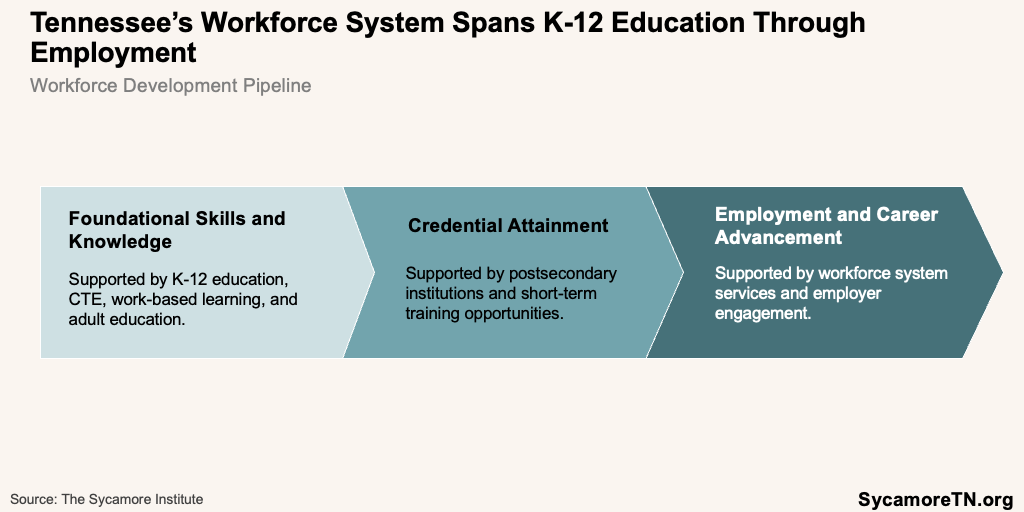
The workforce development system is a continuum of efforts that support individuals from early education through career advancement (Figure 1). The system supports a pipeline that begins with career awareness and foundational skill-building in K-12 education, continues through postsecondary education, and extends into job training opportunities for workers at all stages of their careers. Programs are supported by a wide range of partners—including education systems, workforce agencies, employers, and community-based organizations.
Figure 1
Tennessee Workforce Entities
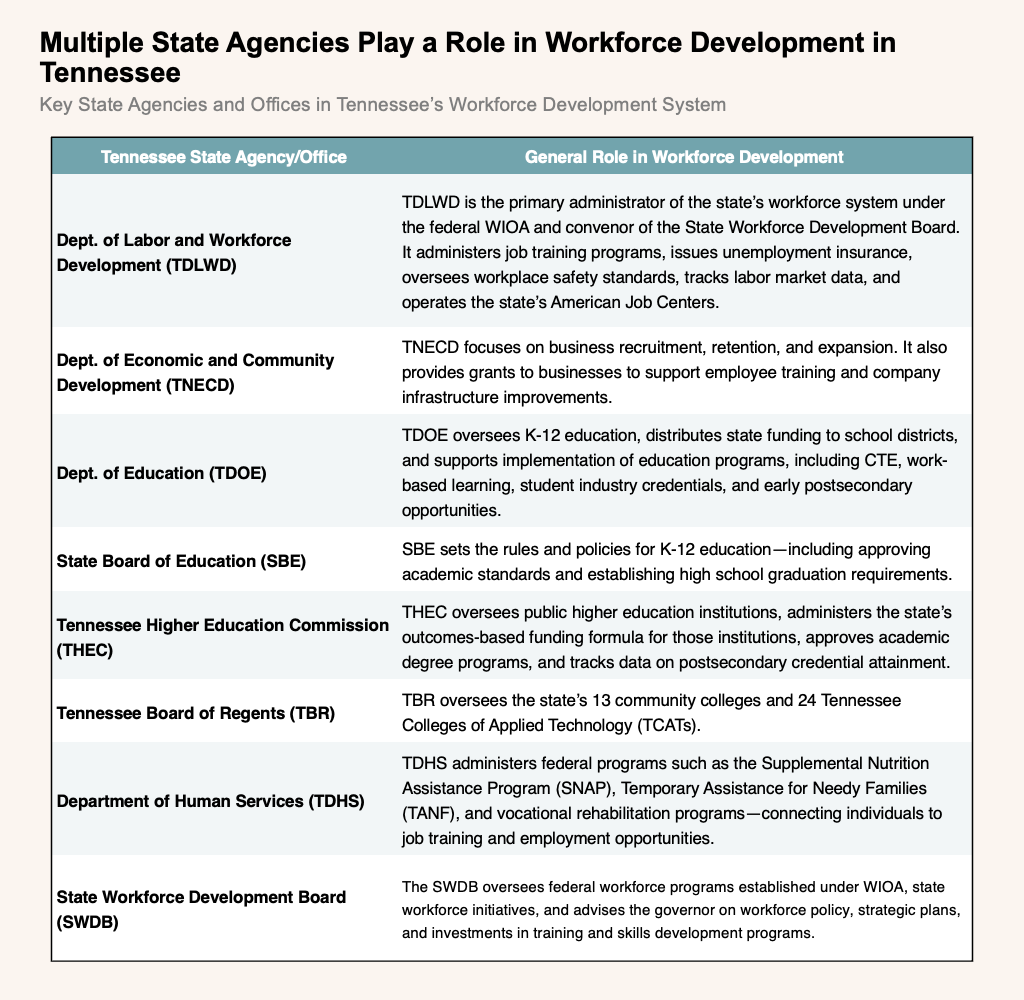
Tennessee’s workforce programs span across multiple state agencies, reflecting the cross-cutting nature of the work. Even as programs are administered or overseen by state agencies, implementation often occurs at the local and regional level through local entities, education and training providers, and community partners. Table 1 summarizes key entities involved in Tennessee’s workforce development pipeline.
Table 1
Federal Workforce Development Laws
Federal laws shape the structure and funding of most workforce development programs. For example, the Workforce Innovation and Opportunity Act (WIOA) guides the public workforce system, and the Carl D. Perkins Career and Technical Education Act (Perkins V) supports career and technical education and early workforce pathways. This section explains the major federal laws guiding workforce development and their role in Tennessee’s workforce system.
Workforce Innovation and Opportunity Act (WIOA)
The federal WIOA creates a national framework to coordinate state and local workforce development efforts. WIOA was enacted in 2014 and replaced similar requirements previously in the Workforce Investment Act of 1998. To receive WIOA funding, states must create 4-year strategic workforce plans, establish performance goals, and provide coordinated services for education, employment training, and job resources. (1) Tennessee’s WIOA state plan outlines the state’s workforce priorities, strategies, and partnerships for implementing these requirements—including efforts to align workforce programs with employer needs and regional labor market demands. (2)
WIOA also requires state and local governments to establish the following:
- The State Workforce Development Board (SWDB) advises the governor on workforce policy, strategic plans, and investments in training and skills development programs. The board oversees federal workforce programs established under WIOA, partners with local workforce development boards, and monitors the performance of the state’s workforce programs. In practice, this includes developing the state’s WIOA plan—which identifies in-demand industries and occupations—and setting a statewide strategy that guides how state agencies and local boards align training programs and services with employer needs and priority populations. Tennessee’s 33-member SWDB—primarily appointed by the governor— includes state elected officials, agency commissioners, local leaders, and representatives from community, business, and labor organizations. (3)
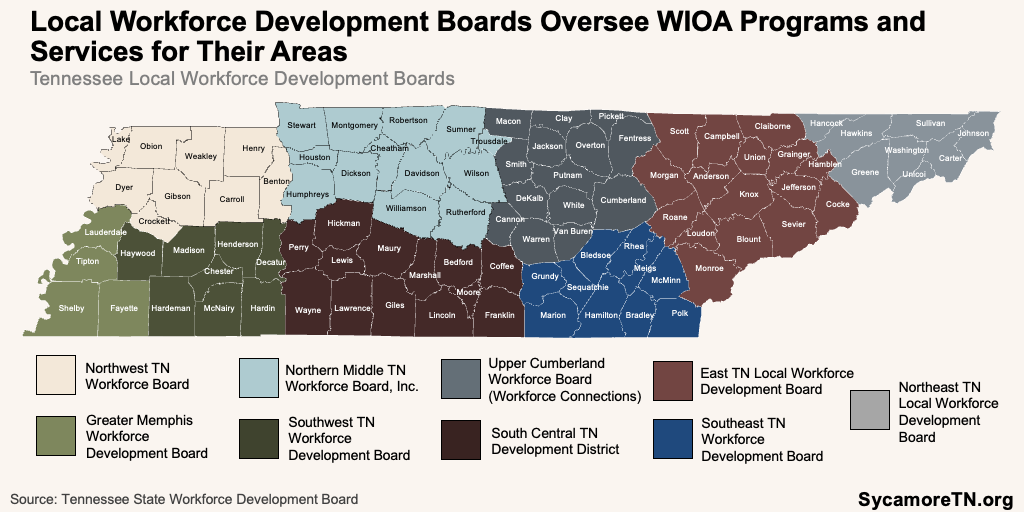
- Local Workforce Development Boards (LWDB) oversee and support federally-funded workforce development programs for their region. They develop local plans that include labor market analyses, strategic planning, and details on implementation of federal WIOA programs. In practice, this includes selecting eligible job training providers and directing funding toward in-demand occupations and local workforce priorities. Tennessee has 9 local workforce development boards that include members appointed by local county mayors in their respective areas (Figure 2). The state’s local workforce development areas are geographically aligned with development districts. (4) (5)
- American Job Centers (AJC) offer training referrals, career counseling, job listings, and employment-related services. WIOA requires LWDBs to establish a “one-stop delivery system” that provides centralized employment services. AJCs function as the “one-stop” location. (6) There are 59 American Job Centers in Tennessee. (1) (7)
Figure 2
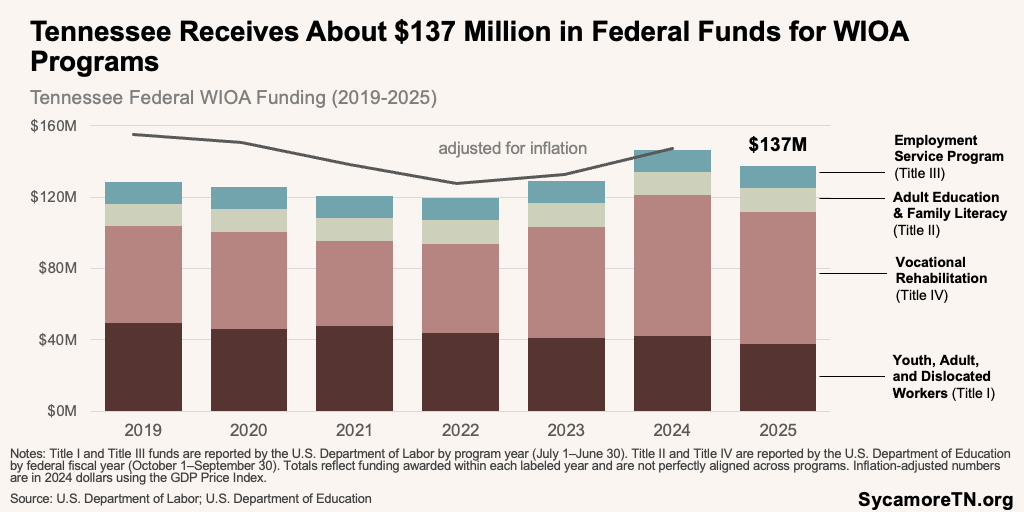
WIOA funding is awarded to states for specific workforce programs and activities. (6) Tennessee received about $137 million in WIOA funding across the following programs and services in 2025 (based on program year and federal fiscal year allocations) (Figure 3):
- Youth, Adult, and Dislocated Workers (Title I) programs target young people ages 14-24, low-income adults, and individuals who have lost their job. (11) Federal funding is distributed to TDLWD, which then allocates funding to LWDBs based on a federal formula that considers unemployment rate, number of disadvantaged youth, and layoffs. Program services are provided by AJCs in each geographic area. (12)
- The Adult Education and Family Literacy Act (Title II) supports education services to help adults develop basic skills necessary for employment and postsecondary education. Programs include adult basic education to improve math, reading, and writing skills, high school equivalency credential preparation, and language services. (13) Federal funding is provided to states to distribute to local providers—including school districts, higher education institutions, and community-based organizations. Funding is based on a federal formula that considers each state’s share of adults without a high school diploma and legal immigrants. (14)
- Employment Services (Title III) includes public employment offices that provide job search and placement assistance, counseling, and referrals to other resources. (15) Because WIOA requires employment service offices to be located with one-stop centers, these services are generally provided in AJCs. Funding is based on each state’s share of the labor force and total unemployment. (6)
- Vocational Rehabilitation (Title IV) programs support people with disabilities to prepare for and obtain employment. THDS administers vocational rehabilitation services to individuals with disabilities. (16) (17) Funding is provided to states based on a federal formula that considers population and per-capita income.
Figure 3
The Strengthening Career and Technical Education for the 21st Century Act (Perkins V)
The Strengthening Career and Technical Education for the 21st Century Act—also known as Perkins V—is a federal law that guides CTE. (18) CTE includes educational programs offered at the secondary and postsecondary levels to provide students with academic knowledge, technical skills, and work-based learning experiences in specific career fields. (19) Tennessee’s Perkins V state plan outlines how the state designs, funds, and evaluates CTE. (20)
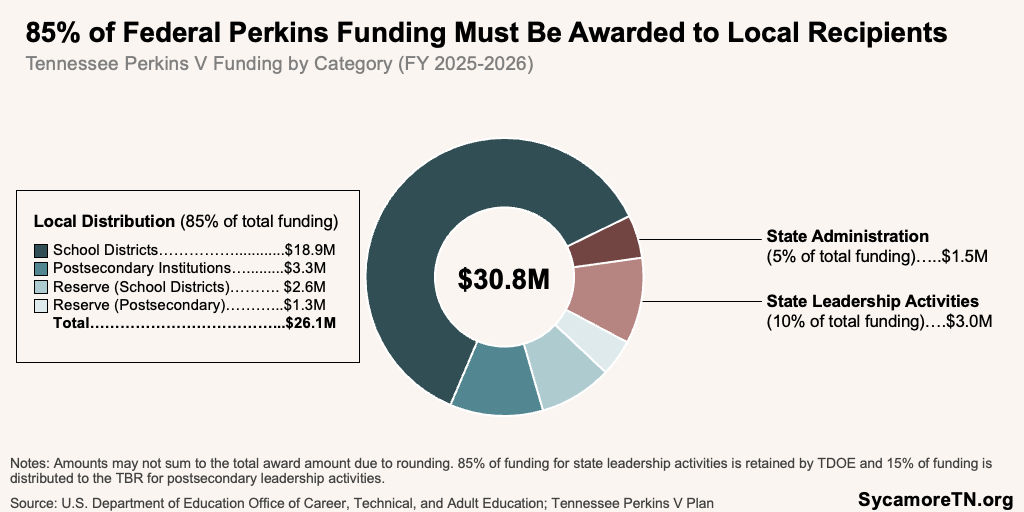
Tennessee received approximately $31 million in Perkins V funding to support CTE programming in FY 2025. (21) Federal law specifies a proportion of funds must be distributed to local entities and reserved for certain activities (Figures 4 and 5):
- 85% of the state’s total allocation must be awarded to school districts and postsecondary institutions. Of the funding distributed to local entities, 15% is awarded through a competitive grant process known as the Perkins reserve grant.
- 10% of the state’s total allocation is reserved for state leadership activities.
- 5% of the state’s total allocation is reserved for state administrative costs.
Figure 4
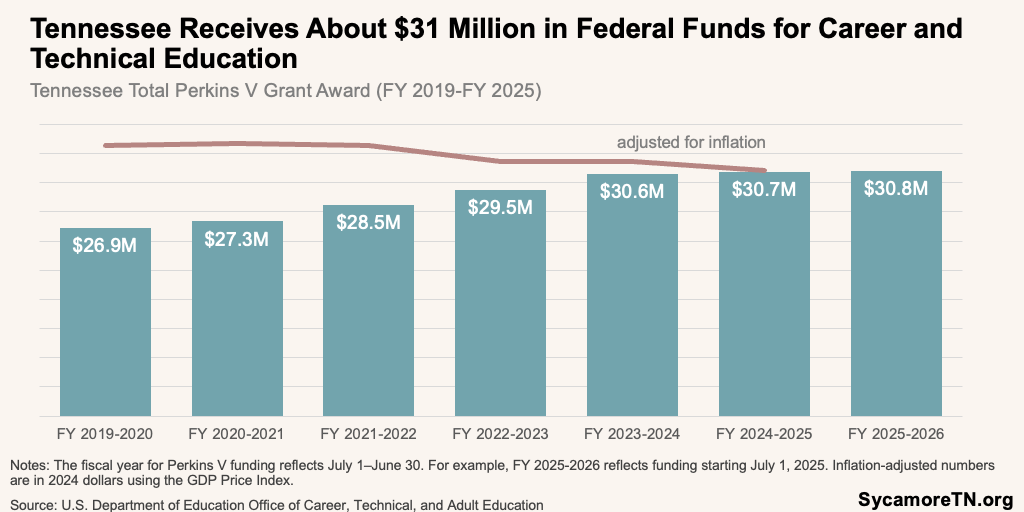
Figure 5
To receive Perkins V funds, school districts and postsecondary institutions must conduct a comprehensive local needs assessment (CLNA). The CLNA requires local recipients to assess labor market alignment, student performance outcomes, gaps across student populations, program quality, and alignment between K-12 and postsecondary CTE programs. The results must directly inform local spending decisions and program strategies. (22)
Tennessee Workforce Programs and Initiatives
While the federal WIOA establishes a framework for workforce development, Tennessee has a variety of standalone programs and investments to address specific needs and priorities. As a result, Tennessee’s workforce landscape includes both federally-supported programs and independent initiatives administered across multiple agencies and implemented through regional and local partners. The following section outlines the state’s major workforce development programs organized by category. However, many programs serve multiple purposes, and individual initiatives may align with more than one workforce development category based on their goals, activities, and target populations. Appendix A provides a list of significant programs and services available across Tennessee.
Category 1: Early Talent Development
Workforce development begins before individuals formally enter the labor force. In Tennessee, K-12 and postsecondary programs and initiatives are designed to prepare students to successfully enter the workforce. These efforts include academic coursework to build foundational skills, CTE and work-based learning opportunities that expose students to specific industries, and financial supports that reduce barriers to postsecondary credential attainment.
K-12 Coursework and Early Career Exposure
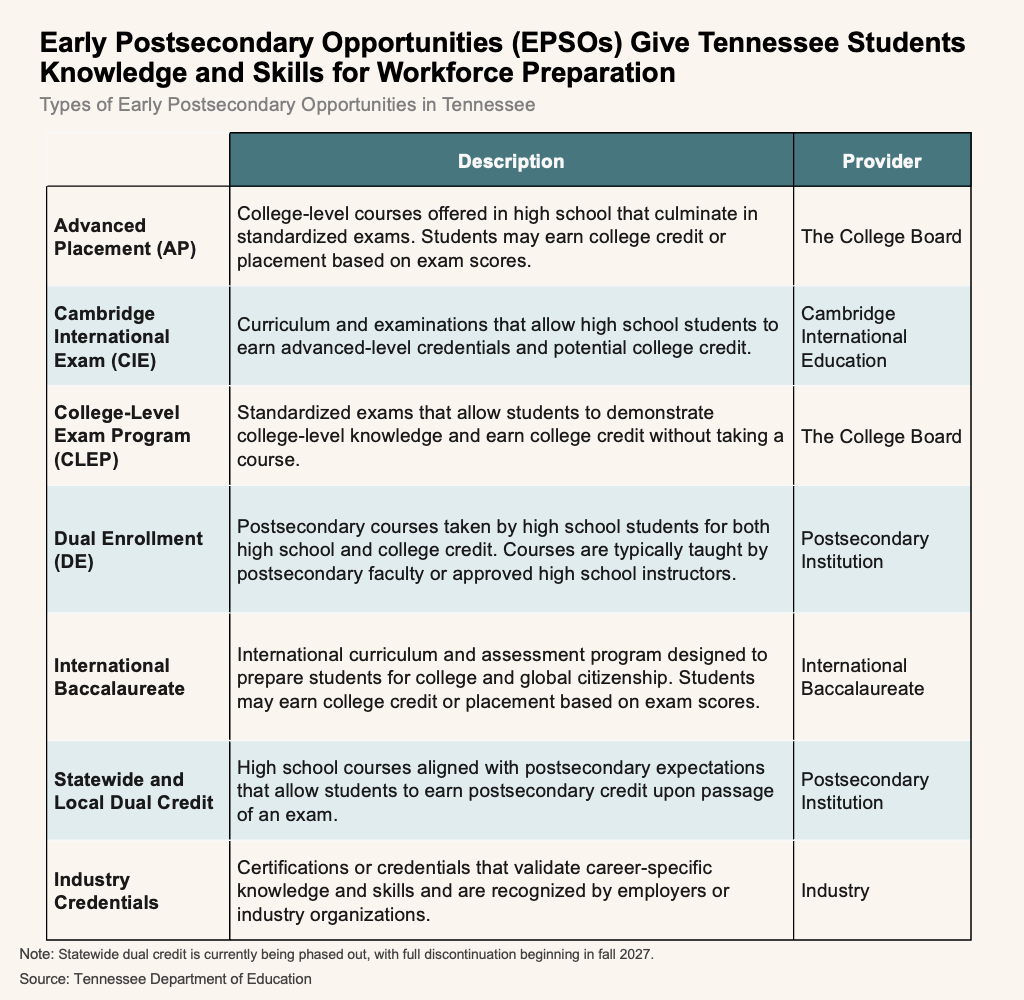
- Early postsecondary opportunities (EPSOs) are courses and exams that allow high school students to earn college credit or workforce credentials. EPSOs are typically offered through national organizations or postsecondary institutions. (23) Table 2 summarizes each EPSO, its provider, and how students can obtain credit. In the 2024-2025 academic year, Tennessee students took about 335,000 EPSOs. (24) The state’s K-12 school funding formula incentivizes school districts to offer EPSOs, and student completion is one of the qualifying criteria for outcomes bonuses (see below).
Table 2
- Career and technical education courses allow middle and high school students to learn about specific industries through classroom instruction and hands-on experiences. Tennessee’s CTE courses are categorized into 14 clusters (e.g., agriculture, digital technology, health care and human services, etc.). Within each career cluster are “programs of study” that outline the course sequence for more specific occupations. For example, the advanced manufacturing cluster includes a program of study for welding with 4 courses. (19) Student enrollment in CTE programs is also included in the state’s K-12 school funding formula (see below).
- Work-based learning (WBL) opportunities allow high school students to gain work experience for school credit. WBL activities include project-based learning, internships, apprenticeships, and practicums. They are typically associated with a CTE program of study and allow students to connect classroom instruction with workplace experiences. (25)
- Youth Employment Program (YEP) is a program led by TDLWD to provide young people ages 14-24 with paid work experiences, internships, and other work-based learning opportunities. The program awards grants to employers to create youth employment opportunities, and participants are eligible to earn up to $3,000 through their job placements. In FY 2027, the state allocated $8 million for YEP, and TDLWD also leverages federal WIOA Title I Youth funds to support the program. (28) (29)
- Innovative School Strategies was a one-time state initiative administered by the TDOE to help school districts implement innovative workforce education strategies. In FY 2023, the state distributed $500 million to middle and high schools to invest in programs that reimagine time, space, and modes of learning. (26) School districts could use these funds to expand CTE programs, EPSOs, and career exploration opportunities for students. (27)
Postsecondary Access and Credential Attainment:
- Tennessee Promise is a last-dollar scholarship program administered by THEC and funded through endowment earnings, surplus lottery revenues, and excess sports wagering fees. (30) It helps students cover tuition and mandatory fees at community colleges or TCATs. By reducing financial barriers to postsecondary education, the program supports credential attainment for students pursuing associate degrees and technical diplomas. In the 2024-2025 academic year, nearly 12,000 students participated in Tennessee Promise. (31) (32)
- The Governor’s Investment in Vocational Education (GIVE) Act focuses on capacity-building through competitive community grants that support partnerships between K-12 school districts, postsecondary institutions, and employers to expand CTE programming aligned with workforce needs. Between 2019 and 2024, THEC awarded a total of $91 million in GIVE community grants to postsecondary institutions. (34) (35)
- Workforce Pell is a new federal program initiated in July 2026 that expands access to Pell Grants—need-based financial aid for low-income students—to those enrolled in eligible short-term workforce training programs aligned with high-skill, high-wage, and in-demand occupations. In Tennessee, the SWDB, TDLWD, and THEC coordinate implementation of the program to approve eligible programs. (36)
- Supporting Postsecondary Access in Rural Counties (SPARC) is a program administered by THEC and designed to expand postsecondary and workforce training opportunities in Tennessee’s rural communities by addressing gaps in infrastructure, geographic access, and CTE dual enrollment. The program provides grants to K-12 school districts in distressed, at-risk, and transitional counties—a national designation based on county poverty, income, and unemployment. School districts can use funds for CTE equipment, industry certification exam fees, work-based learning, teacher training, and dual enrollment partnerships with TCATs. In FY 2023, the state appropriated approximately $10 million for SPARC. (34) (37)
- Rural Health Care Pathways Programs is a THEC initiative to strengthen Tennessee’s rural health workforce by expanding education and career pathways in health care, behavioral health, and dental health. The state allocated about $68 million over FYs 2025-2030 for grants to higher education institutions to support activities spanning K–12, postsecondary education, and midcareer advancement—including increasing early exposure to health careers, improving transitions into health science education, and expanding opportunities for career advancement in in-demand fields. (38) In 2025, THEC awarded $2 million across 20 institutions to develop or scale programs that connect rural students to training and employment opportunities. (39)
- Rural Works Health Care is a state grant program administered by TDLWD that provides local education providers, health care organizations, and workforce partners with up to $250,000 to expand health care training and apprenticeship opportunities in rural communities. It seeks to address rural health care workforce shortages by increasing access to credentials and employment pathways while helping remove barriers that prevent individuals from entering health care careers. In FY 2027, the state allocated $8.2 million in non-recurring funding for the program, supporting 50 grantees across the state. (40) (29)
Tennessee’s workforce development priorities are also embedded within the state’s funding formulas for both K-12 and postsecondary institutions. Each includes components that allocate funding based on CTE enrollment, program completion, and credential attainment to incentivize institutions to expand early exposure to careers pathways and increase the number of students earning workforce-relevant credentials. This approach encourages schools and colleges to align their programs with labor market demands and to strengthen the pipeline of students prepared to enter high-need fields.
The Tennessee Investment in Student Achievement (TISA)—the state’s public K-12 school funding formula—incentivizes school districts’ workforce development efforts two ways.
- CTE Direct Funding: The TISA formula provides different funding amounts to school districts for student participation in CTE programs that are in-demand, high-wage, and high-skill. The amount of funding a district receives per student is based on the tier of the program and student progression through the program. Each CTE program is categorized into 3 tiers based on whether the program is in-demand, high-wage, and/or high-skill. Districts also receive additional funds for “high-cost” CTE programs that are distributed proportionally based on the number of students participating in certain programs. (41) (42)
- Outcomes Bonuses: TISA also includes bonus payments for school districts whose students meet specific performance targets. One of the qualifying outcomes is completion of EPSOs that results in either postsecondary credit or clock hours, a passing score on EPSO exams (e.g., AP exam, CLEP, etc.) or attainment of a Tier 2 or Tier 3 industry credential identified by TDOE. (41) (42)
Tennessee’s outcomes-based funding (OBF) formula for public higher education incorporates workforce development priorities by tying a portion of institutional funding to student outcomes. OBF allocates operating funds to public colleges and universities based on student outcomes, fixed costs, and quality assurance measures. 80% of the formula is tied to outcomes. Of that degree completion and student credit progression account for 65% of outcome measures for universities and 55% for community colleges. Economic development outcomes—which include job placement and workforce training for community colleges—account for an additional 15% of outcome measures in the formula. (43) (44)
OBF also includes a workforce investment premium which provides additional funding to postsecondary institutions for programs in in-demand fields. For the 2026-2030 formula, THEC approved changes to the workforce investment premium to place greater emphasis on credentials leading to livable wages and alignment with in-demand fields. The revised approach aligns the premium with Workforce Pell-eligible programs and allows institutions to nominate academic programs that meet regional workforce needs and priorities. (45)
Category 2: Employer Support
In addition to building a future talent pipeline, Tennessee’s workforce strategy includes an emphasis on supporting employers and strengthening the current workforce. These efforts focus on enhancing business competitiveness while helping workers adapt to evolving industry needs through upskilling, reskilling, and workplace-based training. The state leverages a mix of financial incentives and targeted initiatives to encourage business investment, expand job opportunities, and improve workforce retention.
- Apprenticeship TN is a statewide initiative led by TDLWD to promote apprenticeships as a workforce development strategy. In addition to its outreach and coordination role, it provides technical assistance to employers who want to develop registered apprenticeship programs and promotes state and federal grant opportunities targeted at launching and expanding apprenticeship programs. As of April 2026, there are about 10,000 apprentices in Tennessee. (46) (47)
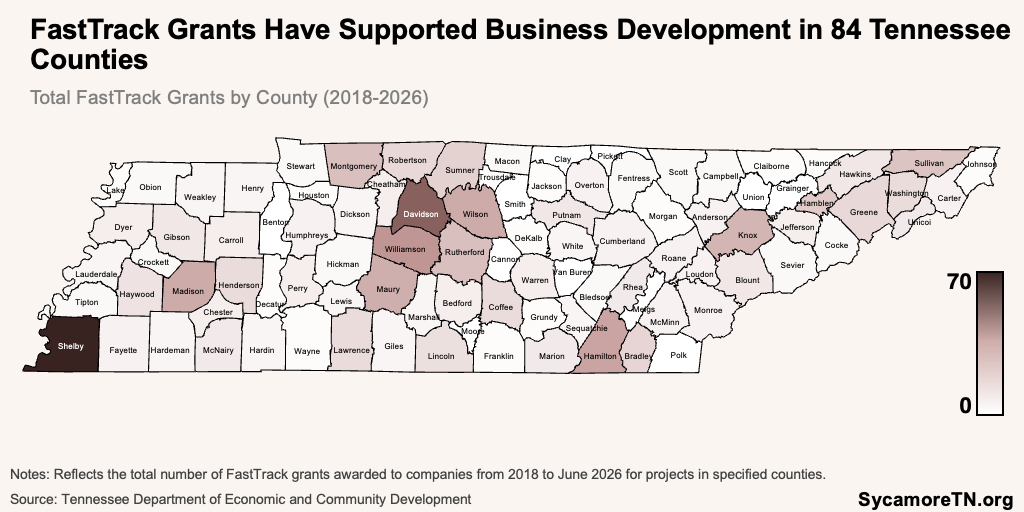
- FastTrack Grants from the TNECD provide financial incentives to new and expanding companies that commit to creating and retaining jobs. One of these investments is the Job Training Assistance Program which supports the training of new employees. FastTrack funding can also support site development (known as the Economic Development Fund) and public infrastructure improvements tied to business expansion (known as the Infrastructure Program). (48) Additional incentives target projects in economically distressed or at-risk counties to encourage job creation in areas with greater need. In 2025, TNECD awarded about $45 million in FastTrack grants to 45 projects across 30 counties—$12 million of which supported Job Training Assistance Program grants. (49) (Figures 6 and 7)
Figure 6
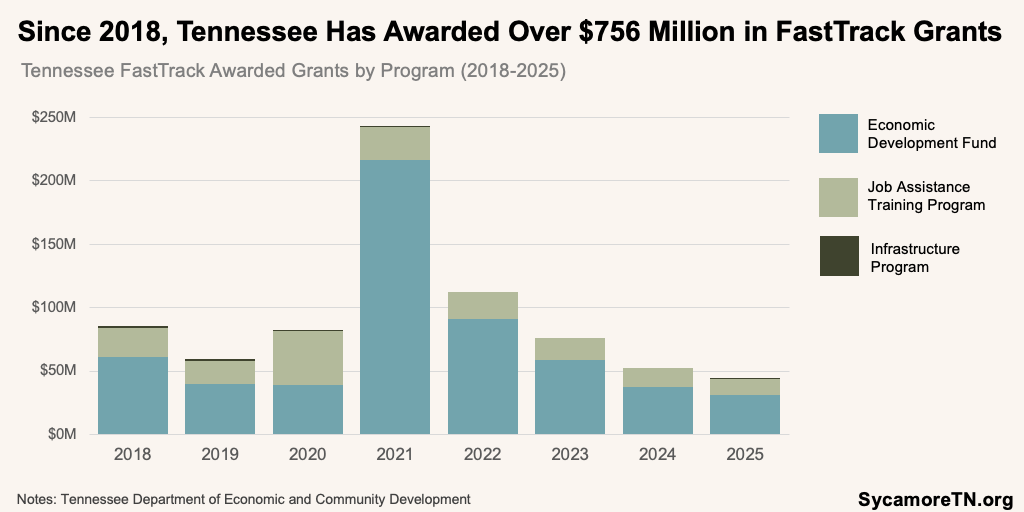
Figure 7
Category 3: Targeted Populations
Tennessee’s workforce system also includes targeted efforts to support individuals who face barriers to employment. These programs include both state and federally-funded initiatives to help individuals enter or re-enter the labor market by providing job search assistance, training, and other services. They frequently prioritize specific populations, like veterans, older adults, and individuals involved in the criminal justice system, to improve labor force participation and access to employment opportunities.
- Tennessee Reconnect is a last-dollar scholarship program funded from lottery proceeds that helps eligible adult learners cover tuition and mandatory fees at community colleges or TCATs. The program is designed to help adults return to school, complete a postsecondary credential, and re-enter the workforce with in-demand skills. In the 2024-25 academic year, about 7,000 adults participated in Tennessee Reconnect. (50) (32)
- The Tennessee Office of Reentry (TOOR) is an initiative within TDLWD to coordinate workforce services for individuals involved in the criminal justice system. The office administers state-funded grants like the Community Reentry Reinvestment Grant (CRRG) and federally-funded initiatives like Partners for Reentry Opportunities in Workforce Development (PROWD). The programs support community-based organizations in providing training, wraparound services, and employment pathways for individuals returning from incarceration. (51)
- Jobs for Veterans State Grant (JVSG) is a federally-funded program for individualized career and training services to help veterans transition into or re-enter the civilian workforce. In federal FY 2026, Tennessee received $3.9 million for JVSG. (52) (53)
- The Senior Community Service Employment Program (SCSEP) is a federally-funded program that supports unemployed older adults (55+) by offering subsidized, work-based training opportunities that build skills and facilitate re-entry into the labor force. In 2026, Tennessee was allocated about $1.5 million in federal funds for the program. (54) (55)
Programs targeting specific populations often operate alongside other federal safety net programs. For example, programs such as the Supplemental Nutrition Benefit Program (SNAP) and Temporary Assistance for Needy Families (TANF) program leverage existing infrastructure—such as AJCs and other WIOA-funded services—to connect participants to training, job placement, and supportive services.
Category 4: System Coordination and Infrastructure
Tennessee’s workforce system includes efforts to strengthen coordination and improve access across the many entities involved in workforce development. These efforts include governance structures, cross-agency initiatives, and shared infrastructure that connect state agencies, education and training providers, employers, and job seekers.
- TN Works is a statewide initiative established in 2025 and housed within TDLWD that serves as a single point of contact for employers seeking workforce support. It brings together 6 state agencies to help better coordinate workforce programs, reduce duplication, and make it easier for businesses to access the state’s range of workforce development services and partners. (56)
- Executive Order 109 issued by Governor Lee in 2025 sought to reestablish and outline the role of the SWDB in advising the governor on workforce priorities and overseeing coordination across the state’s workforce system. The order directs the board to work with state agencies, education partners, employers, and other stakeholders to identify workforce needs, align programs and investments, and support strategies that connect Tennesseans with employment and training opportunities. (57)
- Jobs4TN is a public database managed by the TDLWD that compiles job postings provided by Tennessee employers and offers access to labor market information, hiring tools, and training resources. (58)
Parting Words
Tennessee’s workforce development system includes a diverse network of programs that support individuals at different stages of the education and employment pipeline. These efforts help students explore career pathways, provide workers with opportunities to gain skills and credentials, assist employers in meeting workforce needs, and improve coordination among workforce partners. As Tennessee’s economy and labor market continue to evolve, coordination among these partners will remain important to ensuring that workforce programs effectively connect individuals with opportunities and meet the needs of employers.
Key Terms
American Job Center: A local workforce service center established under WIOA that connects job seekers and employers with employment services, training opportunities, and career resources.
Apprenticeship: A structured training program that combines paid on-the-job learning with related instruction to prepare individuals for a specific occupation.
Career and Technical Education: Educational programs that provide students with academic and technical skills needed for careers in specific industries or occupations.
Credential: A recognized qualification that verifies an individual has completed education, training, or demonstrated skills needed for employment.
Early Postsecondary Opportunities: Courses or exams that allow high school students to earn college credit or industry credentials (e.g., Advanced Placement, dual enrollment, etc.)
High-skill occupations: Occupations that require education or training beyond a high school diploma—such as postsecondary credentials, industry certifications, apprenticeships, or on-the-job training.
High-wage occupations: Occupations that offer wages above a defined threshold relative to state or regional wages. In Tennessee, this includes occupations with wages at least 20% above the median regional wage. (67)
In-Demand Occupations: Occupations identified using state or regional labor market data as having a need for workers based on number of openings, projected growth, or difficulty filling positions.
Industry-Recognized Credential: A credential valued by employers that demonstrates an individual has the skills and knowledge needed for a specific occupation or industry (e.g., commercial driver’s license, certified nursing assistant, etc.).
Local Workforce Development Board: A local entity responsible for overseeing federal workforce programs, developing local workforce plans, and coordinating services to meet regional workforce needs.
One-Stop Delivery System: The network of workforce programs and partners that provide coordinated employment and training services through American Job Centers.
Registered Apprenticeship: A federally recognized apprenticeship program that combines paid on-the-job training with related instruction and meets established standards for quality and worker protections.
Reskilling: Training that helps workers learn new skills needed to transition into a different occupation or industry.
Upskilling: Training that helps workers develop new or advanced skills related to their current occupation or career path.
Workforce Innovation and Opportunity Act: A federal law that provides funding and guidance for workforce programs designed to connect individuals with employment, training, and career services.
Work-Based Learning: Learning experiences that combine classroom instruction
Acronym Glossary
AJC: American Job Center
AP: Advanced Placement
CIE: Cambridge International Exam
CLEP: College-Level Exam Program
CLNA: Comprehensive Local Needs Assessment
CTE: Career and Technical Education
DE: Dual Enrollment
DC: Dual Credit
EPSO: Early Postsecondary Opportunity
GIVE: Governor’s Investment in Vocational Education
IB: International Baccalaureate
JVSG: Jobs for Veterans State Grant
LWDB: Local Workforce Development Board
OBF: Outcomes-Based Funding
SCSEP: Senior Community Service Employment Program
SPARC: Supporting Postsecondary Access in Rural Communities
STEM: Science, Technology, Engineering, and Mathematics
SWDB: State Workforce Development Board
TCAT: Tennessee College of Applied Technology
TBR: Tennessee Board of Regents
TDHS: Tennessee Department of Human Services
TDLWD: Tennessee Department of Labor and Workforce Development
TDOE: Tennessee Department of Education
THEC: Tennessee Higher Education Commission
TISA: Tennessee Investment in Student Achievement
TNECD: Tennessee Economic and Community Development
WBL: Work-Based Learning
WIOA: Workforce Innovation and Opportunity Act
References
Click to Open/Close
- U.S. Congress. H. R. 803 Workforce Innovation and Opportunity Act . [Online] July 2014. https://www.congress.gov/113/bills/hr803/BILLS-113hr803enr.pdf.
- Tennessee Department of Labor and Workforce Development. Tennessee Workforce Innovation and Opportunity Act (WIOA) State Plan PY 2024-2027. [Online] 2024-2027. https://www.tn.gov/content/dam/tn/workforce/documents/wfs/WIOATennesseePYs2024-2027.pdf.
- State Workforce Development Board. Board Goals and Governance. [Online] [Cited: July 12, 2026.] https://www.tn.gov/workforce-services-tn/swdb/board-goals-and-governance.html.
- Tennessee State Workforce Development Board. Local Workforce Development Areas. [Online] [Cited: 12 July, 2026.] https://www.tn.gov/content/tn/workforce-services-tn/workforce-development-areas.html.
- —. WIOA Regional and Local Plans. [Online] [Cited: July 12, 2026.] https://www.tn.gov/workforce-services-tn/swdb/swdb-strategies/wioa-regional-and-local-plans-.html.
- Collins, Benjamin. The Workforce Innovation and Opportunity Act and the One-Stop Delivery System. [Online] September 26, 2022. [Cited: July 12, 2026.] https://www.congress.gov/crs-product/R44252.
- Tennessee Department of Labor and Workforce Development. Find a Local American Job Center. [Online] [Cited: July 12, 2026.] https://www.tn.gov/workforce/jobs-and-education/job-search1/find-local-american-job-center.html.
- U.S. Department of Labor. State Statutory Formula Funding. [Online] PY 2019- PY 2024. [Cited: July 12, 2026.] https://www.dol.gov/agencies/eta/budget/formula/state.
- U.S. Department of Education Office of Career, Technical, and Adult Education. AEFLA State Grants. [Online] FY 2019-FY 2025. [Cited: July 12, 2026.] https://octae.ed.gov/aefla/grants/state-grants.
- U.S. Department of Education Rehabilitation Services Administration. Formual Grant Award Details. [Online] 2019-2025. [Cited: July 12, 2026.] https://rsa.ed.gov/fiscal/grant-awards.
- Tennessee Department of Labor and Workforce Development. Youth Employment Program. [Online] [Cited: July 12, 2026.] https://www.tn.gov/workforce/jobs-and-education/services-by-group/services-by-group-redirect/youth-services.html.
- Tennessee State Workforce Development Board. Workforce Services Policy – Title I Formula Allocation Methodology . [Online] February 21, 2020. https://www.tn.gov/content/dam/tn/workforce/documents/wfs/TitleIFormulaAllocationMethodology.pdf.
- U.S. Department of Education Office of Career, Technical, and Adult Education. AEFLA Laws and Guidance. [Online] [Cited: July 12, 2026.] https://octae.ed.gov/aefla/laws-guidance.
- Collins, Benjamin. Adult Education and Family Literacy Act: Major Statutory Provisions. Library of Congress. [Online] November 17, 2014. [Cited: July 12, 2026.] https://www.congress.gov/crs-product/R43789.
- U.S. Department of Labor. Wagner-Peyser Program. [Online] [Cited: July 12, 2026.] https://www.dol.gov/agencies/eta/american-job-centers/wagner-peyser-program.
- U.S. Department of Education Rehabilitation Services Administration. State Vocational Rehabilitation Services Program. [Online] [Cited: July 12, 2026.] https://rsa.ed.gov/about/programs/vocational-rehabilitation-state-grants.
- Tennessee Department of Human Services. Vocational Rehabilitation. [Online] [Cited: July 12, 2026.] https://www.tn.gov/humanservices/ds/vocational-rehabilitation.html.
- U.S. Congress. H.R.2353 – Strengthening Career and Technical Education for the 21st Century Act. [Online] July 31, 2018. [Cited: July 12, 2026.] https://www.congress.gov/bill/115th-congress/house-bill/2353.
- Tennessee Department of Education. CTE Career Clusters and Standards. [Online] [Cited: July 12, 2026.] https://futureready.tnedu.gov/pillar-3/career-clusters.
- —. Strengthening Career and Technical Education in Tennessee: State Plan for Strengthening Career and Technical Education for the 21st Century Act. [Online] 2024-2028. [Cited: July 12, 2026.] https://www.tn.gov/content/dam/tn/education/ccte/FY24_Perkins_V_State_Plan_2-2.pdf.
- U.S. Department of Education Office of Career, Technical, and Adult Education. Perkins V Tennessee Fiscal Information. [Online] 2025-2026. [Cited: July 12, 2026.] https://octae.ed.gov/pcrn/profile/fiscal/state/2025/TN.
- Tennessee Department of Education. Comprehensive Local Needs Assessment (CLNA) Guide. [Online] July 2025. [Cited: July 12, 2026.] https://www.tn.gov/content/dam/tn/education/ccte/FY26_Perkins_V_CTE_CLNA_Guide.pdf.
- —. Early Postsecondary Opportunities. [Online] [Cited: July 12, 2026.] https://futureready.tnedu.gov/pillar-2/epso.
- Tennessee Board of Regents. Early Postsecondary Opportunities (EPSO) Data Dashboard. [Online] [Cited: July 12, 2026.] https://app.powerbi.com/view?r=eyJrIjoiMGRhNDA1ZDEtMjI5Yy00NTg5LTljNjAtMThmNDYxYzA5MWMzIiwidCI6Ijc4ZTkwNWIzLTE4ZWEtNGE5MS04YjlmLTMzZTRmZTNjYTQ4YSIsImMiOjN9.
- Tennessee Department of Education. Work-Based Learning. [Online] [Cited: July 12, 2026.] https://futureready.tnedu.gov/pillar-4.
- State of Tennessee. State of Tennessee Fiscal Year 2022-2023 Budget Document. [Online] FY 2022-2023. https://www.tn.gov/content/dam/tn/finance/budget/documents/budget-archive/budget-documents/2023BudgetDocumentVol1.pdf.
- Tennessee Department of Education. Innovative School Models Reimagine Report. [Online] November 2024. https://www.tn.gov/content/dam/tn/education/innovative-school-models/SR_ISM_ReimagineReport.pdf.
- YEP Tennessee. YEP Tennessee. [Online] [Cited: August 5, 2026.] https://yeptn.com/.
- State of Tennessee. State of Tennessee FY 2026-2027 Budget Document – Recommended. [Online] Februrary 2, 2026. [Cited: August 5, 2026.] https://www.tn.gov/content/dam/tn/finance/budget/documents/budget-archive/budget-documents/2027BudgetDocumentVol1.pdf.
- Tennessee Higher Education Commission. Tennessee Education Lottery Scholarship Program Summary. [Online] February 20, 2026. [Cited: August 11, 2026.] https://www.tn.gov/content/dam/tn/thec/bureau/research/other-research/hope/Tennessee%20Education%20Lottery%20Scholarship%20Program%20Summary.pdf.
- College for TN. Tennessee Promise. [Online] [Cited: July 12, 2026.] https://www.collegefortn.org/tnpromise/.
- Tennessee Higher Education Commission. Tennessee Education Lottery Scholarship Program 2025 Annual Report. [Online] 2025. [Cited: July 12, 2026.] https://www.tn.gov/content/dam/tn/thec/bureau/research/other-research/hope/TELS_Report_2025.pdf.
- State of Tennessee. Public Chapter 203 of 2019. [Online] April 10, 2019. https://publications.tnsosfiles.com/acts/111/pub/pc0203.pdf.
- Tennessee Higher Education Commission. Governor’s Investment in Vocational Education (GIVE) and Supporting Access in Rural Counties (SPARC). [Online] January 28, 2022. https://www.tn.gov/content/dam/tn/thec/cm/2022/winter/12%20Regular%20IV_THEC%20Jan%202022_GIVE%20SPARC.pdf.
- —. THEC Announces New Round of GIVE Grants to Assist Rural Workforce Development. [Online] August 28, 2024. https://www.tn.gov/thec/news/2024/8/28/give.html.
- State Workforce Development Board. Workforce Pell. [Online] July 1, 2026. [Cited: August 11, 2026.] https://www.tn.gov/workforce-services-tn/swdb/workforce-pell.html.
- Tennessee Office of the Comptroller of the Treasury. CTE initiatives in Tennessee: Helping students connect to future careers. [Online] August 2023. https://comptroller.tn.gov/content/dam/cot/orea/advanced-search/2023/CTEinitiatives.pdf?utm_source.
- Tennessee Higher Education Commission. Workforce and Economic Development. [Online] [Cited: July 12, 2026.] https://www.tn.gov/thec/for-institutions/workforce-and-economic-development.html.
- —. THEC Announces Award Recipients for Rural Health Care Pathways Expansion Grant. [Online] May 21, 2025. https://www.tn.gov/thec/news/2025/5/21/rural-health-care-grant-recipients.html.
- State Workforce Development Board. Rural Workforce Initatives. [Online] [Cited: August 5, 2026.] https://www.tn.gov/workforce-services-tn/swdb/swdb-strategies/rural-workforce-initiatives.html.
- Tennessee Secretary of State. Tennessee Investment in Student Achievement (TISA) Chapter 0520-12-05. [Online] June 2024. [Cited: July 12, 2026.] https://publications.tnsosfiles.com/rules/0520/0520-12/0520-12-05.20240623.pdf.
- Tennessee Department of Education. TISA Guide 2025-2026. [Online] 2025-2026. [Cited: July 12, 2026.] https://www.tn.gov/content/dam/tn/education/tisa-resources/2025-26_TISA_Guide.pdf.
- Tennessee Comptroller Office of Research and Education Accountability. Outcomes Based Funding Formula. [Online] [Cited: July 12, 2026.] https://comptroller.tn.gov/office-functions/research-and-education-accountability/publications/higher-education/obf.html.
- —. Outcomes-based Funding Formula Update. [Online] September 2023. https://comptroller.tn.gov/content/dam/cot/orea/advanced-search/2023/OBF2023Update.pdf.
- Tennessee Higher Education Commission. 2026-2030 Outcomes-Based Funding Formula Recommendations. [Online] July 23, 2026. [Cited: August 11, 2026.] https://www.tn.gov/content/dam/tn/thec/bureau/fiscal_admin/fiscal_pol/obff/2026-30/RC8%202026-2030%20Outcomes-Based%20Funding%20Formula%20Recommendations.pdf.
- Tennessee Comptroller Office of Research and Education Accountability. An Overview of Registered Apprenticeships in Tennessee. [Online] July 2024. [Cited: July 12, 2026.] https://comptroller.tn.gov/content/dam/cot/orea/advanced-search/2024/ApprenticeshipReport.pdf.
- Apprenticeship TN. Program Data and Reports. [Online] April 23, 2026. [Cited: July 12, 2026.] https://www.tn.gov/apprenticeshiptn/about-us/program-data.html.
- Tennessee Economic and Community Development. Incentives and Grants. [Online] [Cited: July 12, 2026.] https://tnecd.com/why-tennessee/incentives-grants/.
- Tennessee Economic and Commmunity Development. FastTrack Project Database. [Online] 2018-2026. [Cited: July 12, 2026.] https://www.tn.gov/ecd/resources/openecd/fasttrack-project-database.html.
- Tennessee Reconnect. Tennessee Reconnect. [Online] [Cited: July 12, 2026.] https://tnreconnect.gov/.
- Tennessee Department of Labor and Workforce Development. About Us – Tennessee Office of Reentry. [Online] [Cited: July 12, 2026.] https://www.tn.gov/workforce/reentrytn/about.html.
- —. Jobs for Veterans State Grant Program. [Online] [Cited: July 12, 2026.] https://www.tn.gov/workforce/jobs-and-education/services-by-group/services-by-group-redirect/job-placement-for-veterans.html.
- U.S. Department of Labor Veterans’ Employment and Training Service . Jobs for Veterans State Grants (JVSG) Application Instructions. [Online] FY 2026. [Cited: July 12, 2026.] https://www.dol.gov/agencies/vets/grants/state/JVSG-Application-Instructions.
- U.S. Department of Labor mployment and Training Administration . Senior Community Service Employment Program. [Online] [Cited: July 12, 2026.] https://www.dol.gov/agencies/eta/seniors.
- U.S. Department of Labor. Training and Employment Guidance Letter No. 13-25. [Online] May 21, 2026. https://www.dol.gov/sites/dolgov/files/ETA/advisories/TEGL/2025/TEGL%2013-25/TEGL%2013-25%20%28Complete%20Document%29.pdf.
- Tennessee Department of Labor and Workforce Development. TNWorks. [Online] November 2025. [Cited: July 12, 2026.] https://www.tn.gov/workforce/newsletter/2025/tnworks.html.
- State of Tennessee. Executive Order No. 109. [Online] June 10, 2025. [Cited: July 12, 2026.] https://publications.tnsosfiles.com/pub/execorders/exec-orders-lee109.pdf.
- Tennessee Department of Labor and Workforce Development. Jobs4TN. [Online] [Cited: July 12, 2026.] https://www.tn.gov/jobs4tn.html.
- —. Community Reentry Reinvestment Grant (CRRG) & Pathway to Employment Funding Opportunity. [Online] June 2026. [Cited: July 12, 2026.] https://www.tn.gov/content/dam/tn/workforce/documents/reentry/CRRG-Grant-Application-Guide-2026-2027.pdf.
- —. PROWD Grant. [Online] [Cited: July 12, 2026.] https://www.tn.gov/content/tn/workforce/reentrytn/prowd-grant.html.
- U.S. Department of Labor Employment and Training Administration Advisory System. [Online] May 2026, 21. [Cited: July 12, 2026.] https://www.dol.gov/sites/dolgov/files/ETA/advisories/TEGL/2025/TEGL%2013-25/TEGL%2013-25%20%28Complete%20Document%29.pdf.
- U.S. Department of Treasury. SSBCI Capital Program Summaries. [Online] April 2024. [Cited: July 12, 2026.] https://home.treasury.gov/policy-issues/small-business-programs/state-small-business-credit-initiative-ssbci/capital-program-summaries.
- State of Tennessee. FY 2026-2027 Budget. [Online] February 2, 2026. https://www.tn.gov/content/dam/tn/finance/budget/documents/budget-archive/budget-documents/2027BudgetDocumentVol1.pdf.
- Tennessee Higher Education Commission. 2025-26 THEC Operating Appropriation Recommendation. [Online] 2025-26. [Cited: July 27, 2026.] https://www.tn.gov/thec/data-research-reports/fiscal-policy/appropriations.html.
- Fund Tennessee. About Fund Tennessee. [Online] [Cited: July 12, 2026.] https://fundtennessee.org/.
- Tennessee Comptroller Office of Education Research Accountability. Tennessee Reconnect Grant Evaluation. [Online] May 2026. [Cited: July 12, 2026.] https://comptroller.tn.gov/content/dam/cot/orea/advanced-search/2026/ReconnectUpdateReport.pdf.
- State Workforce Development Board. Workforce Pell Grant Policy. [Online] July 1, 2026. https://www.tn.gov/content/dam/tn/workforce-services-tn/documents/Workforce-Pell-Grant-Framework.pdf.