

Key Takeaways
- K-12 education is the largest expense from state revenues in Tennessee’s budget—making up over a quarter of total state spending.
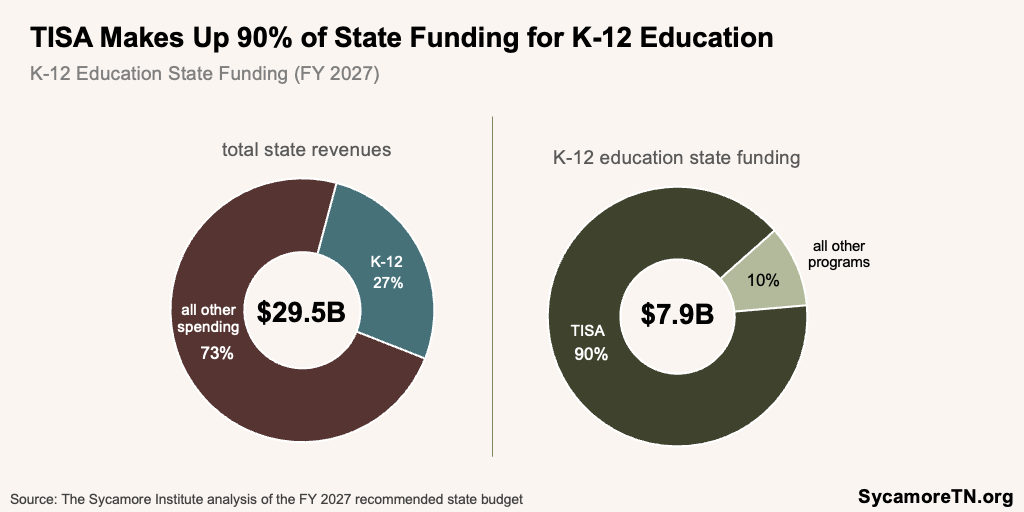
- About 90% of state funding for K-12 education is for the Tennessee Investment in Student Achievement (TISA), the state’s student-based funding formula for K-12 public education.
- Local fiscal capacity is a defining feature of school funding in Tennessee, shaping how much each school district receives and how much a local government must contribute toward K-12 education.
- Federal funding plays a targeted role in K-12 education—supporting specific student populations and programs, such as students with disabilities and child nutrition.
- State policymakers have prioritized investments in teacher pay, but Tennessee still lags behind other states.
- New school choice programs—such as Education Freedom Scholarships (EFS)—aim to expand school options for families, but the system-wide effect on school funding remains uncertain.
The decisions made by Tennessee’s next governor and General Assembly will shape the state’s future for years to come. Throughout the remainder of 2026, the Sycamore Institute will release a series of concise, evidence-based insights drawn from our past research to provide context on the policies, trends, and challenges that could define Tennessee’s next chapter. Each brief offers a quick, accessible overview of an important issue and links to deeper analysis for those who want to explore it further.
This brief highlights 6 insights on how K-12 education is funded in Tennessee—including the roles of state, local, and federal funding, the structure of the state’s public school funding formula, and key policy priorities shaping the system.
1. K-12 education is the largest expense from state revenues in Tennessee’s budget—making up over a quarter of state spending.
Tennessee spends over a quarter of total state revenues on K-12 education. In the FY 2027 recommended budget, total state funding for K–12 education is about $7.9 billion—90% of which supports the state’s public school funding formula, the Tennessee Investment in Student Achievement (TISA) (Figures 1 and 2). (1) (2)
Figure 1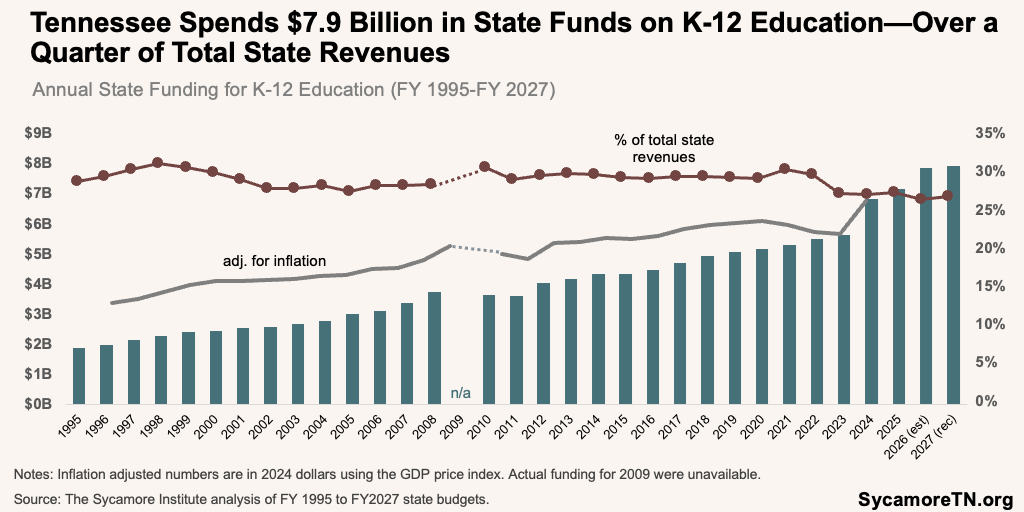
Figure 2
See complete analyses in recent annual budget summaries.
2. Tennessee uses a student-based funding formula for public K-12 education.
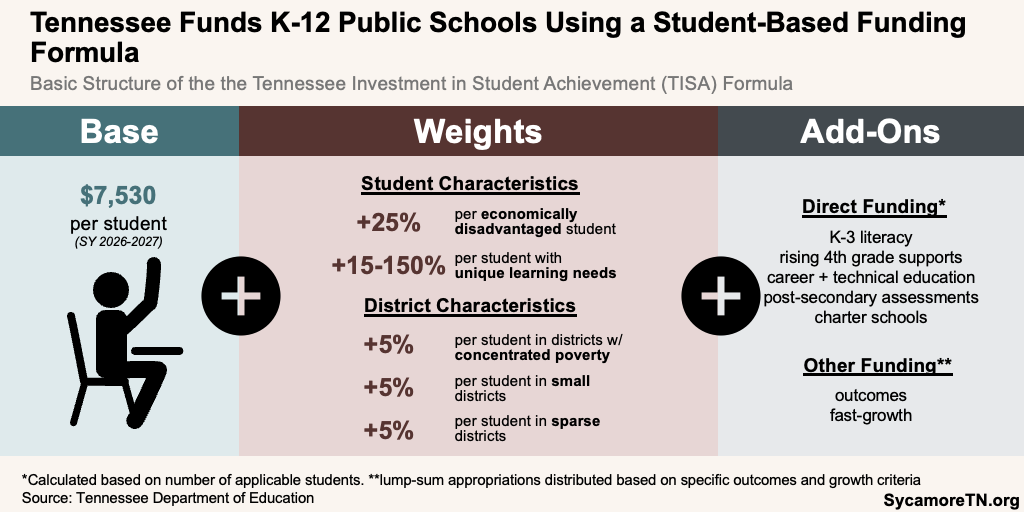
In 2023, Tennessee implemented TISA—the state’s public K-12 funding formula—which replaced the Basic Education Program (BEP). Under TISA, funding for each school district is determined by a base amount per student with additional weights for certain student and district characteristics (Figure 3). As such, changes in student enrollment and characteristics play a significant role in a school district’s TISA allocation. (3)
TISA is a funding formula, not a spending plan. Although the formula generates funding based on student and district characteristics, school districts have discretion over how they budget and spend those funds based on their local priorities and needs. This distinction means that a district’s TISA allocation does not necessarily indicate how those funds will ultimately be spent.
Figure 3
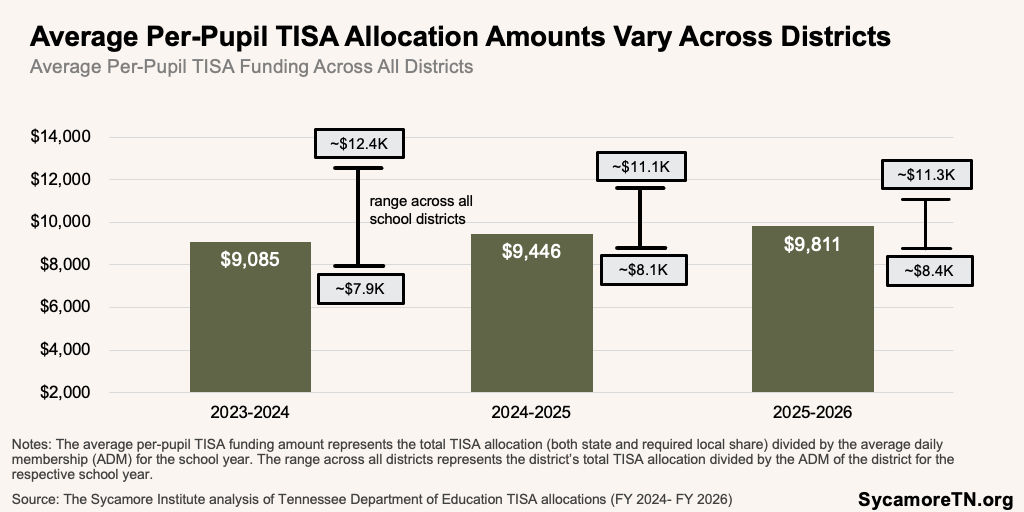
Because TISA funding is tied to student enrollment and characteristics, per-pupil allocation amounts vary across districts. In the 2025-26 school year, the average TISA allocation—including both the state and local share—was just over $9,800 per student. However, TISA generated per-pupil allocations ranging from about $8,400 to $11,300 across the state’s 143 school districts due to differences in student and district characteristics (Figure 4). (4)
Figure 4
See related discussion in TISA 101: Student and School District Characteristics that Boost K-12 Funding.
3. Local fiscal capacity is a defining feature of public school funding in Tennessee.
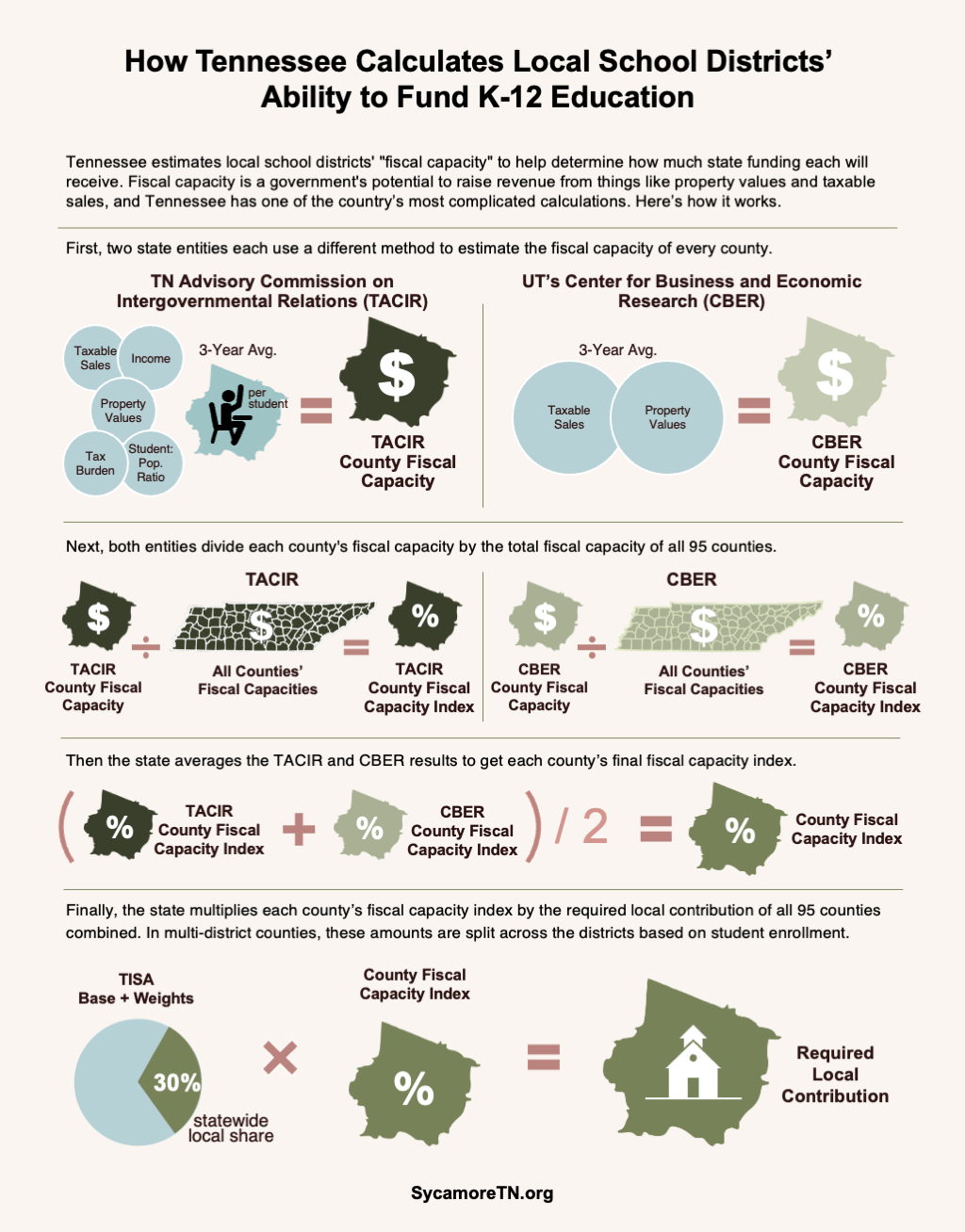
Fiscal capacity—a local government’s ability to raise revenue from sources like property values and taxable sales—plays a central role in Tennessee’s K-12 funding system. The state expects local governments to collectively contribute about 30% of total education funding under TISA, but each county’s required share varies based on its fiscal capacity. Tennessee estimates each county’s fiscal capacity using an average of two models—one developed by the University of Tennessee’s Center for Business and Economic Research (CBER) and another by the Tennessee Advisory Commission on Intergovernmental Relations (TACIR)—which account for differences in property values, income, and local economic activity (Figure 5). (7)
Figure 5
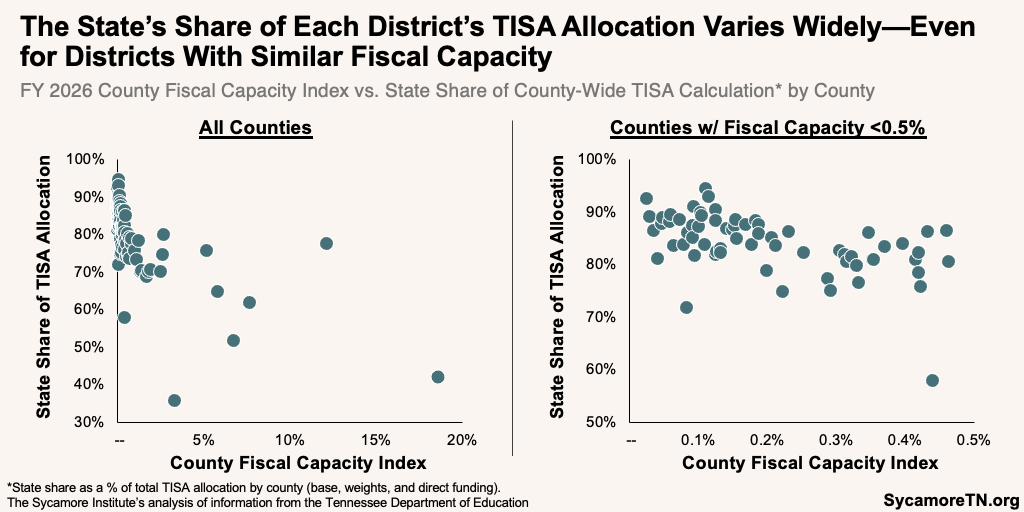
A county’s required local contribution is based on its share of total fiscal capacity across all 95 counties, not its individual funding needs. (8) As a result, the state’s share of TISA funding can vary widely across districts—even among those with similar fiscal capacity (Figure 6). For example, counties with nearly identical fiscal capacity may still receive different levels of state support because their total TISA allocations differ based on student enrollment and characteristics. This means fiscal capacity primarily determines how much a county is expected to contribute toward the statewide total, rather than the share of its own district’s funding covered by the state.
Figure 6
See related discussions in Fiscal Capacity 101: A Key Factor in K-12 Education Funding in Tennessee and How Does TISA Affect School District’s Local Funding Requirements?
4. Federal funding plays a targeted role in K-12 education in Tennessee.
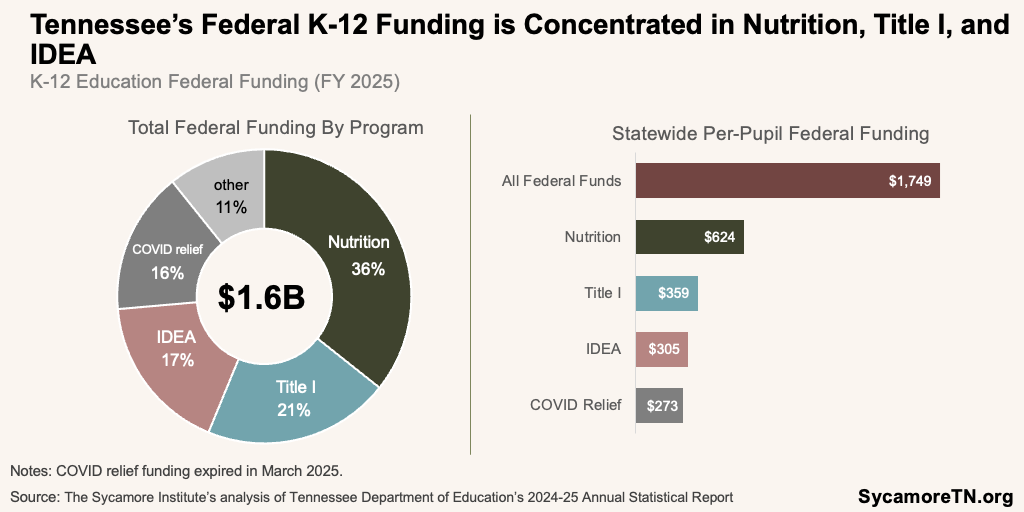
Federal funding for K-12 education is targeted to certain student populations and programs. In FY 2025, Tennessee received about $1.6 billion in federal K-12 funding for several programs with both grant-specific and broader federal requirements. (11) The largest federal education programs in Tennessee are for child nutrition, the Every Student Succeeds Act (ESSA) Title I, and the Individuals with Disabilities Education Act (IDEA) (Figure 7).
Figure 7
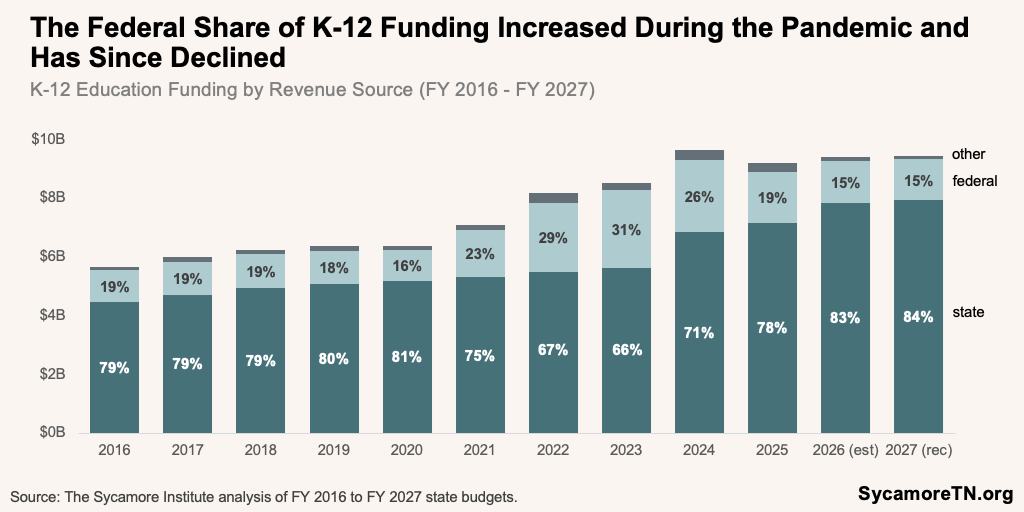
During the pandemic, federal aid provided a large influx of funding for K-12 education—driving temporary increases in the state’s reliance on federal K-12 funds (Figure 8). In Tennessee, school districts used these one-time federal funds for academic recovery programs, staffing, and technology and facility needs related to pandemic response. (12) However, these funds generally expired in March 2025, meaning districts may face budget pressures as they adjust to lower federal funding levels. (13)
Figure 8
See related discussions in Federal Funding for K-12 Education in Tennessee, Federal Funding for Tennessee’s School Districts, and Federal K-12 Funding in Tennessee School District Dashboard.
5. State policymakers have prioritized investments in teacher pay, but Tennessee still lags behind other states.
State policymakers have increased funding for teacher salaries in recent years, often through recurring investments tied to the TISA funding formula. Each year since FY 2024, the state budget has included $125 million in recurring funding for teacher salaries within TISA’s base—including $87.5 million from the state and $37.5 million from local school districts. (1) Under TISA, funds designated for teacher pay increases must be used for that purpose. Separately, state law requires the minimum teacher salary to rise to $50,000 by the 2026-27 school year. (14)
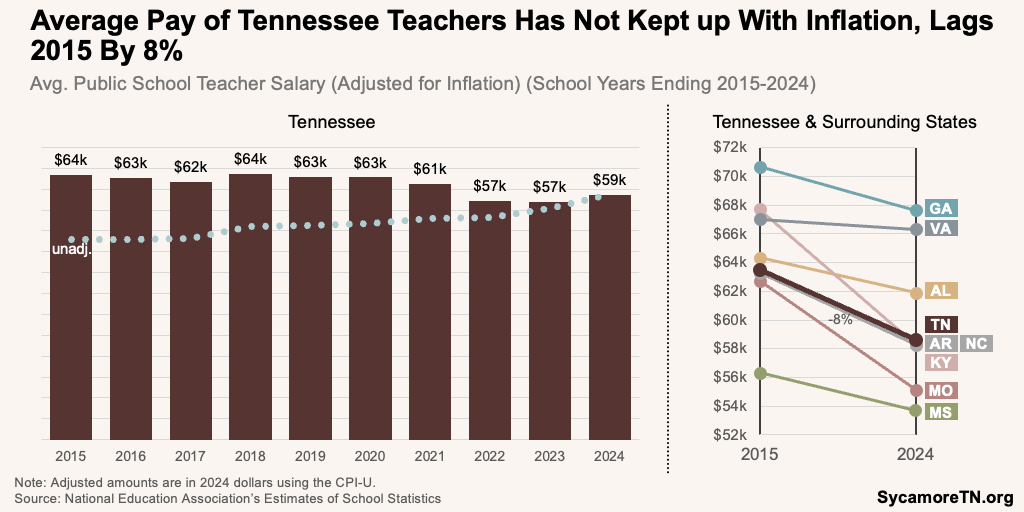
Despite these efforts, Tennessee teachers’ average pay growth has not kept up with inflation. After adjusting for inflation, teachers’ average pay during the 2023-2024 school year was still about 8% lower than in 2014-2015 (Figure 9). For context, teacher pay in Tennessee’s surrounding states also failed to keep up with inflation, while median earnings for Tennessee workers with bachelor’s degrees saw 3% real growth. (15) (16) (17)
Figure 9
See related discussion in The Budget in Brief: Summary of Gov. Lee’s FY 2027 Recommended Budget.
6. School choice is expanding, but its effect on school funding remains uncertain.
New school choice programs—such as Education Freedom Scholarships (EFS)—reflect a growing emphasis on expanding educational options for families. The FY 2027 budget includes $304 million in recurring state funding for 35,000 scholarships. While EFS funding is separate from TISA, award amounts are tied to the formula’s combined state and local base per-pupil amount ($7,530 in FY 2027). (2) State law includes hold harmless provisions for districts experiencing enrollment and funding declines, but the long-term effects on public school systems, government finances, and student outcomes will depend on factors such as participation rates, funding levels, and interactions with existing funding structures. (18)
See related discussion in Education Freedom Scholarship Act and Private Schools in Tennessee and The Budget in Brief: Summary of Gov. Lee’s FY 2027 Recommended Budget.
Additional Sycamore Resources
- TISA 101: Student and School District Characteristics that Boost K-12 Funding
- Fiscal Capacity 101: A Key Factor in K-12 Education Funding in Tennessee
- How Does TISA Affect School District’s Local Funding Requirements?
- 6 Facts about State and Local Education Funding in Tennessee
- Tennessee’s New Education Funding Formula: What’s in Law and What’s Left to Decide?
- Federal Funding for K-12 Education in Tennessee
- Federal Funding for Tennessee’s School Districts
- Federal K-12 Funding in Tennessee School District Dashboard
- The Education Freedom Scholarship Act and Private Schools in Tennessee
- Key Features of Education Freedom Scholarships
Note: This report was updated on August 31, 2026, to update the link to fiscal capacity paper.
References
Click to Open/Close
- State of Tennessee. Budget Archives. [Online] FY 1995-FY2027. [Cited: August 14, 2026.] https://www.tn.gov/finance/fa/fa-budget-information/budget-archive.html.
- —. FY 2026-2027 Recommended Budget. [Online] [Cited: August 14, 2026.] https://www.tn.gov/content/dam/tn/finance/budget/documents/budget-archive/budget-documents/2027BudgetDocumentVol1.pdf.
- Tennessee Department of Education . 2026-27 TISA Guide. [Online] 2026. https://www.tn.gov/content/dam/tn/education/tisa-resources/2026-27_TISA_Guide.pdf.
- Tennessee Department of Education. FY 2025-26 TISA Final Allocations. [Online] August 15, 2025. [Cited: August 14, 2026.] https://www.tn.gov/content/dam/tn/stateboardofeducation/documents/2025-sbe-meetings/august-15%2c-2025-sbe-meeting/8-15-25%20II%20C%20FY%202025-26%20TISA%20Allocations%20Attachment.pdf.
- —. FY 2024 TISA Final Allocations. [Online] August 4, 2023. https://www.tn.gov/content/dam/tn/stateboardofeducation/documents/2023-sbe-meetings/august-4%2c-2023-sbe-meeting/8-4-23%20II%20B%20TISA%20Allocations%20for%20FY%202023-24%20Attachment.pdf.
- —. FY 2025 TISA Final Allocations. [Online] August 16, 2024. https://www.tn.gov/content/dam/tn/stateboardofeducation/documents/2024-sbe-meetings/august-16%2c-2024-sbe-meeting/8-16-24%20II%20B%20TISA%20Allocations%20for%20FY%202024-25%20Attachment.pdf.
- Tennessee Advisory Council on Intergovernmental Relations. Fiscal Capacity for Education. [Online] [Cited: August 14, 2026.] https://www.tn.gov/tacir/fiscal-capacity-for-education.html.
- Tennessee Department of Education. 2026-27 TISA Guide. [Online] July 1, 2026. [Cited: August 14, 2026.] https://www.tn.gov/content/dam/tn/education/tisa-resources/2026-27_TISA_Guide.pdf.
- —. FY 2025-26 TISA Final Allocations. [Online] August 15, 2025. https://www.tn.gov/content/dam/tn/stateboardofeducation/documents/2025-sbe-meetings/august-15%2c-2025-sbe-meeting/8-15-25%20II%20C%20FY%202025-26%20TISA%20Allocations%20Attachment.pdf.
- —. FY 2026 County Fiscal Capacity Calculations. [Online] 2025. [Cited: August 10, 2026.] https://www.tn.gov/content/dam/tn/education/tisa-resources/FY26_County_Fiscal_Capacity_Calculations.pdf.
- —. 2025 Annual Statistical Report. [Online] February 1, 2026. [Cited: August 14, 2026.] https://www.tn.gov/education/districts/federal-programs-and-oversight/data/department-reports/2025-annual-statistical-report.html.
- —. ESSER District Planning Resources. [Online] [Cited: August 14, 2026.] https://www.tn.gov/education/districts/esser.html.
- U.S. Department of Education. Frequently Asked Questions (FAQs) for ARP ESSER, ARP EANS, ARP HCY, and ARP Outlying SEA Liquidation Extension Requests. [Online] September 30, 2025. [Cited: August 14, 2026.] https://www.ed.gov/media/document/esf-liquidation-extension-faqs-updated-september-30-2025-110426.pdf.
- Tennessee Code Annotated. Tenn. Code Ann. § 49-3-306. [Online] [Cited: August 14, 2025.] https://advance.lexis.com/documentpage/?pdmfid=1000516&crid=524a758e-ed1e-450b-bbd9-c529144cc7c3&nodeid=ABXAADAADAAG&nodepath=%2FROOT%2FABX%2FABXAAD%2FABXAADAAD%2FABXAADAADAAG&level=4&haschildren=&populated=false&title=49-3-306.+State+salary+schedule+%E2%.
- U.S. Census Bureau. American Community Survey 1-Year Estimates (Table S2001). [Online] 2011-2024. Available from https://www.data.census.gov.
- U.S. Bureau of Labor Statistics. Consumer Price Index for All Urban Consumers: All Items in U.S. City Average [CPIAUCSL]. Retrieved from FRED, Federal Reserve Bank of St. Louis. [Online] February 2026. https://fred.stlouisfed.org/series/CPIAUCSL.
- National Education Association. Teacher Pay & Per Student Spending Rankings and Estimates. [Online] https://www.nea.org/resource-library/educator-pay-and-student-spending-how-does-your-state-rank/teacher.
- State of Tennessee. Public Chapter 963 of the 114th Tennessee General Assembly. [Online] May 7, 2026. [Cited: August 14, 2026.] https://publications.tnsosfiles.com/acts/114/pub/pc0963.pdf.