

Key Takeaways
- Tennessee’s balanced budget and unique tax structure come with trade-offs.
- Budget flexibility is more limited than it appears.
- In recent years, policymakers have relied on conservative budgeting practices, large year-end surpluses, and temporary federal COVID-era funding to fund priorities.
- Tennessee performs well on many key measures of fiscal health, but changing policies, economic conditions, and structural challenges could create long-term budget pressures. These include:
-
- Some resources that bolstered recent budgets are fading.
- Transportation funding faces a structural deficit.
- Lottery-funded scholarship costs may outpace revenues.
- Inflation could increase the cost of existing commitments.
- Disaster recovery is becoming a larger and more uncertain budget issue.
- Federal funding changes can have significant state budget effects.
- Past policy choices can create future budget obligations.
The decisions made by Tennessee’s next governor and General Assembly will shape the state’s future for years to come. Throughout the remainder of 2026, The Sycamore Institute will release a series of concise, evidence-based insights drawn from our past research to provide context on the policies, trends, and challenges that could define Tennessee’s next chapter. Each brief offers a quick, accessible overview of an important issue and links to deeper analysis for those who want to explore it further.
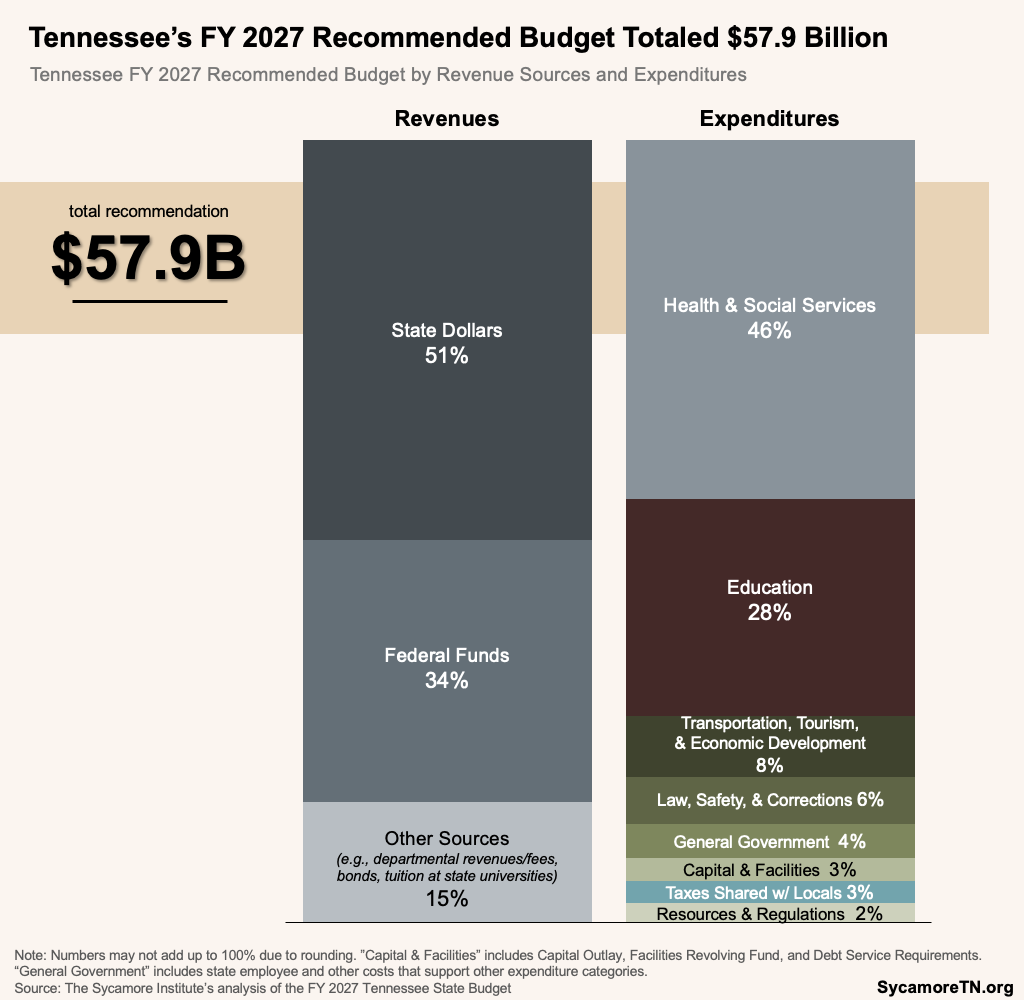
This brief focuses on Tennessee’s $57.9 billion budget (Figure 1)—including important features of Tennessee’s budget, how policymakers funded recent priorities, and 7 challenges to watch going forward.
Figure 1
Key Features of Tennessee’s Budget
Tennessee’s balanced budget requires tough choices. The state’s constitutional balanced budget requirements means the budget is less a static document than an ongoing management process. The state’s constitution requires a balanced budget every year—meaning spending cannot exceed available revenues and reserves. This means policymakers must weigh competing priorities and manage a budget that changes as revenue estimates, federal policy, program costs, and economic conditions evolve.
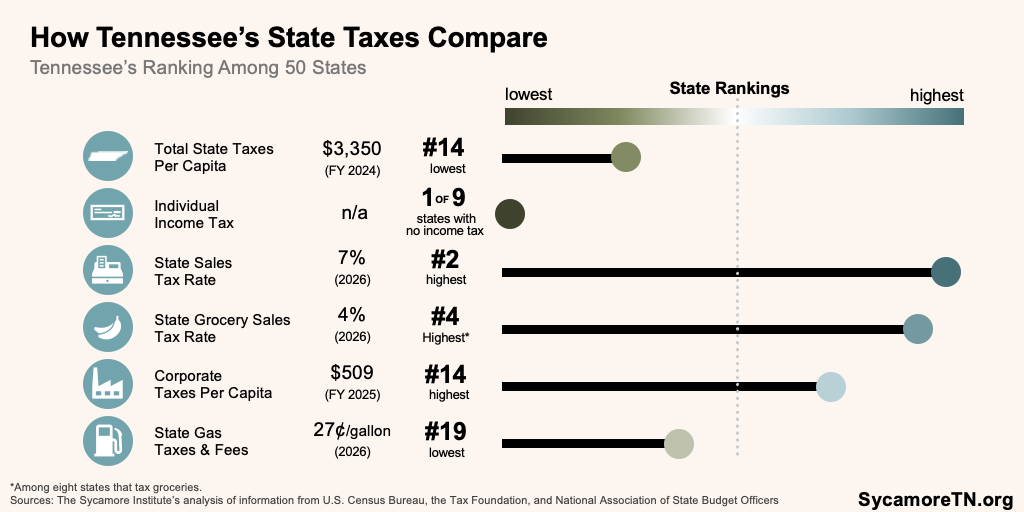
Tennessee’s unique tax structure comes with trade-offs. The state constitution’s income tax ban helps keep overall state taxes relatively low, but it also concentrates state revenues in the sales tax and other relatively high taxes. Because the state has no personal income tax, Tennessee relies more on sales taxes and corporate taxes than other states, on average (Figure 2). It also taxes less overall than most other states. However, many of Tennessee’s individual taxes are relatively high (Figure 3). This uncommon structure potentially limits the range of options available if policymakers want to raise substantial new revenues.
Figure 2
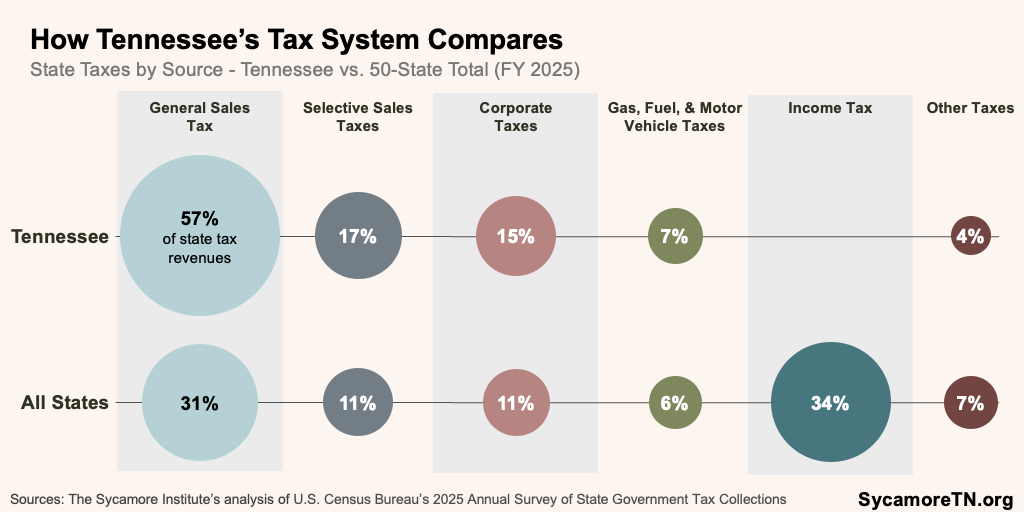
Figure 3
Budget flexibility is more limited than it appears. Most of the money in the state budget has strings attached—including programmatic and/or matching requirements for federal dollars, state revenues earmarked for specific purposes, or funding required by lawsuits against the state. Meanwhile, most “new” dollars from revenue growth each year is needed for routine costs before the budget process even begins. Annual revenue growth helps cover the rising costs of existing commitments—including compensation for state employees, TennCare cost growth, education funding formulas, inflation, and other recurring expenses. As a result, policymakers typically have far less flexibility to fund new priorities than topline numbers might suggest.
Learn more about Tennessee’s budget process and unique features in The Tennessee State Budget Primer.
Tennessee’s Recent Budgets
In recent years, policymakers have relied on conservative budgeting practices, large year-end surpluses, and temporary federal COVID-era aid to fund priorities. These include:
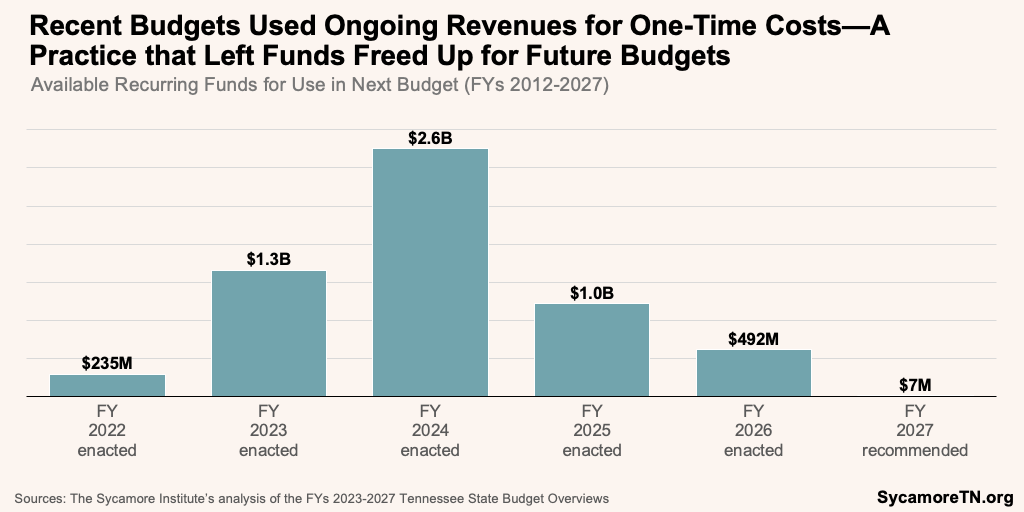
- Reserving Recurring Revenues — In the FYs 2022-2026 budgets, policymakers allocated new recurring revenues to one-time purposes for fear that revenue collections during and after the pandemic could slow or decline. By not tying these dollars up for long-term commitments, they remained available at the fiscal year’s end for recurring uses in the next budget. (Figure 4).
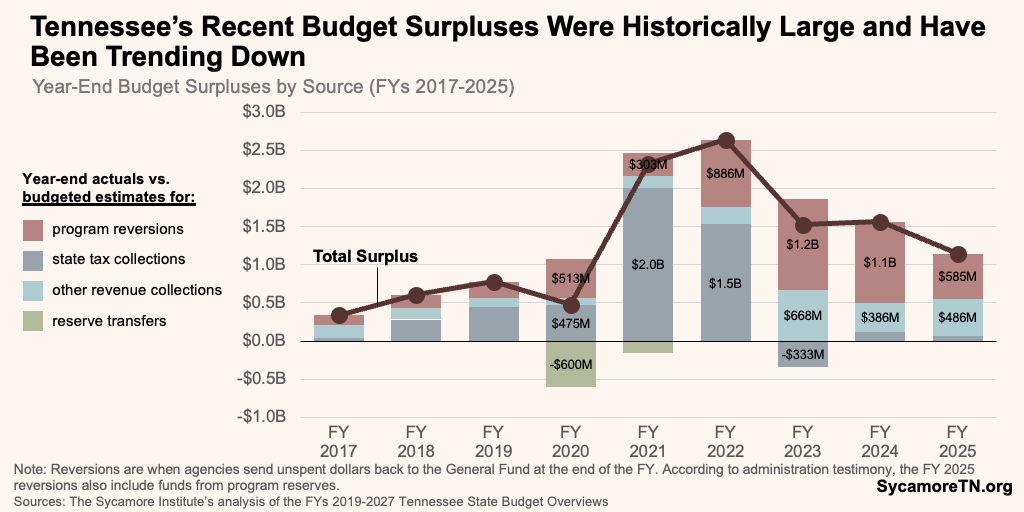
- Budget Surpluses and Program Reversions — Recent budgets also drew on historically large budget surpluses—largely from unspent program “reversions” (Figure 5). Many of those reversions stemmed from temporary fiscal conditions created during and after the pandemic, which included enhanced federal Medicaid funding that reduced the need for state dollars in TennCare.
- Treasury Earnings — Recent surpluses and budgets also benefitted from higher-than-usual state treasury earnings. Some of these additional earnings came from the investment of unspent federal COVID-19 relief funds that Tennessee received in 2020–2021. States were given several years to expend the funds and authorized to invest the balances in the meantime.
These funding sources helped policymakers balance the budget and make major one-time investments. For example, keeping recurring dollars free for future budgets helped lawmakers cover recurring cost increases and new initiatives even when recurring revenue growth was modest. Meanwhile, major one-time investments were directed at capital projects and maintenance, General Fund subsidies for transportation-related activities, and technology and systems-related upgrades throughout state government.
See complete analyses in recent annual budget summaries.
7 Potential Challenges on the Horizon
Tennessee performs well on many key measures of fiscal health, but changing policies, economic conditions, and structural challenges could create long-term budget pressures. The state largely follows recognized budgeting best practices and has one of the nation’s strongest rainy day reserves, relatively low debt, and a triple-A rating from all three credit rating agencies. At the same time, inflation, uncertainty around federal funding and matching requirements, and dedicated revenue sources that aren’t keeping pace with costs could test that position in the years ahead. Seven potential challenges include:
Figure 4
1. Some of the resources that bolstered recent budgets are fading.
Some of the budgeting practices and one-time funding sources that recent budgets benefitted from are winding down. Unlike other recent budgets, the FY 2027 budget did not use a significant portion of new recurring revenue for one-time purposes (Figure 4). Program reversions have gradually declined as enhanced Medicaid funding was fully phased out in the midst of FY 2024 (Figure 5), and the federal funds that generated some of the higher-than-usual treasury earnings must be fully spent by states—and therefore are no longer available for investment—by December 31, 2026. (6) (7)
See related discussions in recent annual budget summaries.
Figure 5
2. Transportation funding faces a structural deficit.
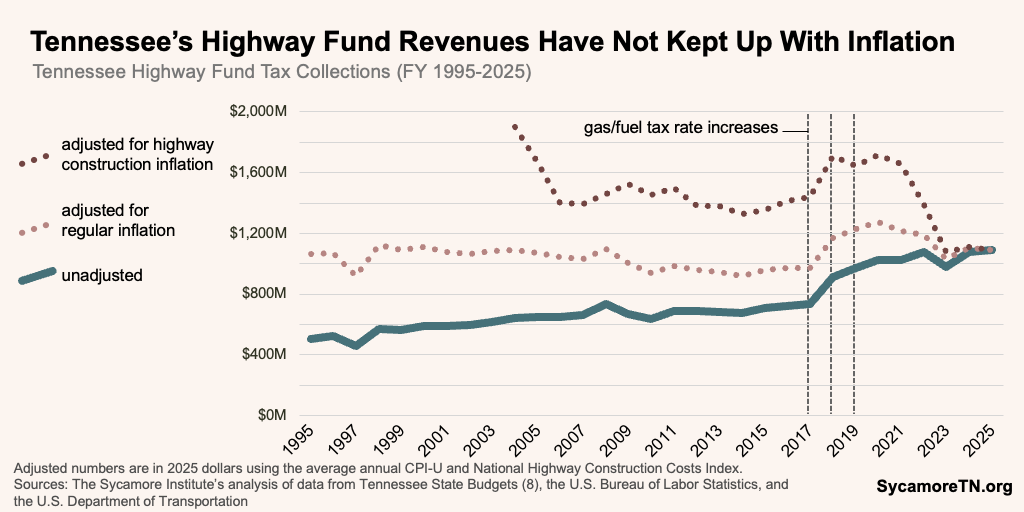
Dedicated taxes and fees that support the Highway Fund have not kept pace with inflation in construction costs and long-term transportation needs (Figure 6). Recent budgets have relied on recurring and one-time General Fund transfers to help address the gap, but policymakers continue to face significant long-term funding needs. (8) (9) (10)
See related discussion in The Budget in Brief: Summary of Gov. Lee’s FY 2027 Recommended Budget and The Tennessee State Budget Primer.
Figure 6
3. Lottery-funded scholarship costs may outpace revenues.
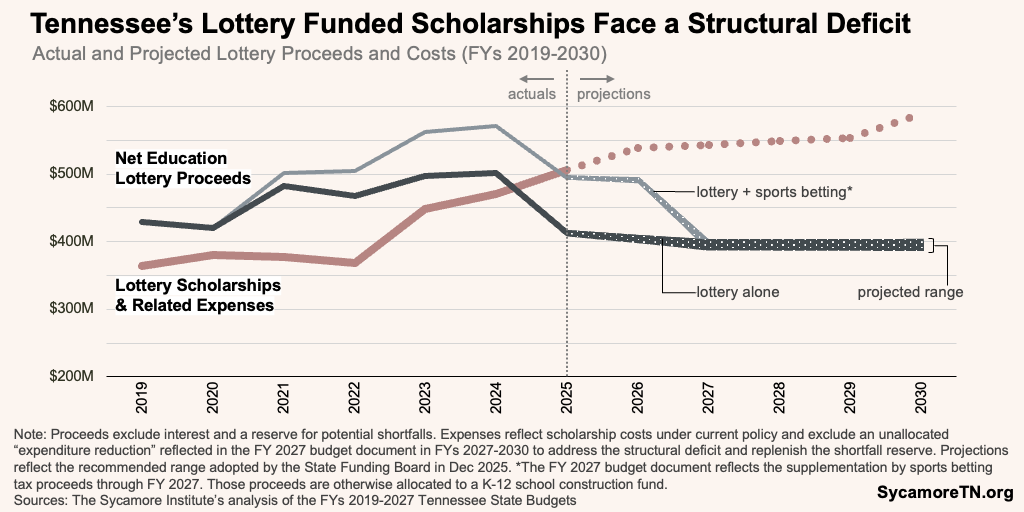
Scholarship costs have grown in recent years while lottery proceeds have declined (Figure 7). (13) A sports betting tax supplemented lottery proceeds since FY 2021, and the FY 2027 budget uses a portion of those collections to close a projected gap in FY 2026. However, recent legislation redirects excess sports betting funds to a K-12 school construction fund. Resulting lottery projections suggest that policymakers will need to address the program’s long-term structural outlook to avoid across-the-board scholarship cuts.
See related discussion in The Budget in Brief: Summary of Gov. Lee’s FY 2027 Recommended Budget and The Tennessee State Budget Primer.
Figure 7
4. Inflation may increase the cost of existing commitments.
The state has made significant investment in capital projects in recent years. Even after these projects are approved and funded, however, inflation can fuel cost overruns—which would require additional appropriations or changes to project scopes. At least one recent budget, for example, included additional dollars to cover higher costs for buildings at Austin Peay and Middle Tennessee State University, and similar cost overruns have been reported for a new building at Vol State Community College. (14)
See related discussion in The Budget in Brief: Summary of Gov. Lee’s FY 2024 Recommended Budget.
5. Disaster recovery is becoming a larger and more uncertain budget issue.
Federally-declared disasters have become more frequent and costlier in recent years—increasing demands on state and local governments. (15) For example:
- In 2024, Gov. Lee made $100 million of state funding available to provide loans to counties affected by Hurricane Helene as they awaited federal dollars. (16)
- Another $472 million was appropriated in 2025 for other Hurricane Helene-related activities—including $100 million for a new Governor’s Response and Recovery Fund specifically for recovery activities not covered by federal programs.(17) (18)
- Another $44 million in non-recurring funding was approved in the FY 2027 budget to replenish the Governor’s Response and Recovery Fund—less than the $100 million originally proposed by the governor in his recommendation.(19) (20)
Meanwhile federal policymakers are considering—and in some cases implementing—changes to disaster assistance that could shift more responsibility to states. (21) Together, these trends create additional uncertainty for future budgets.
6. Federal funding changes can have significant state budget effects.
Changes to federal matching rates, eligibility rules, or grant requirements can substantially affect Tennessee’s budget, even when the underlying services or enrollment remain largely unchanged. Recent trends and changes affecting TennCare and SNAP—the two largest sources of federal funding in the state budget—illustrate how federal policy decisions can quickly alter state costs. Tennessee will need to contribute an additional $77 million for recurring SNAP administrative costs and potentially up to $171 million for benefits in FY 2028. Meanwhile, a 0.82 percentage point decline in Tennessee’s federal Medicaid match rate for FY 2027 required an $86 million state funding increase in the FY 2027 recommendation.
See related discussion in “Hot Topics” in The Tennessee State Budget Primer.
7. Yesterday’s policy choices can create future budget obligations.
Policy decisions made in the past can carry significant and long-lasting fiscal consequences for the state. For example, recent decisions that affect prison populations, sentencing policies, or other long-term commitments will likely increase future operating and capital costs. Tennessee’s fiscal note process is designed to estimate some of these effects, but policymakers must still weigh and ultimately manage the long-term budget implications.
See related discussion in Budgeting for Incarceration in Tennessee.
Additional Sycamore Resources
- Tennessee State Budget Primer
- The Budget in Brief: Summary of Gov. Lee’s FY 2027 Recommended Budget
- Summary of Gov. Lee’s FY 2027 Amended Budget
- 8 Quick Facts About Tennessee’s Budget Process
- How Inflation Affects Tennessee’s State and Local Governments
- Budgeting for Incarceration in Tennessee
- Sycamore’s Complete Budget Analysis Archive
References
Click to Open/Close
References
- State of Tennessee. Information from the FY 2002-FY 2027 State Budgets. [Online] Available via https://www.tn.gov/finance/fa/fa-budget-information/budget-archive.html.
- U.S. Census Bureau. 2025 State Government Tax Tables. Annual Survey of State Government Tax. [Online] April 15, 2026. https://www.census.gov/data/tables/2025/econ/stc/2025-annual.html.
- —. Annual Estimates of the Resident Population for the United States, Regions, States, District of Columbia and Puerto Rico: April 1, 2020 to July 1, 2025 (NST-EST2025-POP). [Online] January 2026. Accessed from https://www.census.gov/data/tables/time-series/demo/popest/2020s-state-total.html.
- Tax Foundation. Facts & Figures 2026: How Does Your State Compare? [Online] April 1, 2026. https://taxfoundation.org/data/all/state/2026-state-tax-data/.
- National Association of State Budget Officers (NASBO). 2025 State Expenditure Report. [Online] 2025. https://www.nasbo.org/reports-data/state-expenditure-report.
- Mitchell, Alison, et al. Consolidated Appropriations Act, 2023 (P.L. 117-328): Medicaid and CHIP Provisions. Congressional Research Service. [Online] October 24, 2023. https://www.congress.gov/crs-product/R47821.
- U.S. Department of the Treasury. State and Local Fiscal Recovery Funds: FAQ. [Online] April 29, 2025. https://home.treasury.gov/system/files/136/SLFRF-Final-Rule-FAQ.pdf.
- State of Tennessee. Public Chapter No. 523 (2025). [Online] May 21, 2025. https://publications.tnsosfiles.com/acts/114/pub/pc0523.pdf.
- Tennessee Department of Finance and Administration. FY 2027 Budget Presentation. [Online] February 2026. https://www.tn.gov/content/dam/tn/finance/budget/documents/budget-archive/overviewspresentations/FY27%20Budget%20Presentation%20-%20FINAL.pdf.
- State of Tennessee. Public Chapter No. 508 (2025). [Online] May 21, 2025. https://publications.tnsosfiles.com/acts/114/pub/pc0508.pdf.
- U.S. Bureau of Labor Statistics (BLS). CPI for All Urban Consumers (CPI-U) – CUSR0000SA0. [Online] Accessed via https://data.bls.gov/PDQWeb/cu.
- U.S. Department of Transportation. The National Highway Construction Cost Index (NHCCI). [Online] March 13, 2026. https://data.transportation.gov/Research-and-Statistics/NHCCI/r94d-n4f9/about_data.
- Tennessee Higher Education Commission. TELS Year-End Reports for 2020-21 through 2024-25. [Online] January 2026. https://www.tn.gov/thec/data-research-reports/reports-studies-pub/financial-aid-reports/tn-hope-scholarship-program.html.
- Baker, Julia. Ballooning Costs for Higher Education Building Raises Concerns on Building Commission. The Tennessee Journal. [Online] July 29, 2026. https://pro.stateaffairs.com/tn/education/volunteers-state-college-budget-hike.
- Government Accountability Office (GAO). High-Risk List: Improving the Delivery of Federal Disaster Assistance . [Online] February 25, 2025. https://files.gao.gov/reports/GAO-25-107743/index.html?_gl=1*rt2u9x*_ga*OTk4MTk5MTU3LjE3ODM2MTg3MzU.*_ga_V393SNS3SR*czE3ODU5NjE2MTkkbzIkZzEkdDE3ODU5NjIyNTAkajYwJGwwJGgw#_Toc190970298.
- Tennessee Office of the Governor. Gov. Lee Announces Helene Emergency Assistance Loans (HEAL) Program . [Online] October 10, 2024. https://www.tn.gov/governor/news/2024/10/10/gov–lee-announces-helene-emergency-assistance-loans–heal–program.html.
- State of Tennessee. Public Chapter No. 4 (2025 Special Session No. 1). [Online] February 12, 2025. https://publications.tnsosfiles.com/acts/114/extra/pc0004EOS.pdf.
- Department of the Tennessee Emergency Management Authority. Hurricane Helene. [Online] https://www.tn.gov/tema/updates/past-disasters/2024-disasters/hurricane-helene.html.
- Stephenson, Cassandra. Tennessee’s Final Budget Shrinks Disaster Response Fund by $55.8M. Tennessee Lookout. [Online] April 2026, 2026. https://tennesseelookout.com/2026/04/30/tennessees-final-2027-budget-shrinks-disaster-response-fund-by-55-8m/.
- House Finance, Ways, and Means Committee. Department of Military Budget Hearing. Tennessee General Assembly. [Online] February 12, 2026. https://tnga.granicus.com/player/clip/32587?view_id=804&redirect=true.
- . Forrest, Page and Maayah, Jad. Uncertainty Surrounding Federal Disaster Funding Looms Over State Budgets. Pew. [Online] January 15, 2026. https://www.pew.org/en/research-and-analysis/articles/2026/01/15/uncertainty-surrounding-federal-disaster-funding-looms-over-state-budgets.