
Key Takeaways
- Criminal justice and public safety in Tennessee involve numerous state and local entities—from lawmakers and law enforcement agencies to county jails and state prisons.
- Tennessee’s crime rates rose during the pandemic but have fallen sharply since 2023.
- Tennessee’s incarcerated population is growing again after a sharp pandemic-era decline.
- Incarceration costs are a significant state and local expense, and the financial impact of policies affecting incarceration can take years to materialize.
- Fees and fines help fund the justice system but can be hard to collect and prolong involvement for people who cannot pay.
The decisions made by Tennessee’s next governor and General Assembly will shape the state’s future for years to come. Throughout the remainder of 2026, the Sycamore Institute will release a series of concise, evidence-based insights drawn from our past research to provide context on the policies, trends, and challenges that could define Tennessee’s next chapter. Each brief offers an accessible overview of an important issue and, in some cases, links to deeper analysis for those who want to explore it further.
This brief focuses on criminal justice and incarceration in Tennessee—providing an overview of Tennessee’s criminal justice system and key trends to watch from recent data and Sycamore’s prior work in this area.
How Tennessee’s Criminal Justice System Works
Criminal justice and public safety in Tennessee involve numerous state and local entities—from lawmakers and law enforcement agencies and to county jails and state prisons (Figure 1). State law generally establishes much of the framework, but numerous state and local actors affect how it operates in practice. These include:
- State and Local Law Enforcement — Municipal police departments and county sheriffs generally investigate crimes, make arrests, and enforce state and local laws. Sheriffs, who are popularly elected at the county level, also typically operate county jails. At the state level, the Tennessee Bureau of Investigation (TBI) investigates certain crimes and provides support to local law enforcement, while the Tennessee Highway Patrol (THP) primarily enforces motor vehicle laws, investigates traffic crashes and other specific criminal activities (e.g., identity theft, insurance fraud), and supports other law enforcement. (1) (2) (3) (4)
- Prosecution — District attorneys general (DAs) and assistant DAs prosecute criminal cases on behalf of the state. Tennesseans elect one DA in each of the state’s 32 judicial districts. (5)
- Defense — Locally-elected public defenders (PDs), assistant PDs, and appointed private counsel provide legal representation to defendants who judges deem cannot afford an attorney.(6) (7)
- Local Courts — Each county has a General Sessions Court that handles most misdemeanor trials and many early-stage matters for felony offenses (e.g., preliminary hearings, bond). General Sessions judges are popularly elected at the county level.( 8) (9)
- State Courts — Each of the state’s 32 judicial districts have Circuit and Criminal Courts. These courts handle criminal trials and misdemeanor appeals. These judges are popularly elected at the judicial district level. (10) The higher-level Court of Criminal Appeals and the State Supreme Court hear appeals. These judges are appointed via a process that involves a Judicial Selection Committee and the governor. Appointed judges are retained or rejected every eight years via a “yes-no” statewide popular vote in a general election. (9)
- State Prisons — The Tennessee Department of Correction (TDOC) operates the state prison system, contracts for some prison operations and services (e.g., privately-run prisons, health care in all prisons), and provides other programming and re-entry services. TDOC has jurisdiction over 14 state prisons—including 10 it operates directly and four operated by private prison operator CoreCivic. TDOC contracts directly with CoreCivic for one of those prisons and with local governments who contract with CoreCivic for the other three. There were about 20,400 individuals convicted of felony offenses who were incarcerated in state prisons monthly in FY 2026. (11) (12)
- County Jails — County jails are operated locally, usually by sheriffs. They house people awaiting trial (i.e., pre-trial detainees) and some people serving sentences after conviction—including many people convicted of felonies who are technically in state custody. (13) There were about 27,400 individuals who were incarcerated in county jails on an average day in FY 2026—including people convicted of felony and misdemeanor offenses and individuals charged with crimes who were awaiting trial. (11)
- Community Supervision — TDOC also provides community supervision of convicted offenders who are on probation or parole. Courts can allow individuals to serve all or part of their sentence in the community as a probationer, and the state Board of Parole can release someone already incarcerated early to complete their sentence in the community as a parolee. Community supervision often comes with specific conditions like frequent check-ins, employment, participation in rehabilitative services, and payment of court fees and fines. There are also other specialized types of community supervision available based on specific circumstances—including Community Corrections and Day Reporting Centers.(14) (15) (16) About 76,200 individuals were under Community Supervision each month in FY 2026. (11)
- Other Public and Private Entities — A range of other organizations help administer, oversee, or provide services within the criminal justice system. Locally elected court clerks, for example, help maintain court records and collect court costs, fines, and other payments. The Tennessee Corrections Institute establishes minimum standards and inspects local jails and detention facilities for compliance, and private and nonprofit contractors may operate correctional facilities or provide services such as medical and behavioral health care, food services, community supervision, employment, and other rehabilitation and reentry programs. (17) (18) (19)
- Local Lawmakers — County commissions and municipal governing bodies make budget and other local policy decisions that affect the criminal justice system. Although their authority is constrained by state law, local governments appropriate available funds for local law enforcement, jails, staffing, contracts, and other locally-administered criminal justice services—some of which may be supported by state or federal grants.(20) (21)
- State Lawmakers — The Tennessee General Assembly defines the policies and funding that define much of the criminal justice system. This includes defining criminal offenses, penalties, and sentencing and release parameters and many of the rules governing courts and corrections. They also appropriate funds for all related state agencies (e.g., TDOC, TBI, THP), DAs, PDs, state courts, and reimbursements to counties for some incarceration costs.
Figure 1
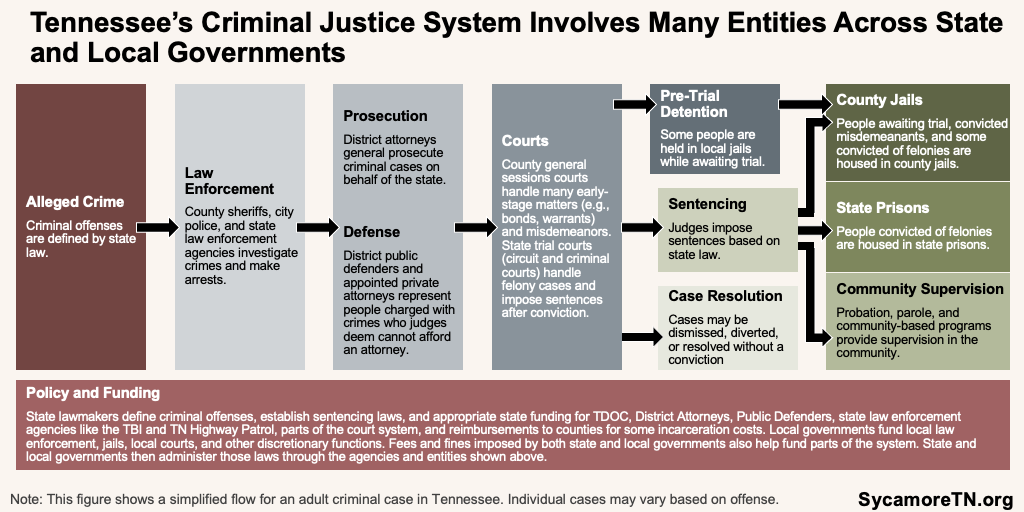
The number of entities involved can make criminal justice outcomes difficult for any single stakeholder to influence. No single entity controls the entire system, and decisions or actions made by one entity can affect the responsibilities, costs, and outcomes of others. For example, state laws influence charging and sentencing, while prosecutors, judges, law enforcement agencies, correctional officials, and others make decisions about individual cases and how policies are implemented. These entities may also have different priorities, resources, incentives, and constituencies. As a result, efforts to change outcomes like incarceration rates, recidivism, and costs may depend on the actions and coordination of numerous state and local stakeholders.
5 Key Criminal Justice Trends to Watch
Figure 2
1. Tennessee’s Crime Rates Rose During the Pandemic but Have Fallen Sharply Since 2023.
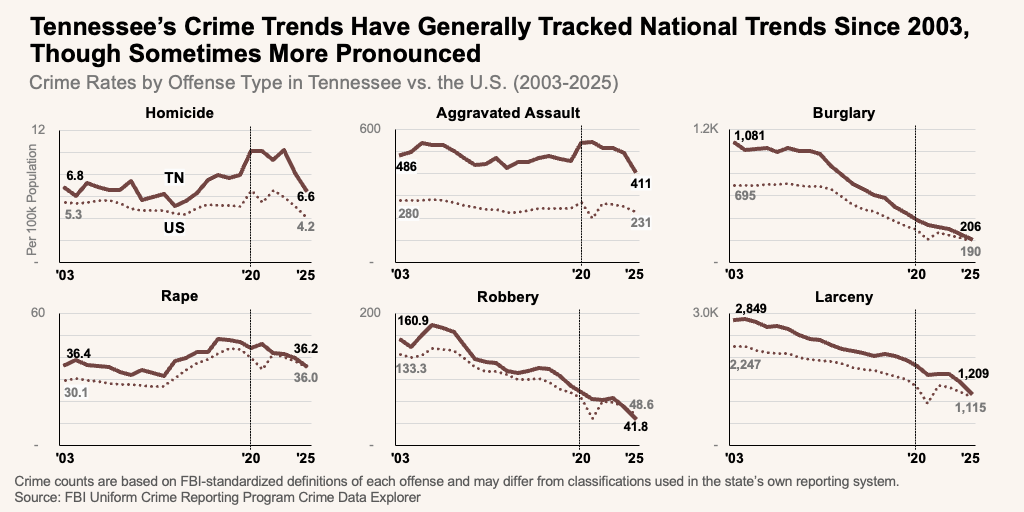
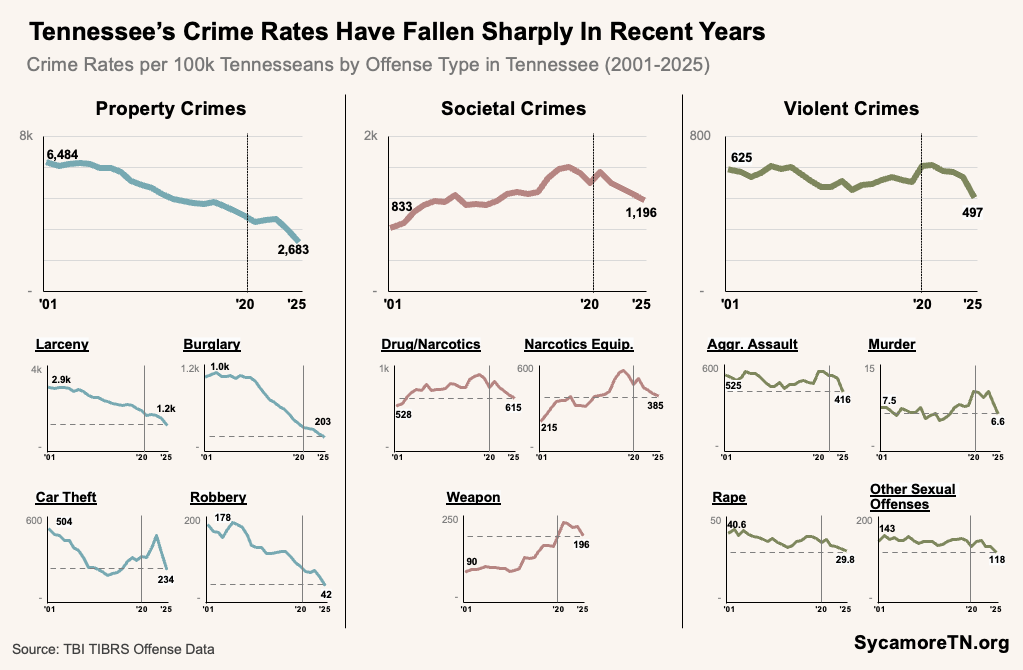
Tennessee’s crime trends before, during, and after the pandemic have largely mirrored national trends. Nationally, rates of many violent and property crimes peaked around the 1980s and early 1990s and generally declined over the decades that followed. Some crimes increased during the pandemic, interrupting those longer-term declines, but most have since started to fall again. (23) (24) (25) (26) (27) Available data since 2003 suggest that Tennessee has generally followed these same broad trends, although changes have sometimes been more pronounced in the state (Figure 2). The timing and magnitude of these trends vary by offense, but by 2025, Tennessee’s overall violent and property crime rates had fallen to 25-year lows, and rates for most individual offenses were below their pre-pandemic levels (Figure 3). (28)
Figure 3
2. Tennessee’s Incarcerated Population Is Growing Again After a Sharp Pandemic-Era Decline.
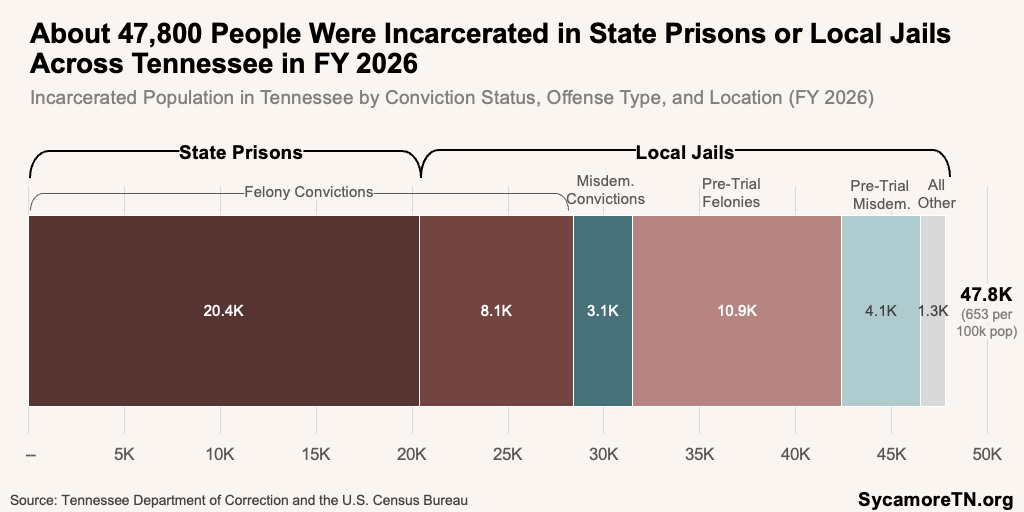
About 47,800 people were incarcerated in state prisons or local jails across Tennessee in FY 2026—or 653 people for every 100,000 Tennesseans (Figure 4). These inmates were primarily convicted of felony or misdemeanor offenses or were awaiting trial for felony or misdemeanor charges, and about 57% of them were housed in local county jails. (12) (29) (30)
Figure 4
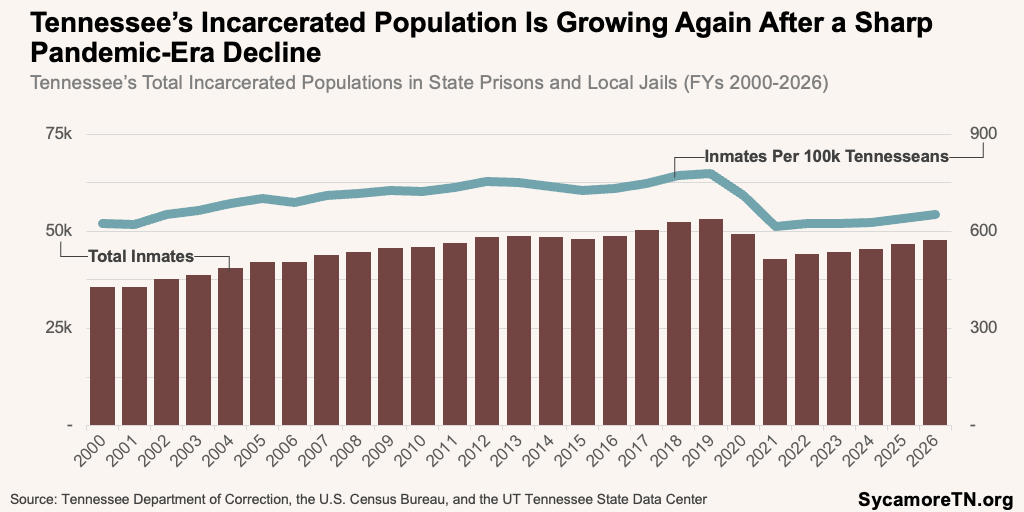
After steady growth through the 2000s and 2010s, Tennessee’s incarcerated population dropped sharply during the COVID-19 pandemic but began to grow again in FY 2022 (Figure 5). Between FYs 2000 and 2019, the number of people incarcerated in state prisons and local jails grew by about 17,500, or 49%. Over the same period, the incarceration rate rose 24%—from 626 to 779 inmates per 100,000 Tennesseans. Incarcerated populations fell during FYs 2020 and 2021 amid efforts to limit the spread of COVID-19 but began increasing again in FY 2022. By FY 2026, Tennessee incarcerated about 12,000 more people than in FY 2000 but about 5,400 fewer than immediately before the pandemic. At 653 inmates per 100,000 Tennesseans, the FY 2026 incarceration rate was about 4% above its FY 2000 level but 16% below its FY 2019 peak. (12) (29) (30)
Figure 5
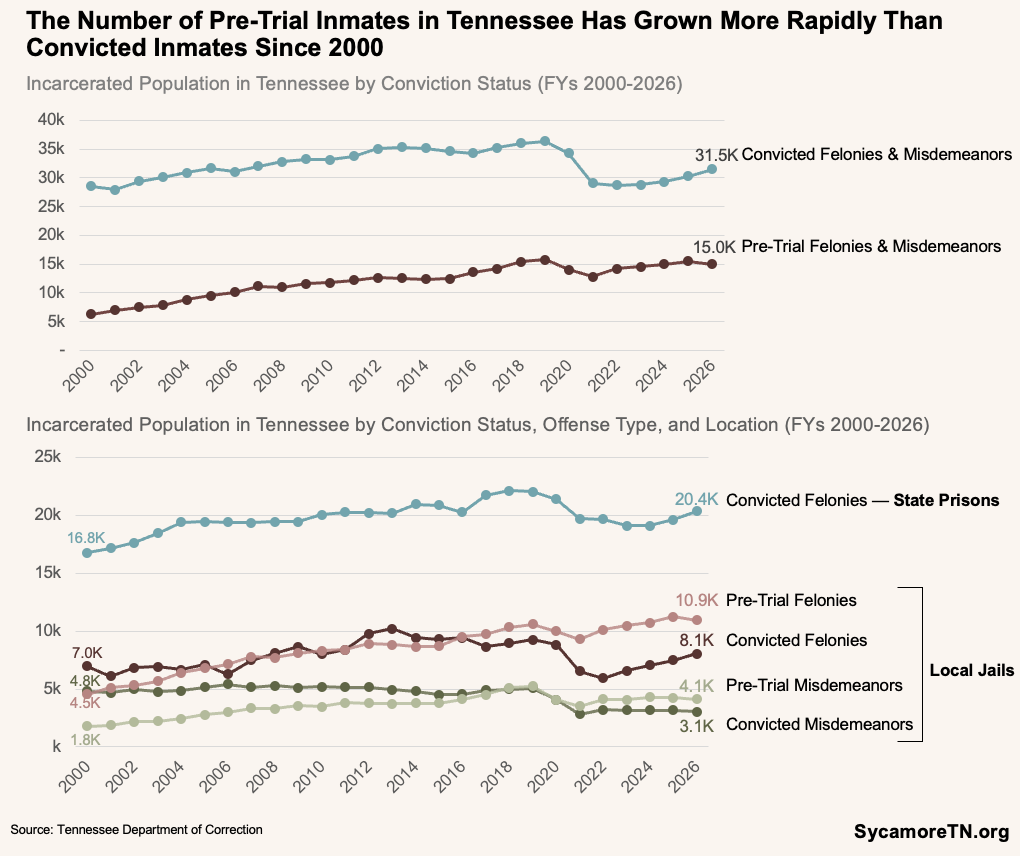
Within that, the number of pre-trial inmates has grown more rapidly than the number of convicted inmates (Figure 6). From FYs 2000 to 2026, the pre-trial inmate population rose by 137%— while the convicted inmate population grew 10%. Before COVID-related declines, the pre-trial population was about 149% larger, while the convicted population was up about 27%. (31) (12) (11)
Figure 6
Incarceration rates reflect both crime and the policies and practices that determine how people move through the criminal justice system. The prevalence and types of crime affect how many people may enter the system, while law enforcement practices, pretrial detention, prosecution, sentencing, time served, and release policies all influence who is incarcerated and for how long. As a result, changes in incarceration rates do not necessarily move in tandem with changes in crime.
4. Incarceration Costs Are a Significant State and Local Expense.
In Tennessee, state and local governments share incarceration costs depending on the stage of the criminal process, offense type, and facility type. In FY 2026, about 43% of the state’s incarcerated population were in state prisons—all of them convicted felons. The remaining 57% were in local jails—including some convicted felons, convicted misdemeanor offenders, and pre-trial detainees (i.e., people awaiting trial, conviction, or acquittal) (Figure 4). (31) (12) (11) The state is responsible for all state prison costs and provides a per diem to local governments to house the 28% of convicted felons housed in local jails. Meanwhile, local governments pick up any remaining local jail costs.
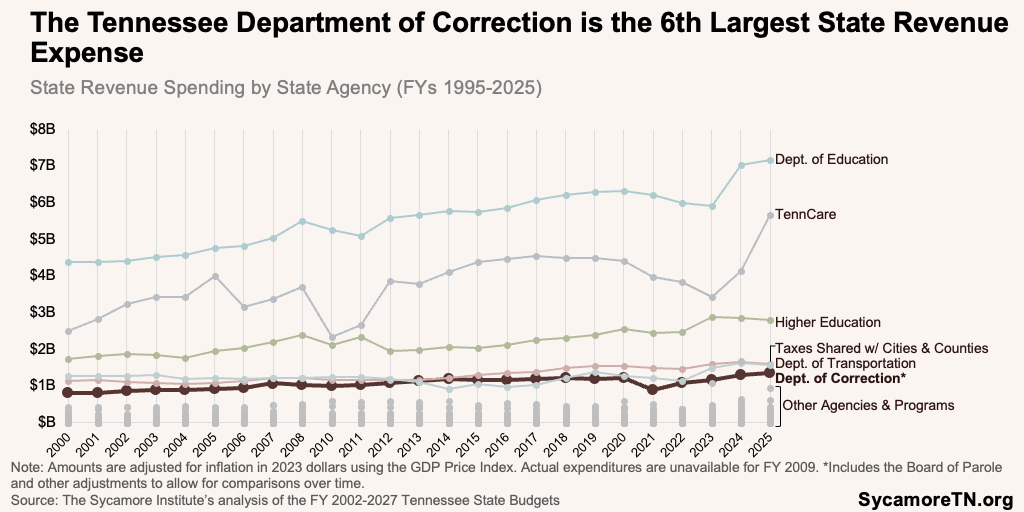
In FY 2025, the Tennessee Department of Correction (TDOC) spent about $1.1 billion on incarceration—excluding capital costs. That’s about 79% of its budget, which is funded mainly by state revenues (Figure 7). (33) The department was the 6th largest state revenue expense that year behind K-12 education, TennCare, higher education, taxes shared with cities and counties, and transportation (Figure 8). The capital costs of maintaining, renovating, and constructing facilities are accounted for separately.
Figure 7
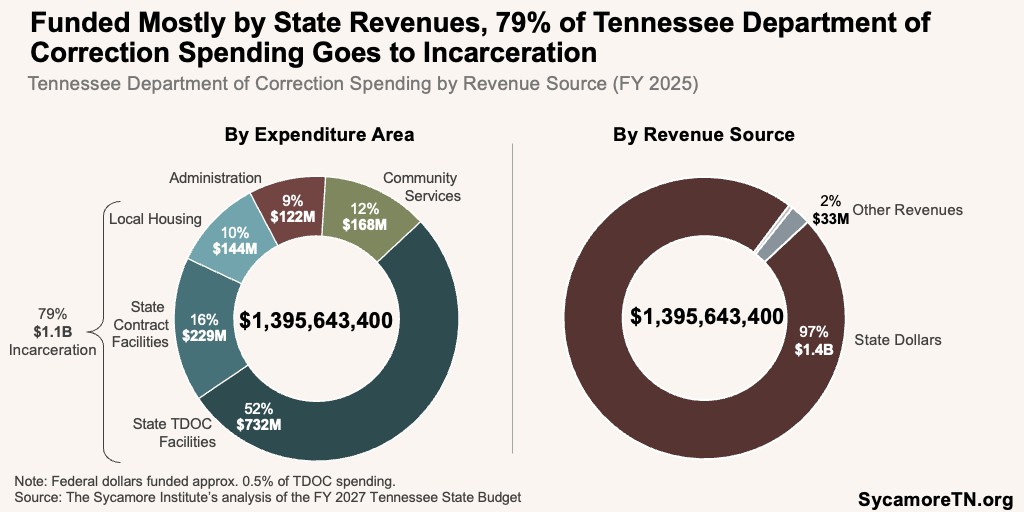
Figure 8
TDOC pays local governments a per diem to house convicted felons, but those reimbursements may not cover local governments’ actual costs. Almost every county gets a max of $41 per prisoner per day in FY 2027. (34) (35) In FY 2027, the estimated average daily cost to house a prisoner in a TDOC facility is $122 (ranging from $76 to $312 per day, depending on the facility)—about three times the standard max per diem to counties of $41. (33) Counties have long said the state’s reimbursements do not cover their total costs. (35) Local governments are also only reimbursed for sentenced felons—not inmates awaiting trial, which are the largest share of the local jail population (Figure 4).
Figure 9
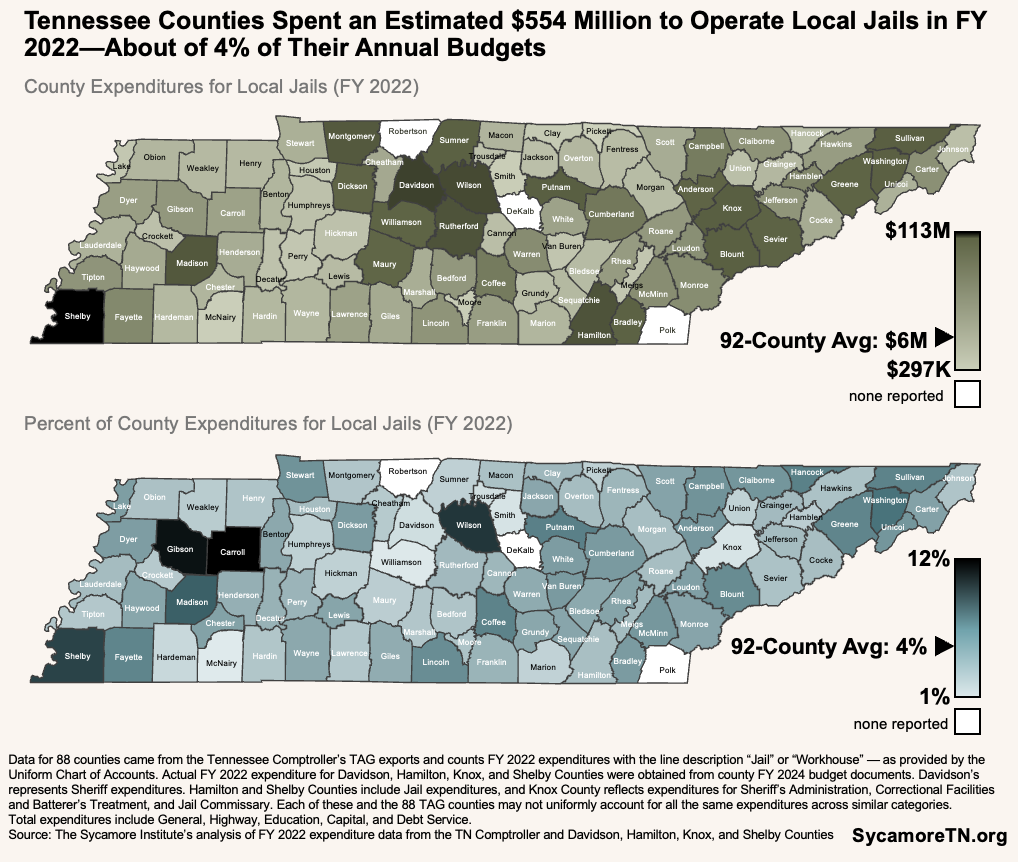
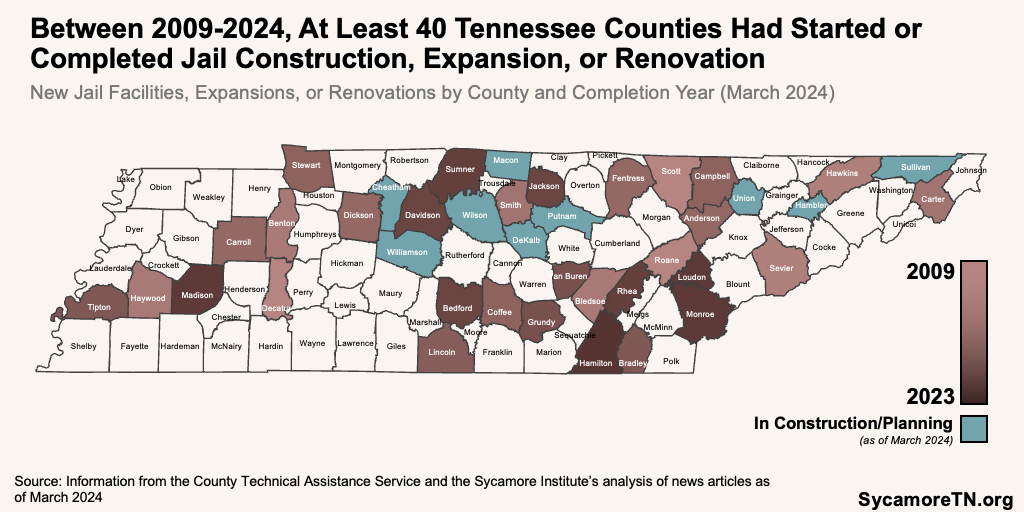
In FY 2022, Tennessee counties spent an estimated $554 million to operate local jails—including reimbursements from the state but excluding capital costs (Figure 9).[1],[2] (36) (37) (38) (39) (40) This amounted to an average of about 4% of each county’s total expenditures. Not included in these costs are capital spending to maintain, expand, and build local jails—which are often accounted for in capital and debt service line items that are not broken down into this level of detail. According to Sycamore’s March 2024 analysis, at least 40 counties had started or completed major jail construction, expansion, or renovation projects since 2009 (Figure 10).[1] (41) (42) (43) (44) (45) (46) (47) (48) (49) (50)
Figure 10
4. The Financial Impact of Policies Affecting Incarceration Can Take Years to Materialize.
Changes to criminal laws and sentencing policies can affect incarceration costs for years or even decades after they are enacted. The number of people incarcerated and how long they remain there are major drivers of correctional costs. As a result, policies that increase sentences, require people to serve larger portions of their sentences, or otherwise increase incarceration can gradually increase prison and jail populations as affected individuals enter the system and remain incarcerated longer. For offenses with lengthy sentences, the full effects may not become apparent for many years.
Tennessee has special budgeting requirements intended to account for some of these future costs. Under current law, the state budget must fund legislation expected to increase incarceration based on the highest operating cost anticipated during the first three years. (51) (52) Before 2022, the state generally used a 10-year window. (53) (54) The shorter time horizon can matter because the costs of some policies continue to grow well beyond the first three years. For example, estimates for the 2022 Truth in Sentencing legislation showed substantially higher costs over a 10-year horizon than were expected within the first three years. (55)
Even these estimates may not capture everything policymakers will ultimately need to fund. Fiscal notes may not quantify effects that occur beyond their projection period, and incarceration-related funding requirements focus on operating expenses rather than potential capital costs. If a growing incarcerated population eventually exceeds available capacity, the state or counties may also face the costs to renovate, expand, or build correctional facilities.
These dynamics mean that the fiscal effects of criminal justice policies enacted during one administration or General Assembly may not be fully apparent until years later. They also make long-term population projections, available bed capacity, and the assumptions underlying fiscal estimates important considerations when evaluating policies that could affect incarceration.
5. Fees and Fines Help Fund the Justice System But Can Be Hard to Collect and Prolong Involvement for People Who Cannot Pay.
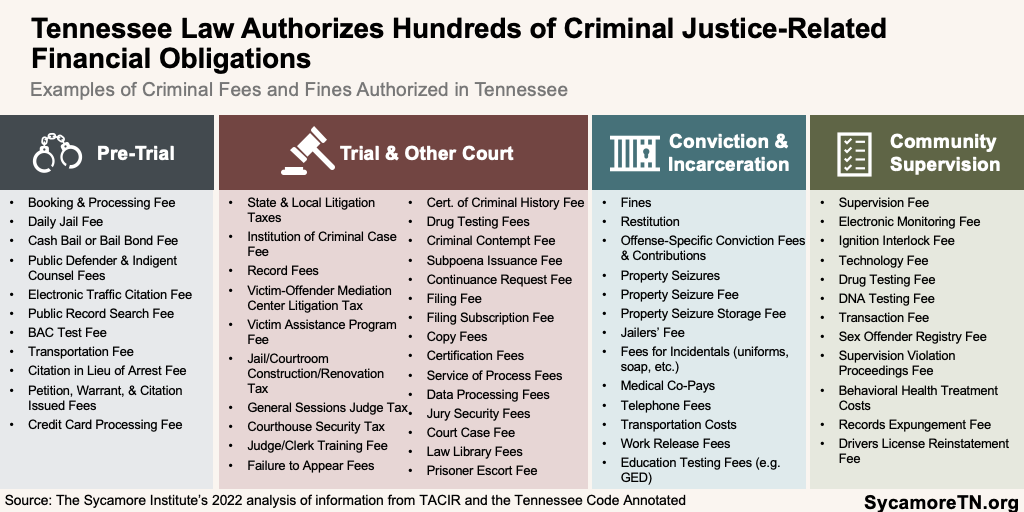
Fees, fines, and other financial obligations serve multiple purposes in Tennessee’s criminal justice system—including punishment, restitution for victims, and funding government services. Tennessee law authorizes hundreds of different financial obligations that can arise from an interaction with the criminal justice system, including court costs, litigation taxes, fines, jail fees, supervision fees, and restitution (Figure 11). Which obligations apply and how much someone ultimately owes depend on the offense, case outcome, and decisions made by numerous state and local actors.
The connection between criminal justice and government funding can create trade-offs. Fee and fine revenues can offset costs that would otherwise be borne by taxpayers, but they are not necessarily a reliable source of revenue. The most recent statewide court data available for Sycamore’s earlier analysis suggested that Tennessee criminal courts collected only about one-quarter of the fees and fines assessed in FY 2012. How much governments collect also varies considerably across counties.
Financial obligations can also affect people’s experiences with the criminal justice system—particularly when they are unable to pay. Unpaid obligations can extend a person’s financial and legal involvement with the system, while associated debt and collection practices can affect employment, housing, transportation, and financial stability. Tennessee also gives courts considerable discretion in considering a person’s ability to pay, contributing to variation in practices and outcomes across jurisdictions.
Figure 11
Additional Sycamore Resources
- Budgeting for Incarceration in Tennessee
- Fees, Fines, and Criminal Justice in Tennessee
- How Criminal Fees and Fines Fund State and County Government in Tennessee
- Criminal Justice Fees & Fines: 11 Options for Tennessee Policymakers
- Four Ways to Improve Tennessee’s Criminal Fee and Fine Data Infrastructure
- How Tennessee Judges Look at Defendants’ Ability to Pay Fees and Fines
References
Click to Open/Close
References
- Municipal Technical Advisory Service (MTAS). Police Operations. UT Institute for Public Service. [Online] https://www.mtas.tennessee.edu/reference/police-operations
- County Technical Assistance Service (CTAS). E-LI: Law Enforcement. UT Institute for Public Service. [Online] https://www.ctas.tennessee.edu/eli/law-enforcement
- Tennessee Bureau of Investigation (TBI). 2025 Annual Report. [Online] https://www.tn.gov/content/dam/tn/tbi/TBI%20Annual%20Report%202025%20FINAL.pdf
- Tennessee Department of Safety & Homeland Security. Annual Report FY 2024-2025. [Online] https://www.tn.gov/content/dam/tn/safety/documents/annual-reports/FY24-25.pdf
- Tennessee District Attorneys General Conference. What Does a District Attorney Do? [Online] https://www.tndagc.org/what-does-a-da-do-tn-district-attorneys-general-conference/
- Tennessee District Public Defenders Conference. About Us. [Online] https://tndpdc.org/about-us/
- Tennessee Appointed Counsel Commission. About Us. [Online] https://tnappointedcounsel.gov/
- Tennessee Administrative Office of the Courts. General Sessions Courts. [Online] https://www.tncourts.gov/courts/general-sessions-courts
- Tennessee Secretary of State. Judicial Branch. Tennessee Blue Book 2025-2026. [Online] https://sos.tn.gov/publications/services/2025-2026-tennessee-blue-book
- Tennessee Administrative Office of the Courts. Circuit, Criminal, Chancery & Business Courts . [Online] https://www.tncourts.gov/courts/circuit-criminal-chancery-courts
- Tennessee Department of Correction (TDOC). Monthly Felon Population Reports. [Online] https://www.tn.gov/correction/statistics/felon-population-reports.html
- —. Annual Reports and Annual Statistical Abstracts. [Online] https://www.tn.gov/correction/statistics/annual-reports.html
- County Technical Assistance Service (CTAS). E-LI: Jail Administration. UT Institute for Public Service. [Online] https://www.ctas.tennessee.edu/eli/jail-administration
- Tennessee Board of Parole. Frequently Asked Questions. [Online] https://www.tn.gov/bop/about-us/information/abtus-info-frequently-asked-questions.html
- Tennessee Department of Correction (TDOC). Types of Release . [Online] https://www.tn.gov/correction/community-supervision/types-of-release.html
- —. Community Supervision: Resources and Information. [Online] https://www.tn.gov/correction/community-supervision/resources-and-information.html
- County Technical Assistance Service (CTAS). E-LI: Clerks of Court. UT Institute for Public Service. [Online] https://www.ctas.tennessee.edu/eli/clerks-court
- Tennessee Corrections Institute. Home Page. [Online] https://www.tn.gov/tci.html
- Tennessee Department of Correction (TDOC). Health Services. [Online] https://www.tn.gov/correction/state-prisons/offender-health-care/health-services.html
- Tennessee Department of Finance & Administration. Office of Criminal Justice Programs – Grants. [Online] https://www.tn.gov/finance/office-of-criminal-justice-programs/ocjp/fa-ocjp-grants.html
- County Technical Assistance Service (CTAS). E-LI: Relationship to County Legislative Body and Other Officials-Sheriff . UT Institute for Public Service. [Online] https://www.ctas.tennessee.edu/eli/relationship-county-legislative-body-and-other-officials-sheriff
- Federal Bureau of Investigation (FBI). Crime Data Explorer. Uniform Crime Reporting Program. [Online] https://cde.ucr.cjis.gov/LATEST/webapp/#/pages/explorer/crime/crime-trend
- Council on Criminal Justice. Trends in Robbery: What You Need to Know. [Online] 2024. https://counciloncj.org/trends-in-robbery-what-you-need-to-know/
- —. Trends in Homicide: What You Need to Know. [Online] December 2023. https://counciloncj.org/homicide-trends-report/
- —. Trends in Motor Vehicle Theft: What You Need to Know. [Online] January 2024. https://counciloncj.org/trends-in-motor-vehicle-theft-what-you-need-to-know/
- —. Trends in Burglary: What You Need to Know. [Online] July 2024. https://counciloncj.org/trends-in-burglary-what-you-need-to-know/
- —. Trends in Assault: What You Need to Know. [Online] July 2024. https://counciloncj.org/trends-in-assault-what-you-need-to-know/
- Tennessee Bureau of Investigation (TBI). Tennessee Incident Based Reporting System. [Online] Accessed from https://crimeinsight.tbi.tn.gov/public.
- U.S. Census Bureau. County Intercensal Tables: 2000-2010. [Online] Downloaded from https://www.census.gov/data/tables/time-series/demo/popest/intercensal-2000-2010-counties.html.
- —. State Population by Characteristics: 2020-2025. [Online] Downloaded from https://www.census.gov/data/tables/time-series/demo/popest/2020s-state-detail.html.
- Tennessee Department of Correction (TDOC). Bed Space & Capacity Reports. [Online] https://www.tn.gov/correction/statistics/bed-space—capacity-reports.html
- UT Tennessee State Data Center. 2026 Certified Population of Tennessee Incorporated Municipalities and Counties. Boyd Center for Business and Economic Research. [Online] July 1, 2026. https://tnsdc.utk.edu/wp-content/uploads/sites/94/2026/07/ECD_Certified_Population_Report_2026.pdf
- State of Tennessee. Tennessee State Budget Archive. [Online] https://www.tn.gov/finance/fa/fa-budget-information/fa-budget-archive/fa-budget-publication-2018-2019.html
- —. Public Chapter No. 1142 (2026) – Section 10, Item 16. [Online] 2026. https://publications.tnsosfiles.com/acts/114/pub/pc1142.pdf
- Tennessee Advisory Commission on Intergovernmental Relations (TACIR). Housing Tennessee’s Convicted Felons: Improving Outcomes while Balancing State and County Needs. [Online] August 2017. https://www.tn.gov/content/dam/tn/tacir/documents/2017HousingTNConvictedFelons.pdf
- Tennessee Comptroller of the Treasury. TAG Exports: FY 2022 Expenditures. [Online] Downloaded from https://comptroller.tn.gov/office-functions/la/e-services/tag-tableau/tag-exports.html on March 8, 2024.
- Metro Nashville-Davidson County. FY 2023-2024 Operating Budget Book – Program Detail for Sheriff. [Online] July 2023. https://www.nashville.gov/sites/default/files/2023-09/FY24_30SheriffPrograms.pdf?ct=1695844975
- Knox County, Tennessee. Adopted FY 2024 Budget. [Online] 2023. https://www.knoxcounty.org/finance/pdfs/2023_2024_budget/FY24_Adopted_Budget.pdf
- Hamilton County, Tennessee. Budget for FY Ending June 30, 2024 . [Online] 2023. https://www.hamiltontn.gov/PDF/FY%202024%20Proposed%20Budget.pdf
- Shelby County, Tennessee. Adopted Budget: FY 2024. [Online] 2023. https://shelbycountytn.gov/ArchiveCenter/ViewFile/Item/13514
- Information provided. Information compiled by County Technical Assistance Services and provided to the Sycamore Institute by the County Services Administration. February 2024.
- Davidson County Sheriff’s Office. Downtown Detention Center (DDC). [Online] https://sheriff.nashville.gov/downtown-detention-center/.
- Justice, Brian. Jail Expansion To Be Done By October. Franklin County Herald Chronicle. [Online] May 30, 2020. https://www.heraldchronicle.com/news/local/jail-expansion-to-be-done-by-october/article_69aaa8cc-9f9f-11ea-bf35-0f60cbb90f59.html
- Lee, Tena. Staffing Shortages Delay Opening of Jail Addition . Hendersonville Standard. [Online] August 14, 2021. https://mainstreetmediatn.com/articles/hendersonvillestandard/staffing-shortages-delay-opening-of-jail-addition/
- Yesterday in Dayton. Rhea County Jail History. [Online] August 6, 2021. https://yesterdayindayton.net/rhea-county-jail-history/
- Floyd, David. Silverdale Jail Construction Project Adds Beds and Offices, Upgrades Security and More. Chattanooga Times Free Press. [Online] February 4, 2023. https://www.timesfreepress.com/news/2023/feb/04/silverdale-jail-construction-tfp/
- Salazar, Deven. Making Progress: Justice Center on Pace for May 2024 Opening. Citizen Tribune. [Online] May 24, 2023. https://www.citizentribune.com/news/local/making-progress-justice-center-on-pace-for-may-2024-opening/article_b9b59852-fa5c-11ed-8f99-bbd36710d68d.html
- Vásquez Russell, Melanie. Union County Jail Overcrowding Contributed to 5 Inmates’ Escape, Officials Say. WATE Channel 6. [Online] September 19, 2023. https://www.wate.com/news/union-county-news/union-county-jail-overcrowding-contributed-to-5-inmates-escape-officials-say/
- Page, Dwayne. Commission Gets Sobering Report from Architect and Contractor on Jail/Judicial Center Construction Costs. WJLE. [Online] February 28, 2024. https://www.wjle.com/news/commission-gets-sobering-report-from-architect-and-contractor-on-jail-judicial-center-construction-costs-view-video-here/
- Keafer, Tori. County Officially Kickstarts $281 Million JJJ Project. Williamson Herald. [Online] September 14, 2021. https://www.williamsonherald.com/news/local_news/county-officially-kickstarts-281-million-jjj-project/article_a9e69dec-150a-11ec-be91-5bcf47ccb6d3.html
- State of Tennessee. Public Chapter No. 412 (2021). [Online] May 12, 2021. https://publications.tnsosfiles.com/acts/112/pub/pc0412.pdf
- —. Public Chapter No. 1007 (2022). [Online] April 21, 2022. https://publications.tnsosfiles.com/acts/112/pub/pc1007.pdf
- —. Tennessee Code Annotated Sec. 9-4-210. 2020.
- —. pB-260 of the FY 2023 Tennessee State Budget Document. [Online] 2022. https://www.tn.gov/content/dam/tn/finance/budget/documents/2023BudgetDocumentVol1.pdf
- Tennessee General Assembly. Testimony and Materials Presented to the House Appropriations Subcommittee. [Online] April 11, 2022. Video available from https://wapp.capitol.tn.gov/apps/videowrapper/default.aspx?CommID=801000.
[1] This analysis was last conducted by The Sycamore Institute in March 2024.
[2] Data for 88 counties came from the Tennessee Comptroller’s TAG exports and counts FY 2022 expenditures with the line description “Jail” or “Workhouse” — as provided by the Uniform Chart of Accounts. Nothing was reported in these categories for DeKalb, Polk, and Robertson Counties. Actual FY 2022 expenditure for Davidson, Hamilton, Knox, and Shelby Counties were obtained from county FY 2024 budget documents. Davidson’s represents relevant program lines from Sheriff expenditures. Hamilton include Jail expenditures, Shelby includes Jail and Corrections expenditures, and Knox County reflects expenditures for Sheriff’s Administration, Correctional Facilities and Batterer’s Treatment, and Jail Commissary. Each of these and the 88 TAG counties may not uniformly account for all the same expenditures across similar categories.